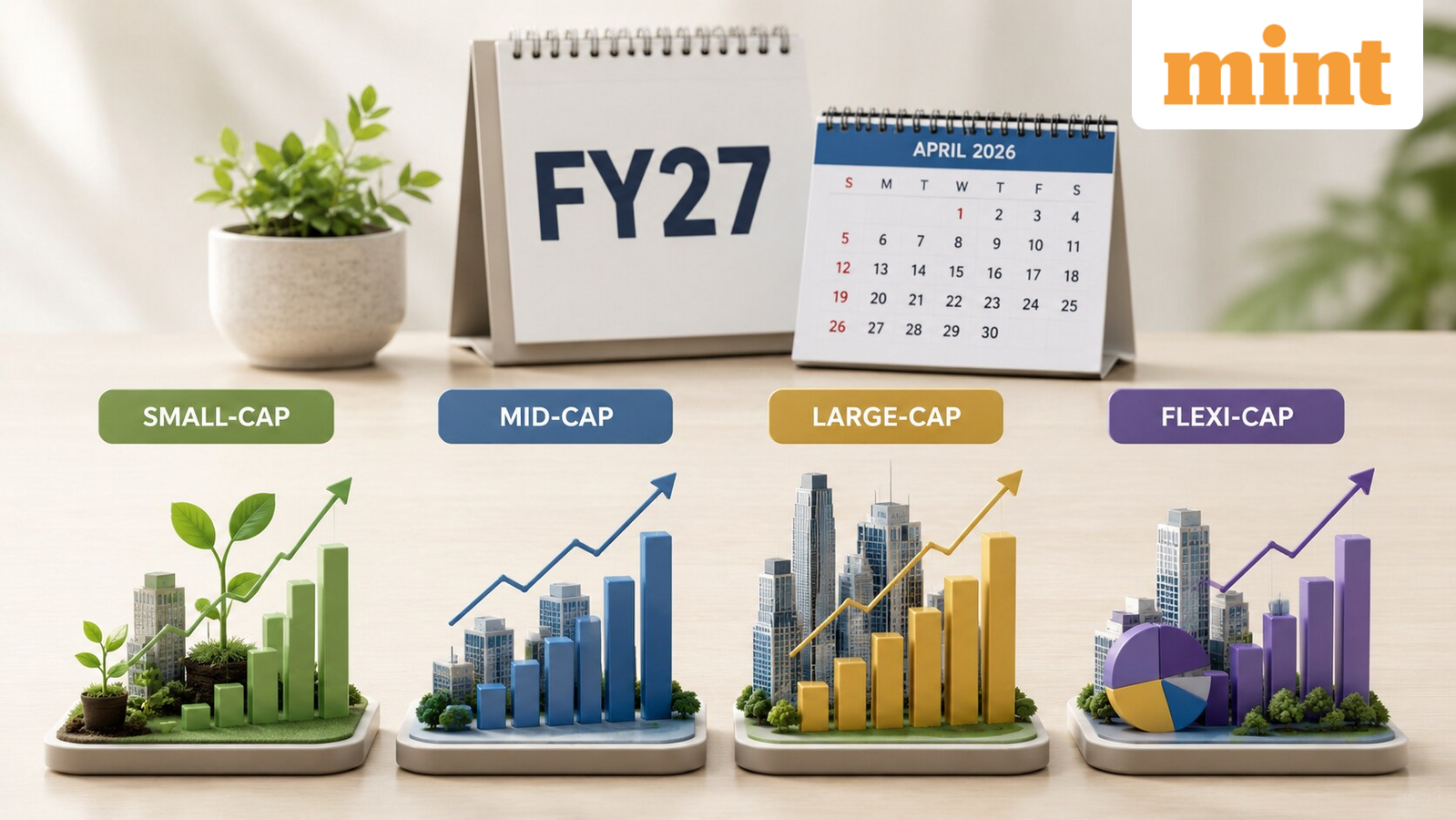
Small-cap funds lead FY27 so far, beating mid, flexi and large-cap funds; JM Small Cap tops chart with over 32% return
The financial year 2026–27 (FY27) began amid uncertainty, with global tariff concerns, geopolitical tensions and volatile crude oil prices putting pressure on Indian equities. However, a comparison of the major categories of equity mutual funds reveals an interesting trend.
A post shared by B. Padmanaban, Founder & Managing Director, Fortune Investment Services on X, shows that small-cap funds delivered the highest category average return of 22.31% between 1 April and 31 July, 2026.
They were followed by mid-cap funds, with an average return of 17.22%, flexi-cap funds at 14.06%, and large-cap funds at 10.52%.
Small-cap funds emerge as the top performers
Among the four equity fund categories, small-cap funds generated the strongest gains during the period, with several schemes delivering returns above 30%.
The top-performing fund was JM Small Cap Fund, which gave 32.41% returns, followed by Bank of India Small Cap Fund and Motilal Oswal Small Cap Fund.
At the other end of the spectrum, The Wealth Company Small Cap Fund delivered the lowest return of 14.57%.
| Small-cap funds – Top 3 performers | Return |
| JM Small Cap | 32.41% |
| Bank of India Small Cap | 32.22% |
| Motilal Oswal Small Cap | 31.49% |
| Bottom 3 performers | |
| The Wealth Company Small Cap | 14.57% |
| HDFC Small Cap | 15.06% |
| ICICI Prudential Small Cap | 16.88% |
*Returns from 1 April to 31 July, 2026
Mid-cap funds also deliver strong gains
Mid-cap funds were the second-best performing category, with an average return of 17.22%.
Invesco India Midcap Fund topped the category with 23.57% returns, followed by JM Midcap Fund and HSBC Midcap Fund. Among mid-cap funds, Samco Mid Cap Fund posted the lowest return at 10.12%.
| Mid-cap funds – Top 3 performers | Return |
| Invesco India Midcap | 23.57% |
| JM Midcap | 22.22% |
| HSBC Midcap | 22.06% |
| Bottom 3 performers | |
| Samco Mid Cap | 10.12% |
| Bank of India Mid Cap | 13.00% |
| Tata Mid Cap | 14.26% |
*Returns from 1 April to 31 July, 2026
Flexi-cap outperforms the large-cap category
Flexi-cap funds, which have the flexibility to invest across market capitalisations, posted an average return of 14.06%.
Invesco India Flexi Cap Fund led the category with 21.10% returns, followed by Quant Flexi Cap Fund at 20.69% and 360 ONE Flexi Cap Fund at 19.70%.
Capitalmind Flexi Cap Fund delivered the lowest return in the category at 5.72%.
| Flexi-cap funds – Top 3 performers | Return |
| Invesco India Flexi Cap | 21.10% |
| Quant Flexi Cap | 20.69% |
| 360 ONE Flexi Cap | 19.70% |
| Bottom 3 performers | |
| Capitalmind Flexi Cap | 5.72% |
| Parag Parikh Flexi Cap | 6.40% |
| Samco Flexi Cap | 8.14% |
*Returns from 1 April to 31 July, 2026
Large-cap funds record relatively modest gains
Large-cap funds delivered the lowest average return among the four categories at 10.52%.
Quant Large Cap Fund topped the category with 19.79% returns, followed by Invesco India Large Cap Fund and Taurus Large Cap Fund.
Samco Large Cap Fund was the poorest performer in the category, delivering a return of just 0.79%.
| Large-cap funds – Top 3 performers | Return |
| Quant Large Cap | 19.79% |
| Invesco India Large Cap | 16.04% |
| Taurus Large Cap | 13.46% |
| Bottom 3 performers | |
| Samco Large Cap | 0.79% |
| Mahindra Manulife Large Cap | 7.71% |
| ICICI Prudential Large Cap | 8.46% |
*Returns from 1 April to 31 July, 2026
Focus on long-term wealth creation, not short-term swings
Sharing the performance data on X, B. Padmanaban wrote that “The beginning of this financial year was filled with uncertainty. Very few people were bullish about the Indian markets. Mr. Trump’s tariff announcements continued to dominate headlines, and concerns over rising geopolitical tensions and oil prices only added to the negative sentiment.”
He added that markets do not move solely based on valuations. “In the short term, prices are driven by a combination of sentiment, liquidity, expectations and unforeseen events.”
Padmanaban clarified that the data is not meant to encourage investors to chase short-term returns.
“The purpose is to help investors understand how markets behave and why it is important to ignore the constant noise around us. If we can appreciate these short-term rallies, we will better understand the much bigger picture of long-term wealth creation through equity mutual funds,” he mentioned.
Disclaimer: This is purely for educational/ informational purposes and should not be taken as any sort of investment advice. Always consult a SEBI-registered advisor before making any investment decisions.