Alphabet Will Spend as Much as $205 Billion This Year. The Depreciation Bill Starts Landing in 2027.
When Alphabet (GOOG +0.95%)(GOOGL +0.90%) reported second-quarter results last week, it raised its 2026 capital expenditure guidance to a range of $195 billion to $205 billion, up from $180 billion to $190 billion. The company spent $44.9 billion on capital expenditures in the second quarter alone, and free cash flow for the period ran negative $5.9 billion.
Most of the debate I’ve seen since the report is about the cash. How long can Alphabet spend at this pace, and what does it do to buybacks and the balance sheet?
But the cash is only half of the accounting. Almost none of this year’s spending has reached the income statement yet, because that’s not how big equipment purchases work. The profit hit arrives later, on a schedule, as depreciation. And the schedule says the heaviest charges start landing in 2027.
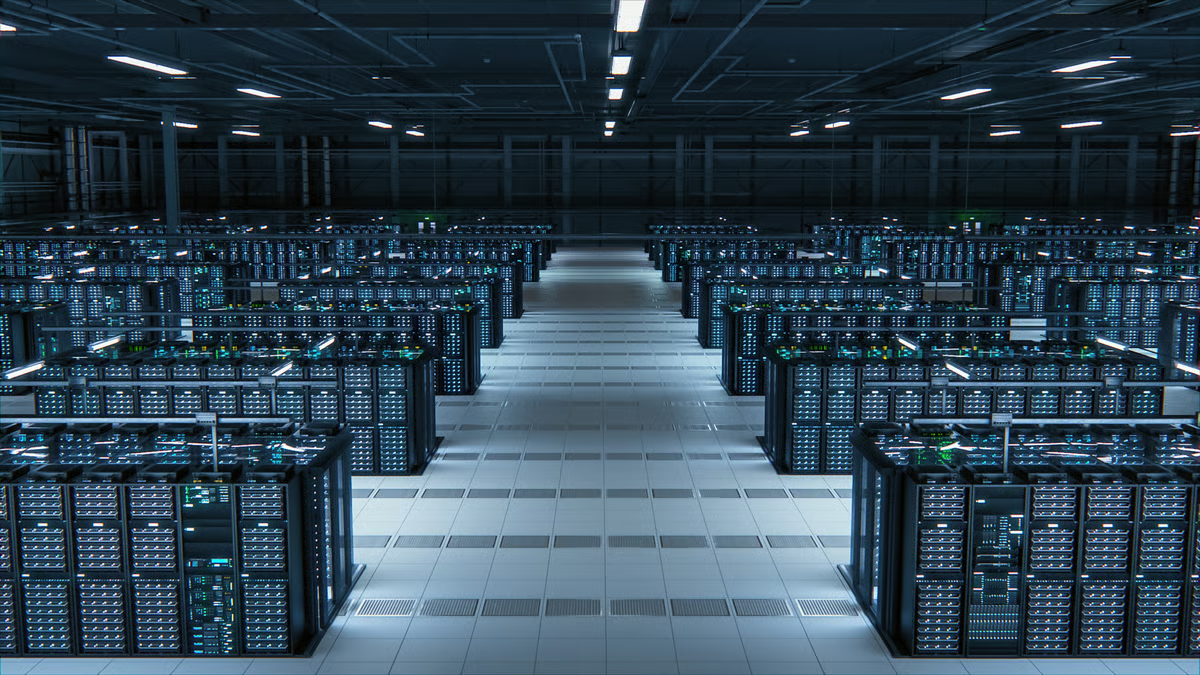
Image source: Getty Images.
The math, in plain terms
When Alphabet buys a server, the cost doesn’t reduce profits up front. Instead, the purchase price is spread across the machine’s useful life, hitting earnings in equal annual slices called depreciation. Alphabet sets that life at six years for servers, a figure it adopted in 2023 after concluding its machines last longer than it previously assumed.
Chief financial officer Anat Ashkenazi gave investors the piece that makes the arithmetic possible. About 60% of last quarter’s infrastructure investment went to servers, she said on the second-quarter earnings call, with the remaining 40% going to data centers and networking equipment.
Now apply that split to the full year. At the midpoint of guidance, Alphabet will spend about $200 billion in 2026. If about 60% of that is servers, the company is buying about $120 billion of equipment that depreciates over six years. That works out to about $20 billion of annual depreciation expense from this year’s purchases alone, recurring every year into the early 2030s. The networking equipment in the other 40% runs on the same six-year schedule, while the data centers themselves spread their cost over as long as 40 years — smaller annual slices that run far longer.
And the layers stack. Assets bought in 2025 are already depreciating. This year’s wave joins them as systems come online. Then comes the next one. Management still expects capital expenditures to increase significantly in 2027, Ashkenazi said on the call.
For scale, Alphabet’s operating income last quarter was $40.8 billion. The servers bought this year will eventually subtract roughly half a quarter’s worth of that from reported profit every year, for six years, before counting 2025’s spending or 2027’s.
The charge is already visible
This isn’t only a forecast. Depreciation is already one of the fastest-rising items in Alphabet’s cost structure. Other cost of revenues rose 22% year over year last quarter to $29.8 billion, and depreciation was among the drivers management named. Research and development expense grew 32%, driven by pay for artificial intelligence (AI) talent and, again, depreciation.
Ashkenazi was direct about where this goes. The surge in infrastructure investment, she said, “will continue to put pressure on the P&L in the form of higher depreciation expense and related data center operations costs such as energy.”

Today’s Change
(0.90%) $3.00
Current Price
$336.71
Key Data Points
Market Cap
Day’s Range
$331.62 – $342.50
52wk Range
$187.82 – $408.61
Volume
91.9K
Avg Vol
33M
Gross Margin
60.94%
Dividend Yield
0.25%
Of course, there is a reason the market has tolerated all this. The spending is buying growth that shows up just as clearly as the charges do. Revenue rose 24% year over year to $119.8 billion, the company’s 12th straight quarter of double-digit growth. Google Cloud revenue grew 82% to $24.8 billion, and the segment’s operating income more than tripled to $8.8 billion. Cloud’s backlog climbed by more than $50 billion sequentially to $514 billion. Operating income for the whole company grew 30%, faster than revenue. So far, the growth is outrunning the bill.
Can that continue once the 2027 layer lands? The two lines behave differently. Depreciation compounds on a fixed schedule. Revenue doesn’t. The charge will arrive whether or not cloud demand cooperates, and management has already told investors that free cash flow will likely stay under pressure as well.
I’d keep owning the stock, and the reason is the operating engine. Growth of 24% at Alphabet’s scale, with the fastest-growing segment tripling its profits, is exactly what the spending is supposed to produce. But with shares near $335 as of this writing, about 18% below their 52-week high, the market hasn’t fully forgiven the spending either — and from 2027 on, earnings growth has to clear a rising fixed charge before it reaches shareholders. The comparison I’ll grade every quarter from here is cloud growth against the depreciation line. If cloud cools while the charge steps up, that’s when I’d change my mind.