Fresh College Grads Face NYC’s Toughest Rental Market Yet as Asking Prices Surge to 7-Year High
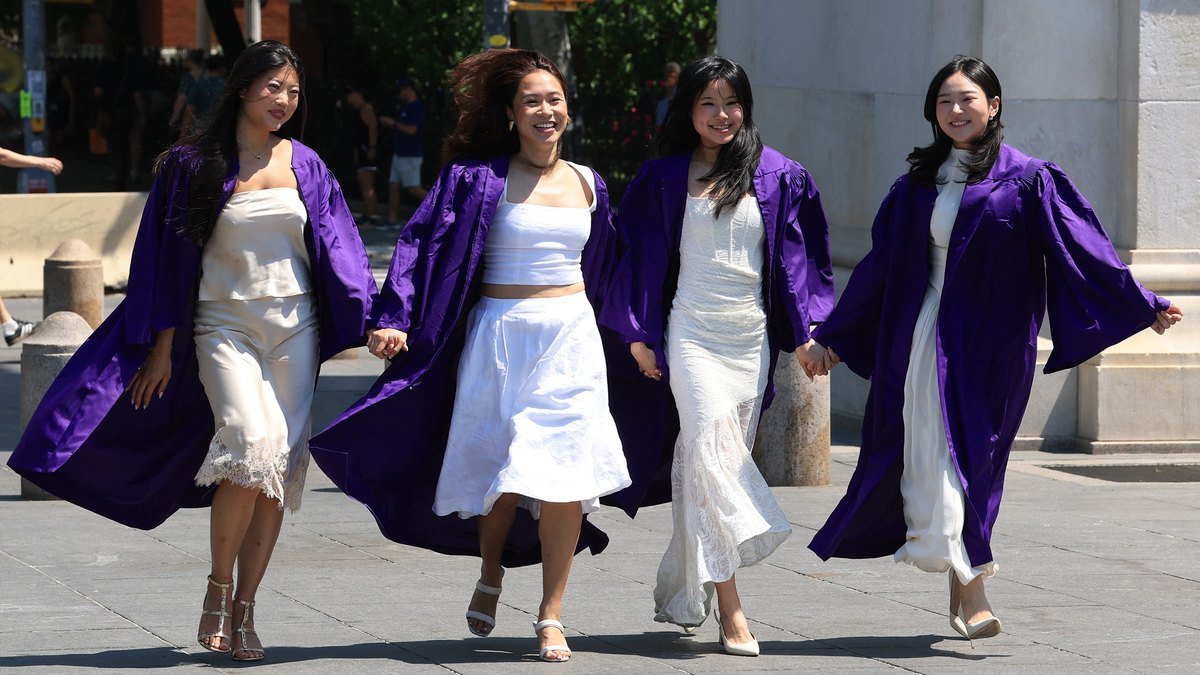
For the Class of 2026, launching a life in New York City comes with serious sticker shock as local rents hit a seven-year high, promising an uphill financial battle even for graduates entering high-paying industries.
This spring, the median asking rent in the Big Apple reached $3,707, up 4.6%, or $164, compared to a year ago, according to the latest Realtor.com® New York City rent report.
That marks the highest rent level recorded since Realtor.com economists began tracking the metro area’s data in the second quarter of 2019.
New college graduates looking to strike out on their own this summer face a massive premium for choosing New York City over other major U.S. metros, while also having to contend with a tight, highly competitive hiring market and rising student debt.
To estimate graduates’ entry-level salaries in New York City and measure how far they stretch, Realtor.com researchers adjusted national Class of 2026 salary projections from the National Association of Colleges and Employers (NACE) upward by 20% to reflect the metro’s higher wage structure.
Grads are feeling the pinch
Under these calculations, recent graduates with a bachelor’s degree in computer science will earn approximately $98,000 annually in New York City, while business majors will average $83,000. These are two of the year’s most in-demand majors, according to the NACE report.
However, finding a place to live independently anywhere in the five boroughs remains a stretch even for these well-paid young professionals.
To quantify what freshly minted white-collar workers are up against when trying to lease an apartment on their own in America’s largest metro, Realtor.com experts used the median asking rent for a studio—the typical housing choice for this cohort—as the affordability benchmark.
At a second-quarter median asking rent of $3,116 per month for a studio, rent would consume over 38% of a computer science graduate’s pre-tax annual income and more than 45% of a business major’s salary.
Notably, financial experts generally advise spending no more than 30% of gross income on housing costs.
By comparison, the median asking rent for a studio across the 50 largest U.S. metros stood at $1,422 in June, requiring computer science and business majors to spend roughly 21% and 25% of their pre-tax pay, respectively.
Making matters worse, the typical U.S. undergraduate leaves a four-year college or university owing around $30,000 in debt, as Forbes recently reported.
Nationally, total student loan debt currently stands at $1.86 trillion, encompassing federal and private loans held by 43 million to 45 million borrowers, further squeezing entry-level workers’ already tight budgets.
The crisis has not gone unnnoticed by local leadership.
Speaking at the Choose NYC Summit in June, Mayor Zohran Mamdani, who has made housing affordability a centerpiece of his administration, highlighted the need for more budget-friendly units to keep graduates and entry-level workforce talent from fleeing the city.
“New York continues to attract talent from around the world—since 2021, more than 500,000 graduates have moved to this city,” the mayor posted on X after the event. “But if workers can’t afford to stay, businesses can’t afford to grow.”
New York City’s skyrocketing rents
Looking at the overall state of the Big Apple’s spring rental market, data reveals that rents increased year over year across all four major boroughs.
Manhattan led the city with the median asking rent jumping 9% ($427) in a single year to reach $5,117. Brooklyn recorded the second-biggest annual spike of 5.9% ($225), as the median rent rose to $4,054. Queens followed closely with rents rising 5.6% to $3,561 from last year.
The Bronx experienced the metro’s most modest uptick of just 0.9% as the median rent climbed to $3,171.
To afford renting a typical unit in these four boroughs while following the 30% rule, a tenant would need to earn a staggering $204,680 per year in Manhattan, $162,160 in Brooklyn, $142,160 in Queens, and $126,840 in the Bronx.
Perhaps unsurprisingly, given these intense income requirements, the second quarter was marked by surging competition for smaller rentals. Asking rent for units with two bedrooms or fewer rose over 7%, to $3,544, while the price of larger units with three or more bedrooms retreated 0.6% year over year to $4,886.
“This divergence suggests that renters are competing hard for compact, more affordable apartments, while fewer renters need—or can afford—larger, pricier units,” says Realtor.com economist Jiayi Xu.
To address the ongoing housing crisis, Mamdani in May unveiled his ambitious $22 billion “Block by Block” plan aimed at building 200,000 new affordable homes and stabilizing another 200,00 existing homes over the next decade.
“This plan meets the housing crisis with the urgency it demands,” said Mamdani in a statement at the time.