Supreme Court rules vehicle’s mere presence is not enough for motor accident compensation
The Supreme Court has ruled that compensation under the Motor Vehicles Act, 1988 cannot be awarded merely because a motor vehicle was connected to the events leading to a person’s death. Setting aside compensation awarded by the Motor Accident Claims Tribunal (MACT) and later enhanced by the Chhattisgarh High Court, the court held that claimants must establish a clear causal connection between the use of the vehicle and the death or injury before liability can arise under the Act.
The judgment came in Dilip Agarwal vs Rajshri Agarwal & Ors., delivered on July 22 by a Bench of Justices Sanjay Karol and Augustine George Masih.
The case stemmed from the death of Anand, who was last seen travelling in a car driven by Dilip Agarwal on November 29, 2009. Three days later, Anand’s body was recovered. His family filed a compensation claim under Section 166 of the Motor Vehicles Act, alleging that he had been murdered inside the vehicle.
While the MACT awarded compensation of ₹5.64 lakh with interest, the Chhattisgarh High Court upheld the finding and enhanced the compensation to about ₹8.61 lakh. The Supreme Court has now overturned those decisions.
Mere involvement of a vehicle is not enough
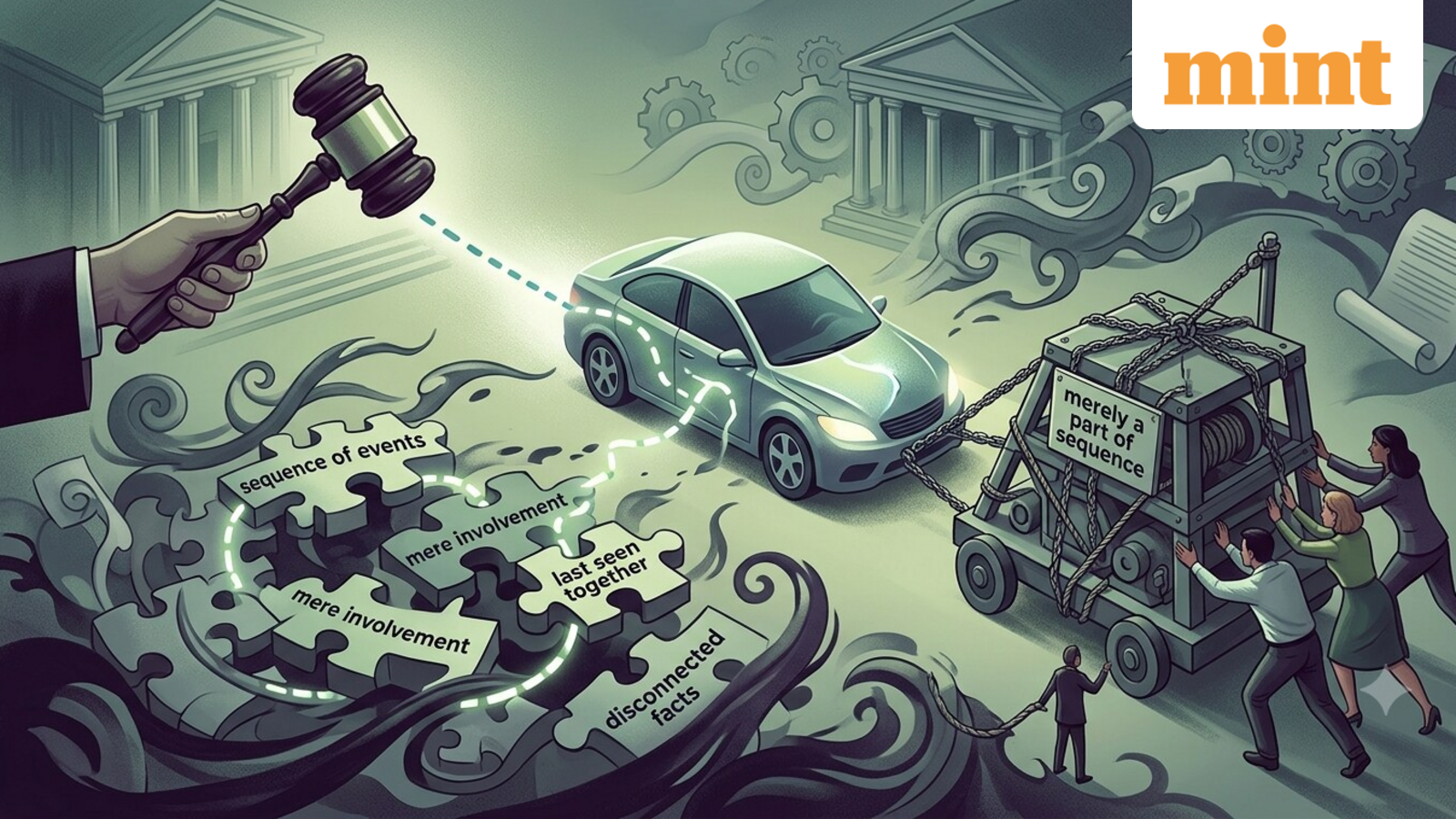
The Supreme Court held that the expression “arising out of the use of a motor vehicle” requires a demonstrable causal nexus between the vehicle and the injury or death. The Bench observed that merely because a vehicle formed part of the chain of events does not automatically make the owner or insurer liable under the Motor Vehicles Act.
The court found that there was no forensic or circumstantial evidence showing that Anand suffered fatal injuries inside the car. There were no bloodstains, hair, skin cells or any other evidence connecting the vehicle to the death, nor was there any allegation that the vehicle had met with an accident or collision.
The Bench noted that the criminal prosecution against the appellant had also failed after the High Court acquitted him, holding that the “last seen” theory could not be proved. Although compensation claims are decided on the civil standard of preponderance of probabilities rather than proof beyond reasonable doubt, some evidence linking the vehicle to the death is still necessary, the court said.
Supreme Court distinguishes earlier precedent
The court distinguished its earlier ruling in Rita Devi v. New India Assurance Co. Ltd. (2000), where compensation was awarded because the driver’s murder occurred during the theft of the vehicle. In that case, the vehicle itself was central to the crime, creating the necessary nexus between the death and the use of the motor vehicle.
By contrast, in the present case, the court held that Anand’s death could not be said to have arisen from the use of the car simply because he was last seen travelling in it. Without proof establishing that connection, liability under Sections 165 and 166 of the Motor Vehicles Act could not be fastened on the vehicle owner or insurer.
However, considering the peculiar facts of the case, the Supreme Court directed that any compensation already paid to the deceased‘s family should not be recovered, even though the award itself was set aside.