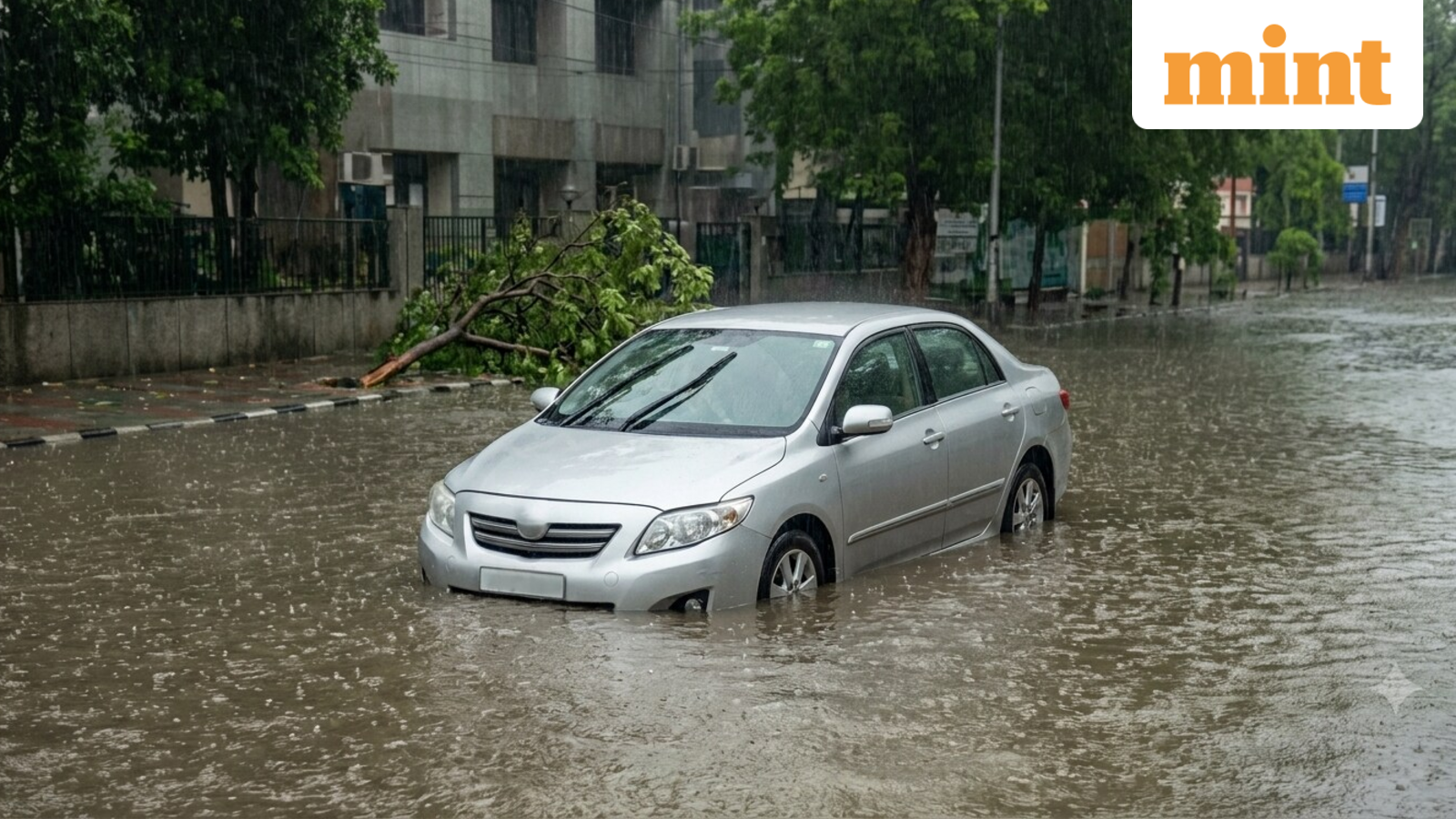
Heavy rains damaged your car? Here’s what motor insurance covers and what it doesn’t
Heavy rains that lashed Delhi this week, toppling trees and damaging parked vehicles, have once again put the spotlight on an annual monsoon problem for motorists. For thousands of car owners caught in similar situations every monsoon, one question inevitably arises: Will insurance pay for the damage?
The answer depends not only on the type of insurance policy you have, but also on how the damage occurred. While comprehensive motor insurance generally covers losses caused by floods, storms and other natural calamities, certain exclusions, particularly those involving engine damage, can leave policyholders with substantial repair bills.
Comprehensive insurance covers most monsoon damage
Insurance experts say damage caused by floods, heavy rainfall, cyclones and storms is generally covered under a comprehensive motor insurance policy because these are treated as natural calamities.
“Flood damage is generally covered under a comprehensive motor insurance policy. Since floods, heavy rain, cyclones and similar natural events are categorised as natural calamities, damage to the insured vehicle arising from such events may be covered, subject to the policy terms, conditions and exclusions,” said Kiran A Kumar, Head–Motor Underwriting at Tata AIG General Insurance.
However, the protection is available only if the vehicle is insured under a comprehensive or standalone own-damage policy.
“A Comprehensive or Standalone Own Damage (OD) policy covers damage to the car’s body, suspension, upholstery and electrical components caused by floods, heavy waterlogging or cyclones. A basic third-party policy only covers damage caused to others and does not protect your own vehicle,” said Niharika Saigal, Head of Insurance and In-App Categories at PhonePe.
Nitin Deo, Chief Technical Officer at Zuno General Insurance, said policyholders often overlook this distinction while buying insurance.
“A third-party insurance policy does not cover damage to the insured vehicle, whereas a comprehensive policy offers protection against weather-related risks, excluding consequential losses,” he said.
Not every rain-related repair is covered
One of the biggest misconceptions among motorists is that every repair bill arising from heavy rain will be paid by the insurer. If a vehicle stalls in a waterlogged area and the driver attempts to restart it, water may enter the engine, severely damaging internal components. Such damage is generally classified as consequential loss and is excluded under a standard comprehensive policy.
“One of the most common examples of consequential loss is engine damage caused by attempting to restart a vehicle after it has stalled in a waterlogged area,” Deo said.
Kumar echoed the same point, saying consequential engine damage caused by driving through waterlogged roads is generally not covered unless the policyholder has opted for an Engine Secure add-on.
According to Shivendra Pancholi, Executive Director, Affinity Business at Coverfox, other exclusions include consequential losses arising from continued driving after the initial damage and losses resulting from negligence or intentional acts.
Saigal advised motorists never to restart a vehicle that has been submerged.
“If your vehicle gets submerged in water, do not crank or start it. Starting the vehicle while it is submerged can lead to hydrostatic lock, which is generally not covered under a standard policy. Coverage for such damage can be obtained through an Engine Protection add-on,” she said.
Claims can also be rejected if policy conditions aren’t followed
Experts say rain-related claims are rarely rejected simply because the damage occurred during heavy rain. More often, claims run into trouble because policy conditions are not followed.
“A claim may be rejected if the damage falls outside the scope of the policy or if policy conditions are not followed,” Deo said.
He said common reasons include delays in informing the insurer, inadequate documentation, or carrying out repairs before the insurer has had an opportunity to inspect the vehicle without a valid reason.
Kumar said claims may also be denied where the damage results from negligent driving, such as knowingly driving through severely waterlogged roads or continuing to drive after the vehicle has stalled in deep water.
Pancholi added that claims may also be rejected if the policy has expired, the loss falls under policy exclusions, or incorrect or fraudulent information is submitted.
To improve the chances of a smooth settlement, experts advise motorists to switch off the ignition immediately if the vehicle gets stranded in deep water, avoid attempting to restart it, take photographs or videos of the damage, inform the insurer as soon as possible, and have the vehicle towed to an authorised workshop.
With extreme rainfall events becoming increasingly frequent across Indian cities, understanding both the protection and the limitations of a motor insurance policy has become just as important as having one.