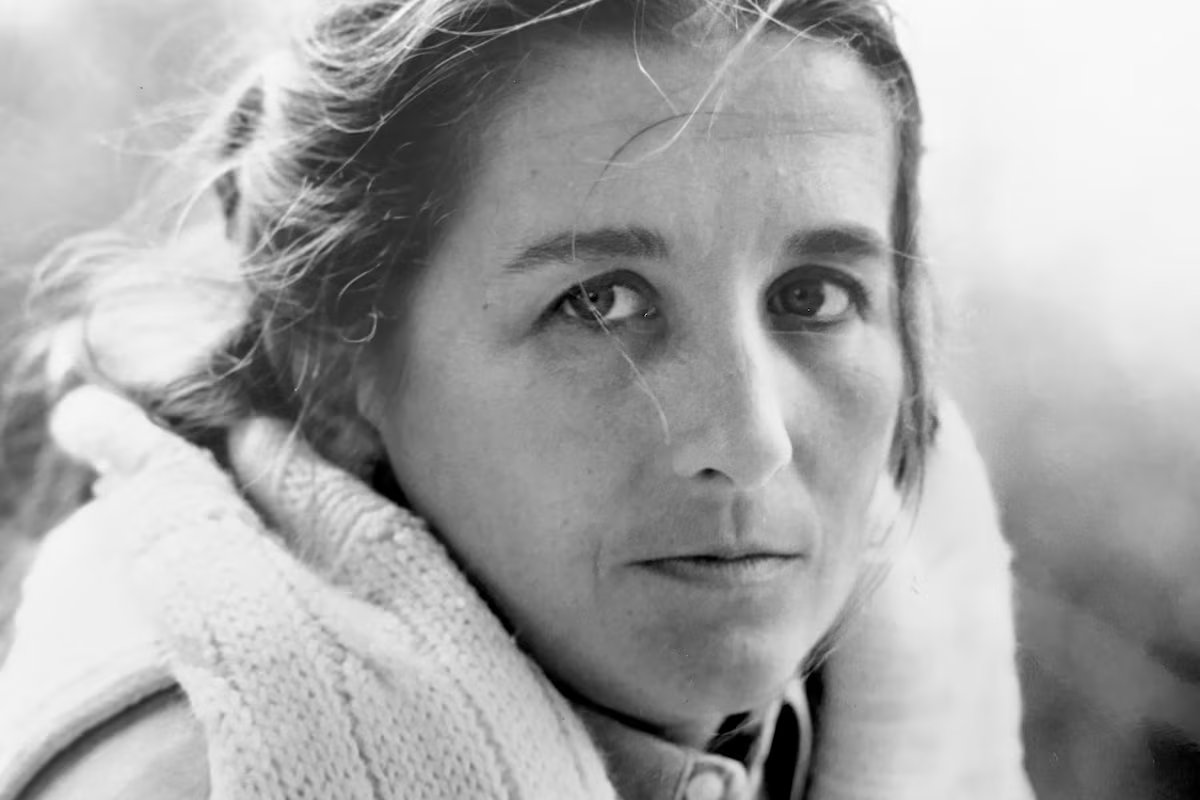
Artist Heather Cooper designed the Roots logo, poster for inaugural TIFF

Heather Cooper was born in Louth, England. She and her family moved to Toronto when she was three.Supplied
Heather Cooper might not have been a household name, but the graphic artist’s designs are iconic.
She created the original logo for Roots, featuring a beaver overtop tree branches, as well as the poster for the inaugural Toronto International Film Festival in 1976. Around the same time, she drew a pair of mating lions as part of advertising campaign for a resort in Jamaica called Couples – a design considered quite risqué back then. The image was part of a successful re-brand of the nation as a vacation spot.
Ms. Cooper, who died at 81 on June 13, was an artist, but commercial graphic artists are also marketers.
“Heather had a tremendous business sense,” said Helga Stephenson, the former executive director of the Toronto International Film Festival, who worked with Ms. Cooper on several projects. “She was an amazing person, in the sense that she was quiet but also direct and highly disciplined. She was a tremendous artist, but on the business side, she always delivered on time and on budget.”
Ms. Cooper was born in Louth, England, on March 16, 1945, to Ronald and Eileen Cooper. When Heather was three years old, the family moved to Toronto. Her parents encouraged their artistic daughter from an early age.
A Heather Cooper painting, titled ‘Guelph University.’Supplied
“Years ago, my father and mother made me the gift of a wonderful wooden box,” Ms. Cooper wrote on her website. “When I opened the box, I discovered a neat row of oil paints in colourful tubes, glass bottles with turpentine and linseed oil, a pair of canvases, and a handful of long-handled brushes. It was my eighth birthday. I began to paint for love and quickly became a passionate consumer of cardboard bag canvas boards. My parents had awakened a gift inside of me.”
Her first painting was of an imaginary cottage in an orchard.
After grade school, Ms. Cooper went to Western Tech near Toronto’s High Park and studied graphic arts. As an eighteen-year-old straight from high school, she landed a dream job working for Don Watt, who ran one of the top design firms in Canada. Mr. Watt was her early mentor. While she was still in her twenties, she started her own design firm, Cooper, Burns and Donoahue.
The firm prospered, and in 1973, the two founders of Roots, Michael Budman and Don Green, approached Ms. Cooper to help them design the logo for their new company.
“The choice of the beaver was symbolic of its industrious nature and paid homage to their shared childhood memories at camp,” said Ms. Cooper in an interview published on the Roots website. “Roots was the name the founders truly desired; together we delved into various logo possibilities, and in 1976, the iconic beaver painting became an integral part of the story.”
“She created the actual illustration that is printed on their bags, tags and all of their clothing – that is her artwork,” said her granddaughter Phoebe Graham-Stienburg.
“The Roots beaver logo has become one of the most recognizable Canadian brand symbols, and Heather’s work helped shape a visual identity that has been associated with Canada for decades. Heather was a pioneer of the graphic design world in Toronto in the ’70s and helped shape it into what it is today.”
The founders of Roots approached Ms. Cooper in 1973 to help them design the logo for their new company.Fred Lum/The Globe and Mail
When the Toronto International Film Festival, then called Festival of Festivals, launched in 1976, Ms. Cooper was approached to design its poster. The original festival didn’t have much of a budget, so Ms. Cooper did it for free – she might have been given some tickets to the films being shown. The poster was simple, a blue background with two red hands placed so they form a blue screen, like a film director framing a shot.
On TIFF’s 50th anniversary, 50 moments that define Canada’s glitziest cultural behemoth
“The poster was very talked about at the time, and it elevated the film festival because we were working with Heather Cooper. It was very prestigious to work with her at that time,” said Ms. Stephenson.
TIFF’s original incarnation in 1976 was called the Festival of Festivals, as shown on the original program book.
Ms. Cooper was also a successful portrait artist. Her list of commissions includes Pope John Paul II, the media entrepreneur Moses Znaimer, game show host Alex Trebek, actress Faye Dunaway, and a trio of hockey stars: Bobby Orr, Daryl Sittler and Henri Richard.
She created intricate illustrations for the Stratford Festival, the Canadian Opera Company, the Houston Opera Company, the Baltimore, Symphony, and the Smithsonian Institute.
A Heather Cooper painting, titled ‘Ophelia.’Supplied
Around 2000, Ms. Cooper left Toronto and moved to a rural retreat in Northumberland, a couple of hours east of Toronto. She lived there with her long-time-partner, Terry Price. The two were sweethearts in high school and reconnected as adults.
Her family said she enjoyed being surrounded by nature and that it influenced her art.
“Fine art and painting were her whole life. She was incredibly involved in all our lives, my mom, my dad and my siblings; she wanted to know what was going on and be a part of it,” said Ms. Graham-Stienburg. “She passed on her love of art and her talent and her gift to her daughter, and she taught Sarah how to oil paint and how to do design work and to look at the world from an artist’s perspective.”
She is survived by her partner, Terry Price, her daughter, Sarah Cooper Burns Graham, and son-in-law, Eric Graham, and by her five grandchildren: Calum Graham, Phoebe Graham-Stienburg, Maxwell Graham, Gavin Graham, and Chloe Graham.
You can find more obituaries from The Globe and Mail here.
To submit a memory about someone we have recently profiled on the Obituaries page, e-mail us at obit@globeandmail.com.