In proprietary trading, the most consequential failures are
rarely the ones that surface first. A denied payout is usually treated as one.
The dispute is framed as a question about the trader: did the trader break a
rule?
That framing places the failure at the wrong moment.
A rule is broken when a position is opened, hedged, held
through a session boundary or filled against a feed. A denial arrives weeks
later, when the withdrawal is reviewed. In between, the firm either could not
see the breach or chose not to look. Neither explanation sits with the trader.
London’s trading industry is coming home!
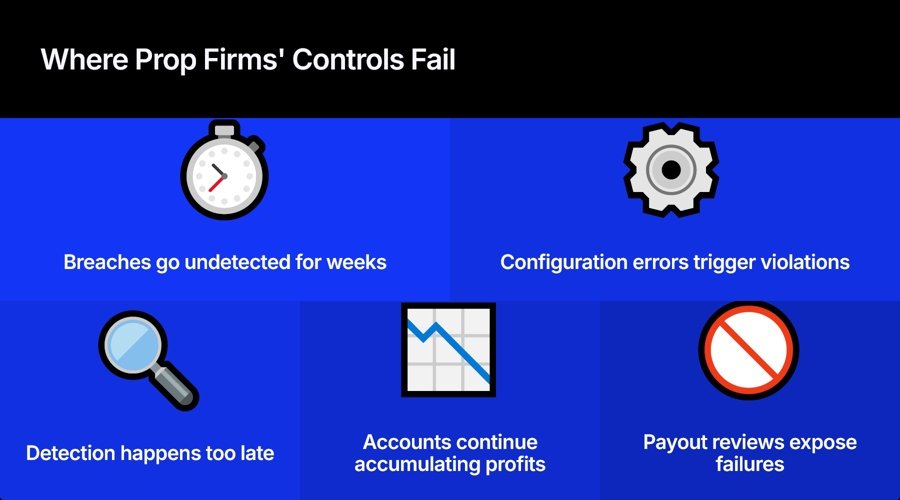
A denial is a control working only if the firm acted when it
first could have known. Otherwise, it is a loss the firm chose to take at the
most expensive moment.
Shervin Arian, OmegaRatio Advisors, Founder and CEO
Consider what a firm does between the moment a rule is
broken and the moment a payout is refused. The account stays active. It may be
scaled. The challenge fee has been retained, and the trader continues to build
the profit that the firm later declines to release.
Payouts are rare events. In FPFX Tech data covering more than
300,000 accounts, about 7% of traders reached one. For the firm, the payout
review is therefore the single moment at which its controls meet a liability
that has been accruing for weeks. It is also the moment at which the firm
learns what it did not see.
Every day of the interval is a decision to carry an exposure
the firm says it should not have carried. A control that finds a breach at
payout time has prevented nothing. It has confirmed, at the most expensive
moment, that the earlier controls did not work.
Denials Tend to Trace Back to Three Failures
The first is configuration. A trader can breach a drawdown
limit because of the price source the firm chose, the session boundary it set
or the fill its simulation produced. When the rule is triggered by the firm’s
own execution model, the breach is partly the firm’s output. A denial built on
it is a claim about a trader that the platform helped write.
The second is detection lag. Behaviours such as
cross-account hedging, copied entries and timing-based exploitation leave a
trail in trade data as they happen. Firms that review them in batches, or only
when a payout is requested, discover the pattern after it has already paid for
itself.
The third is indifference. In some firms, the rulebook is
less an operating control than a filter applied at withdrawal, and the
discretion it carries is part of the economics. Rules that bite only at the
payout stage are the clearest example.
Finance Magnates reported in July 2026
that a new account structure had dropped the consistency rule and the trailing
drawdown, and described the direction of travel as “toward fewer rules,
faster payouts and simpler drawdown math”. One
operator’s chief executive called the consistency rule “a payout
trap”.
A Denial Is Only as Strong as the Evidence Held at the
Time
A denial is an assertion that a rule was broken, and it has
to be proved. The proof is the firm’s own record: timestamps, fills, prices,
account relationships and the rule as it stood when the trade was made.
A firm
that can produce that record from the moment of the breach holds a defensible
position. A firm that assembles it at payout holds a reconstruction.
The difference matters most when the behaviour was
concealed. Hidden coordination, shared access and engineered randomness are
real, and they are the reason firms keep discretion.
They are also the cases in
which the quality of the firm’s data decides the outcome. Concealment may leave
a signature across accounts, timing and execution . A firm that was not looking
for it when it happened is unlikely to prove it afterwards.
Selective enforcement compounds the problem. A rule applied
at payout but not during the life of the account looks less like a control than
like a decision about whom to pay. That is the position in which a firm is
least able to defend its own rulebook.
Regulated Markets Settled the Timing Question Years Ago
In US securities markets, the question of when a risk
control should act was answered in 2010. The SEC’s Market Access Rule requires
brokers with market access to maintain controls reasonably designed to prevent
the entry of orders unless regulatory requirements are met “on a pre-order
entry basis”, and to block orders that exceed pre-set credit or capital
thresholds.
The controls must sit under the broker’s “direct and exclusive
control”. Surveillance staff receive immediate post-trade execution
reports, and the firm must review the effectiveness of its controls regularly.
The rule applies to broker-dealers, not to prop firms. Its
logic is portable. A control that acts after the fact is a reporting function.
A control that acts before the order or during the position is a risk control.
Most prop rulebooks describe the second and operate the first.
The same diagnosis has been offered from inside the
industry. James Glyde, chief executive of PipFarm, told Finance Magnates in
2024 that “most (if not all) recent prop firm failures can be traced back
to a lack of internal controls”.
Finance Magnates Intelligence estimates
that 80 to 100 prop firms ceased operating between January 2024 and the first
quarter of 2026.
Parts of the Industry Are Beginning to Move the Check
Forward
Some firms are treating the problem as one of timing. On 24
August 2026, FundingTraders introduced a dashboard that shows rule breaches
before a trader requests a payout, labelling each outcome as a warning, a
deduction or a reduced profit split.
Finance Magnates reported that one broker
had identified a single rule, profit distribution, as the source of the most
disputes among its challenge clients.
Hola Prime commissioned Deloitte to review its payout
processing from 15 October 2025 to 15 March 2026. The review found that 98.35%
of withdrawal requests were processed within one hour and that no payouts were
denied.
The firm’s chief executive described a “Zero Payout Denial
Policy”. Figures of this kind describe the payout stage. They say less
about the decisions taken before a request reaches it.
The verification problem is wider. In one reported case, a
firm’s monthly payout total for February 2026 and an
independent tracker’s estimate differed by roughly $2.2 million. In an
industry that largely verifies itself, the denial decision is rarely a figure
anyone outside the firm can check.
The Limits of Moving Earlier
A common counterargument is that firms need discretion at
payout because some traders exploit latency, copy accounts or hedge across
entities, and not all of it is visible until a withdrawal is reviewed.
That critique is valid in isolation. Behavioural detection
is probabilistic, false positives carry their own cost, and no industry
standard exists for what counts as sufficient evidence. It becomes less
convincing as soon as the behaviour was visible in trade data for the life of
the account, and in a market that records every fill, most behaviour is.
Discretion exercised at payout is defensible when the evidence emerged at
payout. It is hard to defend when the evidence existed for weeks and the
account was allowed to run.
The direction is clearer than the method. Rules evaluated on
every event rather than every request, consequences shown to the trader while
the account is live, surveillance that runs continuously, and published payout
figures that reconcile against an independent record would each narrow the
interval. None of them is yet common practice.
Retail prop trading also sits largely outside direct
financial regulation. Finance Magnates described the arrangement as
“compliance with a private contract, not oversight by a financial
regulator”. The firm’s own process is therefore the only control the
trader has, and the only one the firm can be held to.
The Question That Follows
The question is not whether firms will deny payouts. It is
whether, for each denial, a firm can state the moment at which it could first
have known, and what it did in the time between.
A control that works only at payout time has already failed.