The World Monuments Fund’s 2026 Irreplaceable America list recognizes the kind of architecture that has come to define the country—landmarks that serve as reminders of who we are and where we came from.
But one place was so emblematic of the country’s past, present, and future that no single building could serve as a symbol of the whole.
New Orleans, LA is the only entire city among the 10 places to receive the designation.
“New Orleans itself is irreplaceable—not just one building, one district or one monument, but the entire living city,” said Kristin Gisleson Palmer, executive director of the Preservation Resource Center of New Orleans when the title was announced.
Yet the buildings that earned the city that recognition now face a mounting threat: the cost of protecting them.
New Orleans has the second-highest homeowners insurance costs relative to property values among the nation’s 100 largest metro areas, according to research from Realtor.com®. Now, as storms intensify and insurance costs rise, the city’s historic homes are becoming more expensive to protect and preserve.

A city shaped by water
On a recent walking tour through Bayou St. John, Heather Veneziano—director of Tulane University’s Historic Preservation Program, who helped spearhead the city’s nomination—began not with a building, but with the ground beneath our feet.
The bayou that gives the neighborhood its name connects to Lake Pontchartrain, a brackish estuary fed by rivers and linked to the Gulf of Mexico. The slower-moving waters served Indigenous communities as a transportation route before European colonization.
Alongside that access, nearby natural ridges offered comparatively high ground in a landscape shaped by water, making the area an appealing, if imperfect, place to settle.
But higher ground didn’t always mean dry ground. And the European settlers who followed knew the water would eventually return, and they built their homes accordingly.
“You have to build for place,” Veneziano told Realtor.com®.
At the Pitot House, a Creole colonial country house built in 1799, she pointed to the elevated living quarters as an example. The ground level, she said, could be used for storage during dry seasons, while allowing floodwater to enter below the principal rooms during wet ones.
“You lived, I think, with the knowledge that water is going to be a thing you can’t fight against,” Veneziano said.
That understanding shaped the building from the ground up. Its broad roof and galleries offered shelter from the elements, while its timber framing incorporated cypress, a locally abundant wood prized for its resistance to decay and insects.
Residents adapted that approach across generations, raising homes as new neighborhoods and architectural forms developed, according to FEMA’s history of building elevation in New Orleans.
But even the most carefully adapted homes can’t eliminate the danger.
Today, an estimated 88.9% of residential property value in the New Orleans–Metairie metro faces severe or extreme flood risk, according to the 2025 Housing and Climate Risk Report from Realtor.com.
The people and movements that built New Orleans
As New Orleans grew, new residents brought their own architectural traditions, transforming both the appearance of its neighborhoods and the ways people lived within them.
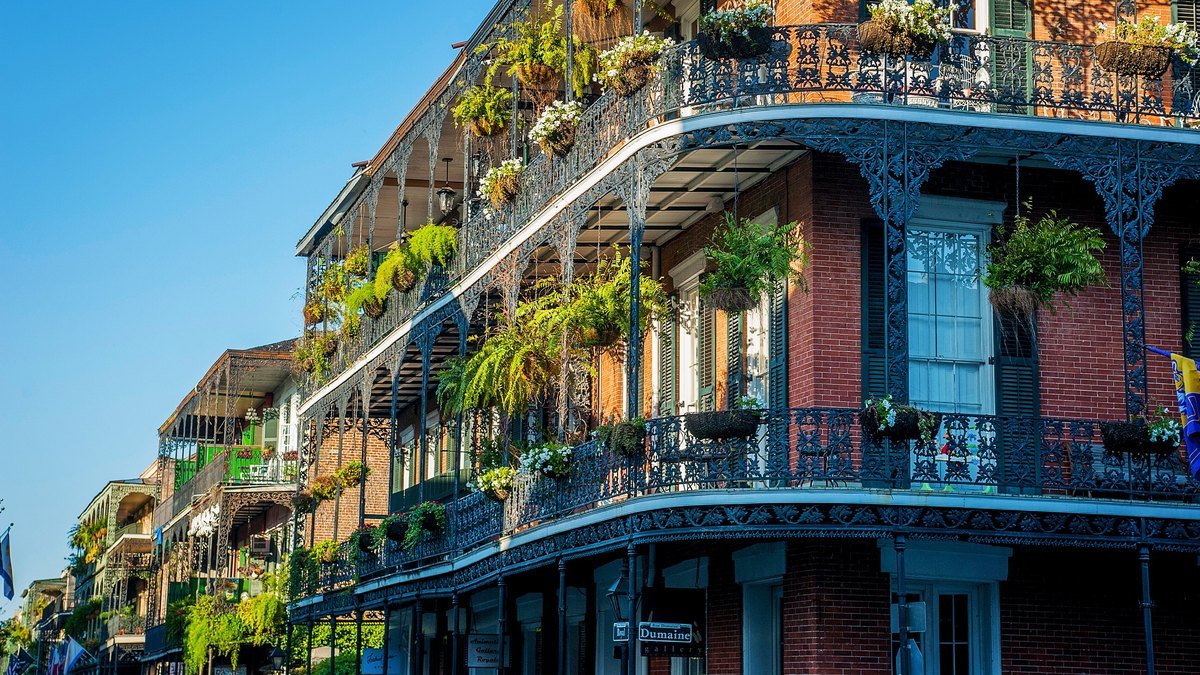
The Creole townhouse, with shops beneath upper-floor residences and courtyards tucked behind masonry facades, became a defining feature of the French Quarter.
Interestingly, its appearance was partly shaped by disaster. After fires destroyed much of the city in 1788 and 1794, Spanish authorities favored more fire-resistant construction, helping establish the brick, stucco, and ironwork associated with the neighborhood today.
New Orleans’ celebrated architecture was also built on slavery.
Behind the ornate facades, enslaved people lived in courtyard quarters and worked in the homes they helped construct. Enslaved craftspeople helped construct the homes themselves, while the city’s wealth was deeply tied to their forced labor.
Yet within this slaveholding society, free Black New Orleanians also established themselves as builders and property owners. Architectural historian Tara A. Dudley has documented how the Dolliole and Soulié families shaped the city’s housing and built wealth through real estate, despite laws restricting Black economic independence.
Following the Louisiana Purchase in 1803, Anglo-American settlers introduced different architectural preferences. Wealthy merchants built double-gallery houses Uptown, their stacked porches and classical columns reflecting fortunes tied to shipping, cotton, and enslaved peoples.
The craftsmanship that distinguished these homes also presents a modern financial challenge.
Rami Sneineh, a licensed insurance producer and owner of Insurance Navy Brokers, says replacing handmade windows, woodwork, or plaster may require scarce materials and specialized craftspeople.
“If your home sustained significant damage, it could take months to source similar materials and you’d likely need to hire specialized craftsmen to restore those one-of-a-kind details,” he says.
An older home worth $400,000, he offers as a hypothetical example, might cost $700,000 to reconstruct with comparable details.
But not every architectural tradition emerged from wealth.
The shotgun house, which spread through working-class neighborhoods during the 19th century, arranged narrow rooms one behind another. Its origins are debated, but historians have identified possible African and Caribbean influences. Double shotguns accommodated two households beneath one roof, making efficient use of narrow lots.
And as drainage technology opened lower-lying areas to development, raised-basement houses appeared in neighborhoods such as Broadmoor and Mid-City. Their main living quarters sat a full story above the ground, carrying the tradition of elevation into the 20th century.
Yet the pumping systems that enabled the city’s expansion also contributed to land subsidence, according to the Historic New Orleans Collection.
The homes remained elevated, but their protection increasingly depended on an engineered system of drainage, pumps, and levees—whose vulnerabilities became devastatingly apparent during Hurricane Katrina.
Who can afford to keep the city standing?
As we walked through Bayou St. John, the distant sound of a marching band practicing for upcoming Mardi Gras parades drifted across the neighborhood. Veneziano paused to listen, reflecting on the communities hidden behind and whithin the structures that surrounded us.
“The architecture is the setting for those relationships,” she said. “And people’s voices are told through the built environment in which they live.”
Today, New Orleans has 26 historic districts listed on the National Register of Historic Places, covering more than 45,000 properties and roughly 40% of its urbanized area.
But preserving the appearance of those neighborhoods doesn’t always preserve the communities within them.
During our walk, Veneziano pointed out double shotguns converted into single-family homes, a trend she said accelerated after Hurricane Katrina. The exteriors might remain recognizable even as two residences become one.
“It’s taking away affordable housing for the rental population because there’s not as many rental units anymore,” she said.
The lost rental unit also means losing a potential source of income that could help an owner maintain an aging structure.
And for the homeowners who do remain, those costs are rising on many fronts.
Single-family homes in the area carry an estimated annual homeowners insurance premium of $8,328, according to research from Realtor.com—equivalent to 3.6% of its median market value, and the second-highest burden among the 100 largest metropolitan areas.
Those estimates don’t even account for the specialized demands of restoring historic architecture or purchasing separate flood coverage.
Even insured owners can face substantial out of pocket expenses. Sneineh notes that a 5% hurricane deductible on a home insured for $600,000 leaves an owner responsible for $30,000 before the insurer covers eligible damage.
“Properties that were previously affordable to purchase may now be unaffordable to insure,” says Mujahid Merchant, an independent researcher in climate risk and mortgage credit.
When private coverage becomes unavailable, homeowners may turn to Louisiana Citizens, the state’s insurer of last resort, which is required to charge higher rates than qualifying private insurers.
And if a mortgaged home loses required coverage, its lender may purchase more expensive insurance and charge the owner. Merchant warns that the resulting increase in monthly payments can contribute to delinquency or foreclosure.
Yet some of the solutions draw on the same practical ingenuity that shaped these homes in the first place.
“Contrary to popular belief, you can strengthen your historic home’s roof without changing its historic look,” Sneineh says.
Louisiana’s Fortify Homes Program offers eligible owners grants of up to $10,000 to strengthen roofs against hurricane winds. A state report found that median recipients saved $1,250 a year, or 22%, on insurance premiums. New Orleans also provides an expedited review process for qualifying roof replacements in local historic districts.
But even as owners find new ways to protect their homes from the elements, keeping those buildings affordable presents a different challenge.
After Hurricane Katrina, thousands of New Orleanians left for cities such as Houston and Atlanta. Not everyone returned.
Veneziano described the familiarity of living near former teachers, relatives, and neighbors whose lives have intertwined for generations—connections that can’t simply be reconstructed in another place.
“You can’t take what you have anywhere and put it somewhere else,” she said. “Places don’t matter without people.”