Forex Has Always Outsourced Its Tech. That’s Why It’s Adopting Crypto So Fast
We are used to hearing that digital asset integration is a
slow, lengthy process, but forex brokers have demonstrated that it doesn’t have
to be the case. Many already accept stablecoin deposits, and a growing number
are rethinking how money moves through the entire business.
London’s trading industry is coming home!
That’s because forex has a completely different business
model from, say, banks. FX is a channel-driven business. Brokers don’t rely on
technological advantages in the same way banks and fintech firms do, so they
have long assembled their technology from vendors. They’re used to third-party
intermediaries handling deposits and withdrawals on their behalf.
But as digital asset volumes have grown, more mid-sized and
large brokers have started rethinking their strategy. No longer satisfied with
simply plugging into payment gateways controlled by third parties, leading forex
brokers are partnering with crypto infrastructure providers to build their
own blockchain tools.
Shawn Yan, Founder & CEO of Cregis, Source: LinkedIn
Traditionally, banks have treated their core technology
stack as a strategic asset. Ledgers, payment systems and account infrastructure
are built in-house, and changing anything is a major undertaking. Digital
assets don’t slot neatly into that architecture, so adoption becomes a
transformation project.
Forex brokers grew up differently. Trading runs on
MetaTrader. Customer management sits in a third-party CRM. Execution comes from
external liquidity providers. Deposits and withdrawals flow through outside
payment gateways. A typical brokerage
is a set of specialised providers stitched together with APIs, and its
operators are fluent in integration.
The appeal of this strategy is obvious: it is fast to deploy
and cheap to build. For small and mid-sized brokers, all it takes is a quick
integration to go live, which is why this became the default approach across
the industry for years.
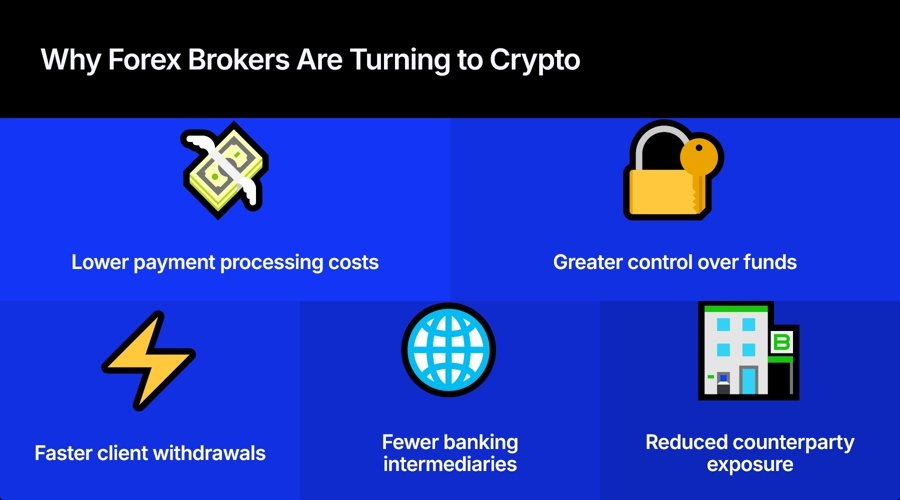
However, the cost model breaks down at scale, comes with
custody and counterparty risks, and ultimately affects the user experience.
Digital asset infrastructure can mitigate these issues, which is why it can
seem so alluring.
And since brokers already have significant experience as an
industry in dealing with specialised providers, the process is much easier for
them than for banks. A broker doesn’t need to become a blockchain company to
use digital assets. It can integrate wallet, custody, compliance and
transaction tools into the systems it already runs, in the same way it plugged
in everything else.
There’s an irony here. Having outsourced so much, brokers
are now using crypto to take something back.
The Wallet Is the New Treasury Account
For brokers operating globally, digital assets are less
about offering clients a crypto product and more about managing the company’s
own money.
The case for digital assets starts with cost. Brokers
typically pay processors between 3.5% and 6% of volume, according to a 2026
survey of high-risk merchants by TheFinRate. At, say, $30 million a month, the
4.7% industry median cited by the survey comes to approximately $1.41 million
in fees every month, which can be a real burden for the business.
Wallet infrastructure, however, is priced mostly as a
subscription. At Cregis, for example, our Business tier costs $9,700 a year and
covers up to $20 million in monthly outbound transfers, with a 0.05% charge
above that.
For a broker processing $30 million a month, a $400 capacity
expansion would cover the additional volume, bringing the annual platform cost
to approximately $10,100, before network fees. Customers purchasing larger
amounts of additional capacity upfront can also benefit from volume-based
discounts, further reducing the overall cost. The economics are completely
different.
Then there’s custody risk. Under the pooled payment-provider
model, brokers have to keep large, pre-funded
balances with the payment company on an ongoing basis. If that provider
runs into trouble, the broker is directly exposed, and so are its clients’
funds. Holding funds in wallets the broker controls, governed by its own
permissions and approval workflows, takes that counterparty out of the
equation.
Processors typically also withhold around 9% of monthly
volume in rolling reserves. So, at $30 million a month, that’s roughly $2.7
million sitting with a third party.
Finally, there’s the customer. Under the gateway model,
withdrawals depend on the payment company processing them. Even at large,
regulated brokers, card and wire withdrawals are measured in days. FxPro tells
clients that international wires take three to five working days and card
refunds around ten days. FXCM warns that card refunds can take up to a full
billing cycle.
Delays feed anxiety about whether funds are safe and when
they’ll arrive, and the broker, under the current model, cannot do anything
about it.
Under self-managed wallets, however, withdrawals can occur
in a matter of minutes, meaning that a broker can get much closer to the
near-instant withdrawals customers have come to expect from major crypto
exchanges.
Put together, a well-structured wallet infrastructure
becomes the operational layer through which a broker manages balances, moves
funds between entities and controls treasury across jurisdictions.
That matters more in forex than almost anywhere else.
Brokers serve customers across countries with different banking systems,
currencies and payment rails. The more fragmented the footprint, the more
valuable it is to reduce dependence on local banking rails and the
intermediaries attached to them.
Owning the Stack Becomes the Edge
More than half of Cregis’s clients now come from outside the
crypto-native sector, with traditional financial businesses accounting for a
significant share. FX brokers make up the largest segment within this group.
That’s because, over time, these advantages compound. A
broker that owns its liquidity, settlement and treasury flows can launch
products faster, since it isn’t waiting on a partner’s roadmap. It can enter
new markets more easily because it isn’t rebuilding banking relationships from
scratch in each one. And it is less exposed when any single bank or payment
provider changes its terms or exits a market.
That is how infrastructure ownership moves from a
back-office decision to a competitive advantage. The brokers that get there
first will set the standard for what customers expect: instant funding,
predictable withdrawals and fewer excuses. The rest will find themselves
explaining delays their competitors no longer have.
We are used to hearing that digital asset integration is a
slow, lengthy process, but forex brokers have demonstrated that it doesn’t have
to be the case. Many already accept stablecoin deposits, and a growing number
are rethinking how money moves through the entire business.
London’s trading industry is coming home!
That’s because forex has a completely different business
model from, say, banks. FX is a channel-driven business. Brokers don’t rely on
technological advantages in the same way banks and fintech firms do, so they
have long assembled their technology from vendors. They’re used to third-party
intermediaries handling deposits and withdrawals on their behalf.
But as digital asset volumes have grown, more mid-sized and
large brokers have started rethinking their strategy. No longer satisfied with
simply plugging into payment gateways controlled by third parties, leading forex
brokers are partnering with crypto infrastructure providers to build their
own blockchain tools.
Shawn Yan, Founder & CEO of Cregis, Source: LinkedIn
Traditionally, banks have treated their core technology
stack as a strategic asset. Ledgers, payment systems and account infrastructure
are built in-house, and changing anything is a major undertaking. Digital
assets don’t slot neatly into that architecture, so adoption becomes a
transformation project.
Forex brokers grew up differently. Trading runs on
MetaTrader. Customer management sits in a third-party CRM. Execution comes from
external liquidity providers. Deposits and withdrawals flow through outside
payment gateways. A typical brokerage
is a set of specialised providers stitched together with APIs, and its
operators are fluent in integration.
The appeal of this strategy is obvious: it is fast to deploy
and cheap to build. For small and mid-sized brokers, all it takes is a quick
integration to go live, which is why this became the default approach across
the industry for years.
However, the cost model breaks down at scale, comes with
custody and counterparty risks, and ultimately affects the user experience.
Digital asset infrastructure can mitigate these issues, which is why it can
seem so alluring.
And since brokers already have significant experience as an
industry in dealing with specialised providers, the process is much easier for
them than for banks. A broker doesn’t need to become a blockchain company to
use digital assets. It can integrate wallet, custody, compliance and
transaction tools into the systems it already runs, in the same way it plugged
in everything else.
There’s an irony here. Having outsourced so much, brokers
are now using crypto to take something back.
The Wallet Is the New Treasury Account
For brokers operating globally, digital assets are less
about offering clients a crypto product and more about managing the company’s
own money.
The case for digital assets starts with cost. Brokers
typically pay processors between 3.5% and 6% of volume, according to a 2026
survey of high-risk merchants by TheFinRate. At, say, $30 million a month, the
4.7% industry median cited by the survey comes to approximately $1.41 million
in fees every month, which can be a real burden for the business.
Wallet infrastructure, however, is priced mostly as a
subscription. At Cregis, for example, our Business tier costs $9,700 a year and
covers up to $20 million in monthly outbound transfers, with a 0.05% charge
above that.
For a broker processing $30 million a month, a $400 capacity
expansion would cover the additional volume, bringing the annual platform cost
to approximately $10,100, before network fees. Customers purchasing larger
amounts of additional capacity upfront can also benefit from volume-based
discounts, further reducing the overall cost. The economics are completely
different.
Then there’s custody risk. Under the pooled payment-provider
model, brokers have to keep large, pre-funded
balances with the payment company on an ongoing basis. If that provider
runs into trouble, the broker is directly exposed, and so are its clients’
funds. Holding funds in wallets the broker controls, governed by its own
permissions and approval workflows, takes that counterparty out of the
equation.
Processors typically also withhold around 9% of monthly
volume in rolling reserves. So, at $30 million a month, that’s roughly $2.7
million sitting with a third party.
Finally, there’s the customer. Under the gateway model,
withdrawals depend on the payment company processing them. Even at large,
regulated brokers, card and wire withdrawals are measured in days. FxPro tells
clients that international wires take three to five working days and card
refunds around ten days. FXCM warns that card refunds can take up to a full
billing cycle.
Delays feed anxiety about whether funds are safe and when
they’ll arrive, and the broker, under the current model, cannot do anything
about it.
Under self-managed wallets, however, withdrawals can occur
in a matter of minutes, meaning that a broker can get much closer to the
near-instant withdrawals customers have come to expect from major crypto
exchanges.
Put together, a well-structured wallet infrastructure
becomes the operational layer through which a broker manages balances, moves
funds between entities and controls treasury across jurisdictions.
That matters more in forex than almost anywhere else.
Brokers serve customers across countries with different banking systems,
currencies and payment rails. The more fragmented the footprint, the more
valuable it is to reduce dependence on local banking rails and the
intermediaries attached to them.
Owning the Stack Becomes the Edge
More than half of Cregis’s clients now come from outside the
crypto-native sector, with traditional financial businesses accounting for a
significant share. FX brokers make up the largest segment within this group.
That’s because, over time, these advantages compound. A
broker that owns its liquidity, settlement and treasury flows can launch
products faster, since it isn’t waiting on a partner’s roadmap. It can enter
new markets more easily because it isn’t rebuilding banking relationships from
scratch in each one. And it is less exposed when any single bank or payment
provider changes its terms or exits a market.
That is how infrastructure ownership moves from a
back-office decision to a competitive advantage. The brokers that get there
first will set the standard for what customers expect: instant funding,
predictable withdrawals and fewer excuses. The rest will find themselves
explaining delays their competitors no longer have.