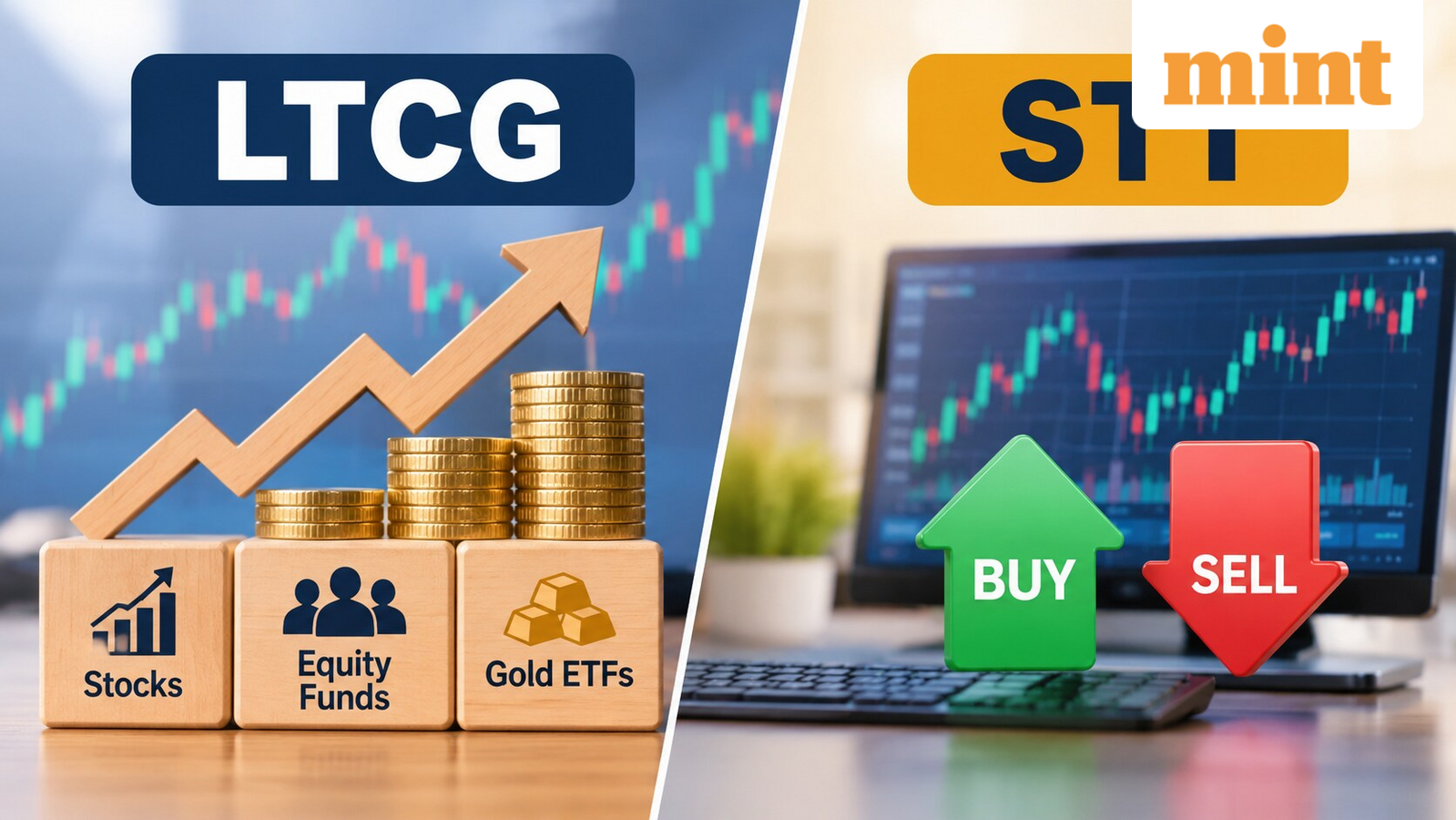
LTCG vs STT: How are investors taxed on stocks, equity mutual funds and gold ETFs? Applicability and tax rules explained
As the Union Budget 2027 approaches, discussions around a possible reduction or removal of Long-Term Capital Gains (LTCG) tax and Securities Transaction Tax (STT) have gained momentum among market participants and policymakers. However, these two levies work differently and have different implications for investors.
LTCG is a tax on the profit earned when an investor sells an investment after holding it for a specified period. On the other hand, STT is a tax charged on eligible buy and sell transactions on recognised stock exchanges, regardless of whether the investor makes a profit or loss.
Here is how the two taxes apply to equities, mutual funds, and gold ETFs.
What is LTCG tax on stocks, equity funds and ETFs?
The tax treatment of long-term capital gains depends on the investment category and the period for which it is held.
For instance, if an investor earns ₹2 lakh in LTCG from listed shares and equity mutual funds combined, ₹75,000 will be taxable at 12.5%. The basic tax liability will be ₹9,375, excluding cess and applicable surcharge.
However, if the investor earns ₹2 lakh in LTCG from a Gold ETF, the entire gain is taxable at 12.5%, resulting in a tax liability of ₹25,000.
What is STT on equities, mutual funds and ETFs?
Unlike LTCG, STT is charged on eligible transactions rather than the profits earned. According to the NSE, the applicable STT rates effective 1 April 2026 are:
- Equity shares: For delivery-based transactions, STT is 0.1% on both purchases and sales. The buyer pays it on purchase, while the seller pays it on sale.
- Intraday equity transactions: The seller pays 0.025% of the transaction value. No STT is payable by the buyer.
- Equity-oriented mutual funds: STT is not charged on purchases. On delivery sales, the seller pays 0.001%.
- ETFs: STT applies at 0.001% on delivery-based sales and 0.025% on intraday sales.
However, gold ETFs, silver ETFs, liquid ETFs, gilt ETFs, and certain international ETFs are exempt from STT.
While LTCG depends on the holding period and type of investment, STT depends on the nature of the transaction. Investors should therefore factor in both taxes when calculating their overall investment costs and post-tax returns.
Disclaimer: This is for informational purposes only. Please consult a qualified tax adviser or your broker before making investment decisions or executing transactions.