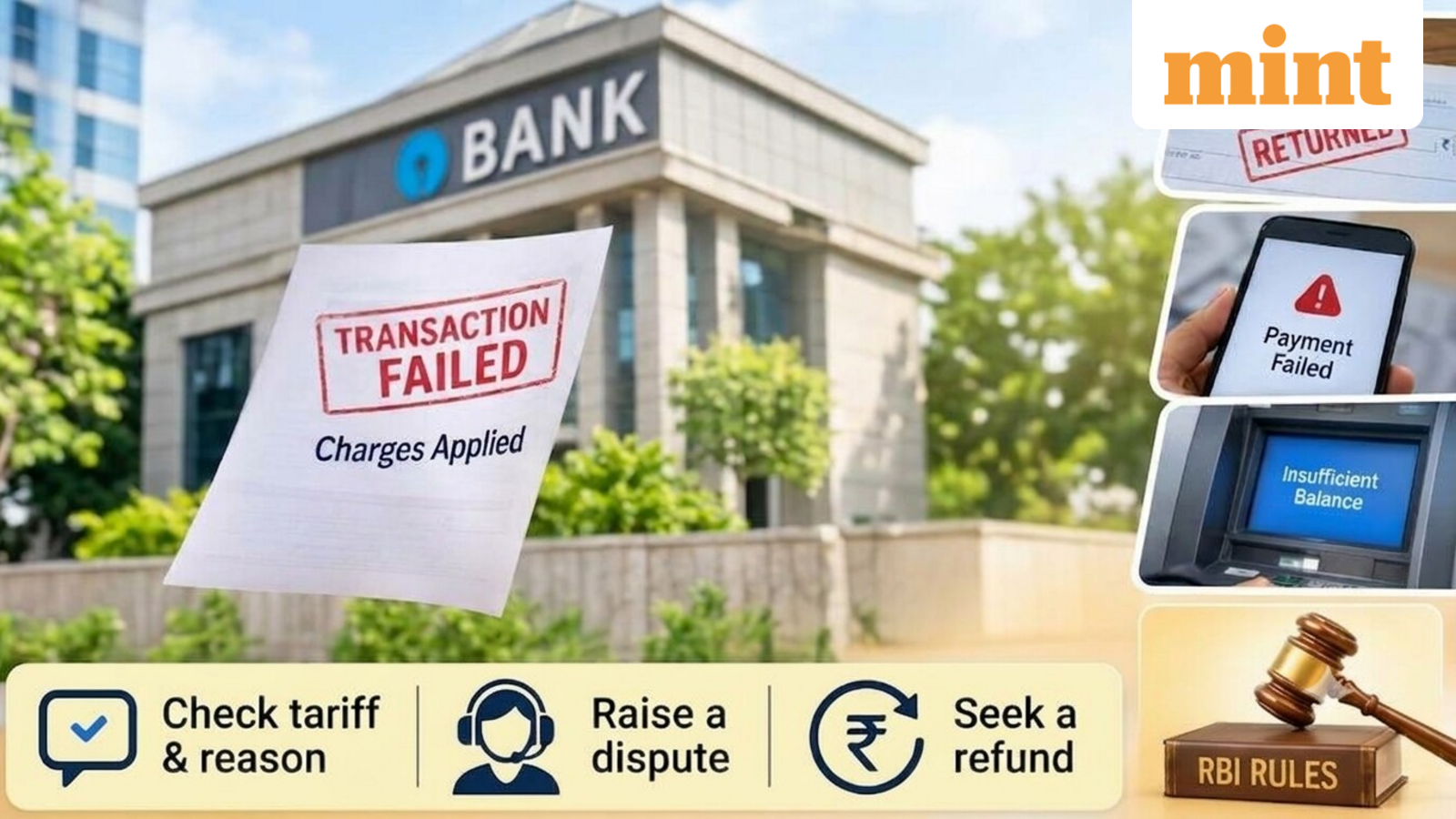
Failed ATM, UPI or cheque transaction? Know when banks can charge you and how to seek redressal under RBI rules
A failed transaction does not always mean you escape the bank’s service charges. A cheque returned due to insufficient funds, a failed automatic payment mandate, or an ATM transaction declined for lack of balance can attract a fee, depending on your bank’s tariff and account terms.
However, banks cannot levy arbitrary charges. The reason for the failure, applicable RBI guidelines and whether the fee was disclosed to you determine whether you can challenge the deduction and seek a refund. Here’s what you need to know.
When can banks levy charges on unsuccessful transactions?
Banks can collect charges for certain failed transactions if these are disclosed in their applicable schedule of charges and account terms.
For example, SBI charges ₹250 plus GST for a failed NACH mandate and ₹500 plus GST for a cheque returned due to insufficient funds. It also levies ₹20 plus GST for ATM transactions declined due to insufficient balance in savings and current accounts. However, the bank does not charge for other failed ATM transactions, including declines due to an incorrect PIN.
HDFC Bank charges ₹500 for the first ECS/ACH mandate return in a month and ₹550 for subsequent returns. Cheque returns due to insufficient funds incur similar charges, while an ATM transaction declined due to insufficient balance at another bank’s ATM or merchant outlet incurs a ₹25 charge plus applicable taxes. These charges are subject to the banks’ applicable account terms and tariff schedules.
Customers should distinguish between:
What compensation does RBI mandate for failed transactions?
These protections apply only to failures not attributable to the customer, and the bank is liable to pay compensation to the customer. Otherwise, it may levy charges.
According to the RBI’s circular, Harmonisation of Turn Around Time (TAT) and Customer Compensation for Failed Transactions Using Authorised Payment Systems, dated 20 September 2019, a ‘failed transaction’ refers to a transaction that remains incomplete for reasons beyond the customer’s control, such as communication failures, unavailability of cash at an ATM, or session time-outs.
It also covers cases where funds cannot be credited to the beneficiary’s account due to incomplete or incorrect information and delays in initiating a reversal.
How can you dispute an incorrect bank charge?
- Collect evidence: Download your bank statement, transaction receipt and failed-payment notification.
- Approach your bank: Register a complaint through its mobile app, customer care helpline or branch. Identify the disputed fee and request a reversal with reasons.
- Seek written clarification: Ask the bank to identify the specific tariff provision authorizing the deduction if it rejects your request.
- Escalate to RBI: If the bank does not respond within 30 days, or you are dissatisfied with its response, approach the RBI Ombudsman through CMS. Under the Reserve Bank – Integrated Ombudsman Scheme, 2026, complaints must generally be filed within 90 days of the applicable deadline or the bank’s last communication.
The key is to establish whether the deduction was contractually permitted and whether the failure resulted from the customer’s actions or a technical lapse.
Disclaimer: This is for informational purposes only. Check your bank’s official website for updated details.