Nvidia Tops Forecasts In First Report Without Jensen Huang, But Gets Choosier About Backing Data Centers
On paper, Nvidia’s first earnings report without Jensen Huang looked a lot like the ones with him.
Almost nothing else about it did.
The world’s most valuable chipmaker has spent recent weeks fighting on nearly every front — its founder’s abrupt exit, a national security probe, midterm backlash against data centers, and a Wall Street sell-off fueled by fears of an AI bubble. Its market value has fallen by roughly $2T since October to about $3.75T.
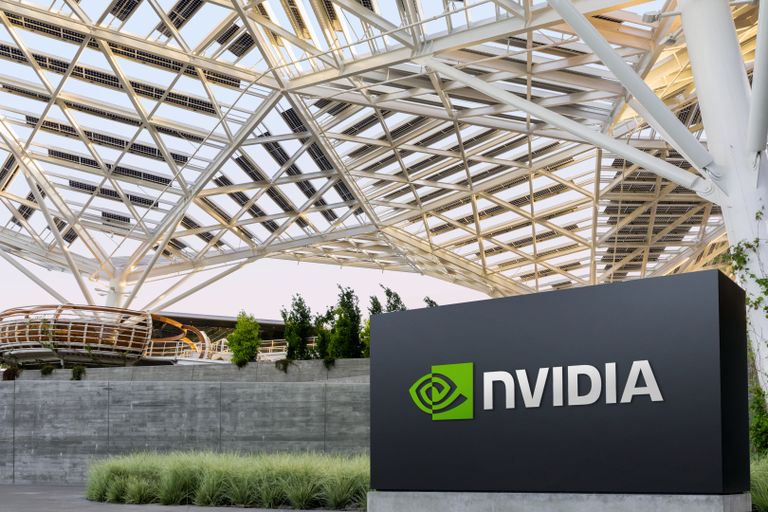
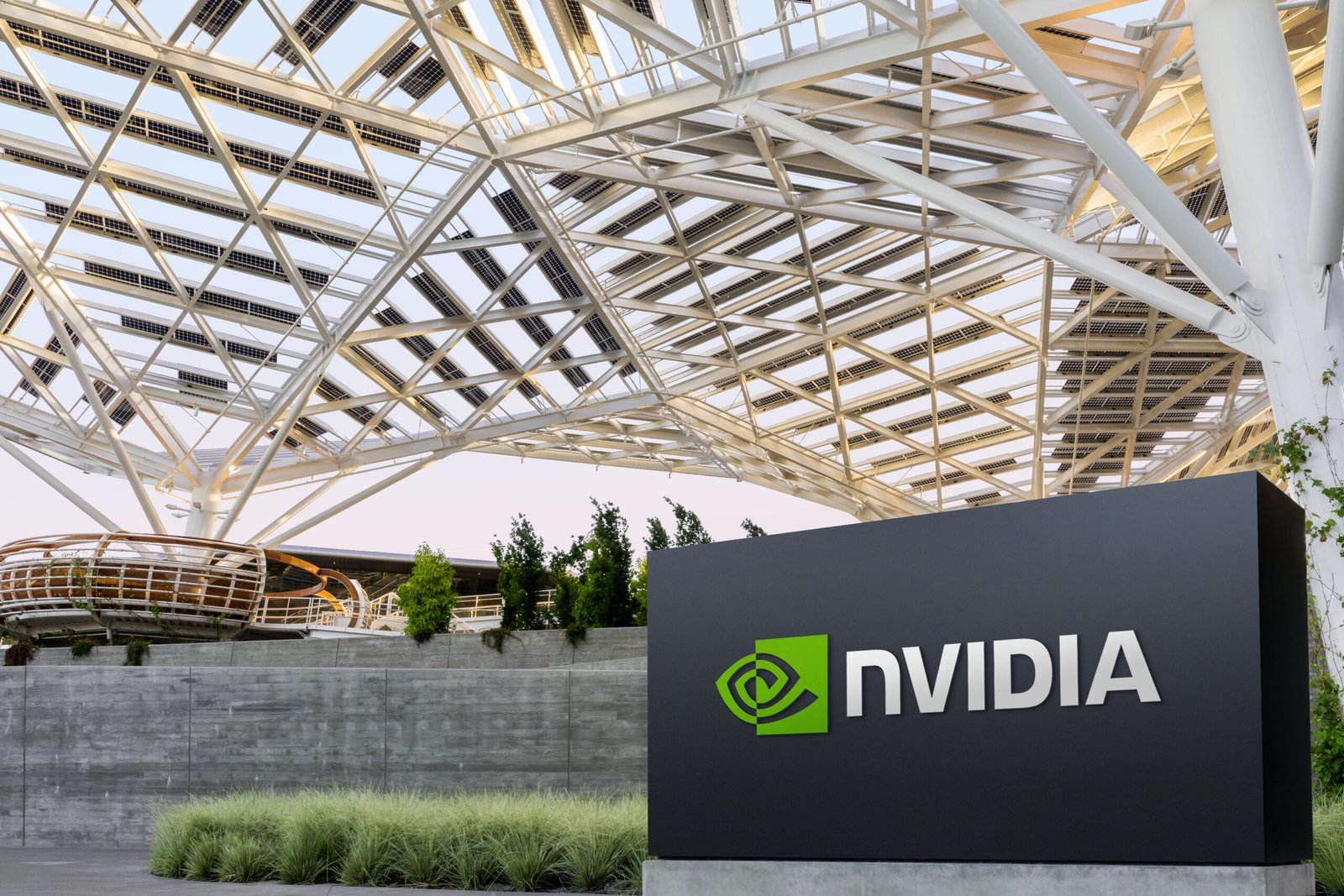
Nvidia Voyager headquarters in Santa Clara, California
On Tuesday’s earnings call, interim CEO Colette Kress argued that none of it has slowed the business. Asked whether Democrats’ takeover of Congress could cool artificial intelligence spending, she said customers had spent the past week asking how to get more chips and that demand will hold “not only in the ’27 perspective, but moving to the ’28 as well.”
As for the turmoil at the top, “from a business perspective, it’s business as usual,” she said.
On the numbers, it was. Nvidia brought in $115.8B in revenue in the three months ending on Oct. 25, double a year earlier and nearly $7B more than Wall Street expected. Data center chips accounted for $107.6B of it. Nvidia expects about $130B this quarter, and Kress raised her forecast for next fiscal year to roughly 75% growth from 70%.
Shares, which closed down 0.4% at $155.46, were up roughly 4% in after-hours trading as of 7 p.m. ET on Tuesday.
In 49 minutes, one of the most anticipated earnings calls in recent memory touched on almost everything that matters to data center owners, developers, lenders and even Washington: whether demand is holding up, which projects Nvidia will help finance, who gets its scarce chips, who will run the company and whether it will keep selling to China.
On China, the answer for now is no. Nvidia has stopped shipping licensed Hopper data center chips there, a business worth $2.4B last quarter, and its outlook assumes no China data center sales.
For commercial real estate, few earnings reports matter more. Nvidia’s chips are the costliest item inside a data center, and the promise of ever more of them has sent developers racing to buy land and lock up power from the New Mexico desert to southern Ohio, a construction boom backed by an estimated $1.3T of debt.
Tuesday’s report was the industry’s first look at whether the engine of the boom keeps running without the man who built it.
By Kress’ account, it does. Nvidia compute “remains fully utilized across every hyperscaler and neocloud we serve,” she said. Hopper chips, now two generations old, are being rerented at up to twice their original price, and the cloud industry’s backlog has grown to $2.5T from $2T three months ago.
The bigger shift was about money. Nvidia hasn’t just sold chips into the boom — it has helped pay for it, with $118B in guarantees outstanding, including $105B for OpenAI’s planned campus at SB Energy’s Ports-Pike site in Ohio.
Kress said it will be “disciplined in how we commit capital” and “disciplined and selective” in backing neoclouds, the younger cloud providers that rent out its chips.
“As the market matures and additional sources of capital become available, we are rigorously evaluating future investments, commitments and guarantees,” she said.
For developers, the fine print matters. Pressed by Bernstein analyst Stacy Rasgon, Kress said Nvidia’s guarantees take effect only once a project is financed, built and ready for chips. If a developer falls behind, “our guarantee doesn’t exist anymore.”
Nvidia, in other words, isn’t taking on construction risk.
When it does help, Kress said, a top priority will be the real estate itself — the land, the power hookup and the building shell that must exist before a single chip arrives. She called that “a great asset for anyone to hold.”
Before Kress said a word, board Chair Harvey Jones closed the door that Huang had cracked open that morning, when the founder said he would be “honored” to return.
The board “does not intend to reinstate Jensen as CEO,” Jones said, and would take no questions “regarding the circumstances of Jensen’s resignation and the ongoing investigation.”
No analyst tried. The board has hired Heidrick & Struggles to find a permanent CEO, but, Jones said, “we won’t expedite the CEO before finding exactly the right person.”
Huang resigned Thursday amid reports of a relationship with a former executive of Singapore data center firm Megaspeed, whom U.S. intelligence suspects of spying for China, and of alleged affairs with Nvidia employees.
The board has since formed a national security and export control oversight committee. Huang is due to give closed-door testimony Dec. 1 to three House committees investigating what they called “a potential breach of our national security.”
The Securities and Exchange Commission is also investigating whether Nvidia’s disclosures misled investors, The Wall Street Journal reported Tuesday, citing people familiar with the matter.
The scandal has already reached data centers.
The U.S. Commerce Department first found Nvidia chips inside a Megaspeed facility in Malaysia, and on Monday, it issued a rule requiring data centers to get a license before renting advanced AI chip capacity to Chinese companies.
Kress said Nvidia is still studying the rule, but “with demand far exceeding supply, we expect our performance to remain strong.”
Lenders are flinching, too. HSBC sold a $300M slice of Project Jupiter’s construction loan at prices in the mid-80s, Bloomberg reported, after Oracle sent the developer a force majeure notice.
By the end, Kress sounded less like a finance chief than a coach rallying her team.
“Our customers and our partners are with us,” she told analysts. “We’ve got this.”