Shift Markets’ Ian McAfee on Prediction Markets for Brokers
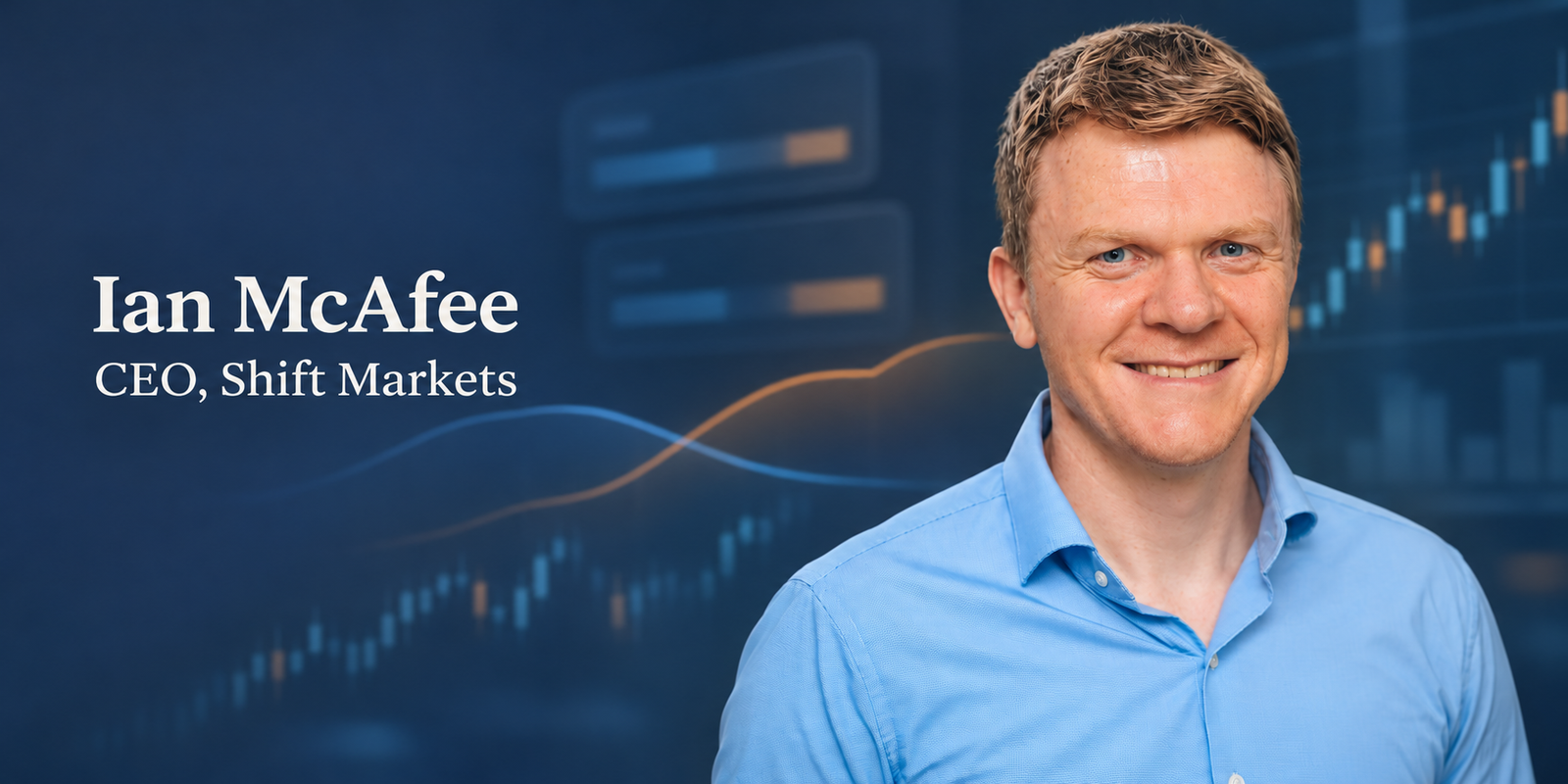
Ian McAfee is co-founder and CEO of Shift Markets, a New York-based trading infrastructure provider founded in 2009 that supplies white-label exchange, brokerage and prediction markets technology to FX brokers, crypto exchanges, iGaming operators and fintechs. In this interview, he explains how established FX and CFD brokers can add event-based markets without rebuilding their core platform.
Q1: What is driving interest in event-based markets among established FX and CFD brokers now?
Their clients are already trading event markets somewhere else, and brokers want that activity back on their own platforms. Brokers competed on coverage for twenty years. Most of that was marketing. On almost any platform the bulk of volume sits in the top five symbols, but traders ask to see a long list before they open an account, so every broker built one. Over the last two years a second race opened, and it is about what clients trade. Prediction markets are the clearest example.
The numbers are hard to argue with. Keyrock and Dune tracked monthly volume at under $100 million in early 2024. It crossed $50 billion this summer, and The Block’s data shows September setting a record with October on pace to beat it. On 27 October, Robinhood reported $173 million of event contract revenue for the third quarter, more than six times the year before, and the product now earns more than its crypto business.
Coinbase and FanDuel with CME launched in the same window, Meta is building its own app, and in July IG Group agreed to pay up to $1.3 billion for Underdog. The smart money is doing it.
Q2: What can a broker add to its existing offering through event-based trading, and where does it differ most from its current products?
An FX or CFD broker can add event contracts, which are markets on real-world outcomes, priced as a yes or no and settled at a fixed value when the event resolves. For the client they sit in the same account as FX, CFDs and crypto, on the login and balance they already use.
The real difference is behavioural. A CFD tracks an underlying price continuously, so activity follows volatility, and what the broker keeps swings with market conditions and hedging. An event contract resolves at a set time, so activity clusters around the event, a match, an election, an economic print, and there is always another one on the calendar.
In IG’s third quarter, revenue was down 14% because IG kept less of what came in after hedging. Underdog, the event business it is acquiring, more than doubled revenue in the same three months. On the operator side, the house position on event contracts runs through a mix of A-book and B-book, which is the risk model brokers already run.
Q3: What parts of an existing brokerage platform can be reused, and what typically needs new integration?
Almost everything carries over. Accounts, onboarding and KYC, balances, funding rails and the back office all stay as they are, and the client trades events from the same login. What needs adding is the markets layer, meaning the pricing and matching engine for event contracts, the settlement logic that pays out when an event closes, and the risk controls for the product.
Keep the traders, license the infrastructure. That’s what we build at Shift, as a module inside the broker’s existing app, so the client sees one product set. Building the layer from scratch is roughly an eighteen-month project. Adding it to a stack that already handles accounts and balances takes under six months.
Q4: What should an operator resolve around risk, settlement and regulation before launch?
Three things, and the fastest operators settle all of them before launch rather than after. Start with risk policy. Decide the house model up front, how much sits in a B-book, the exposure limit per event, and where you hedge. Settlement is next. Every market has to resolve against a clear, defensible outcome at a fixed time, which means a reliable data source and a documented process for the rare disputed case.
Classification varies the most. Event contracts are treated as a financial product in some jurisdictions and closer to gaming in others, so licensing and marketing rules differ by country. We help operators map that, and it still needs local counsel in each market. Someone inside the broker has to own all three.
Q5: Brokers aren’t going to run their own exchange. Where do the markets and liquidity come from?
That is the question we get on almost every call now. By the time a broker calls, they’ve usually settled whether it’s legal in their markets and whether their customers want it. What they lack is a way to do it, or a place to start. A broker should not be building an order book from zero for a product it has never run.
Event contract liquidity behaves like liquidity in every other electronic market. It wants to concentrate in a few deep pools, and distribution wants to scatter across every app that can show a price. When Kalshi onboarded one options market maker in 2024, its book depth went up about thirty times.
The structure that works for a broker is the one FX brokers already know. The platform connects to a small number of upstream sources for markets and prices, routes its flow to them, applies the broker’s own margins and risk limits, and keeps the client on the broker’s platform. The broker owns the customer, the account and the price it shows. It does not own the problem of making markets in every event on the calendar.
At Shift Markets, we connect brokers to prediction market liquidity from Polymarket and other leading venues, delivered as a white-label module inside the broker’s own platform. For operators outside the US, that is the only route that exists, because plugging into a US-regulated venue directly isn’t on the menu.
In practice the connectivity is the easy part. What slows a launch is deciding how much risk the broker carries itself versus passes upstream, and then finding someone inside who has priced an event book before. People who have done this before are in short supply.
Q6: What would you measure in an initial rollout to decide whether the product is working?
Four numbers tell you pretty quickly whether the product is working. Adoption is the share of existing clients who place at least one event trade in the early weeks, and it shows whether the product fits the audience you built. Repeat activity matters more than any launch spike, because event markets live on people coming back, so track trades per active user and the return rate.
House economics means net margin after hedging and revenue per active user, so you know the product pays its way. The wider account is the one I’d watch closest. If clients who trade events also fund more and trade their other products more often, that is where most of the return shows up.
Q7: How do you expect this category to develop over the next year?
I expect event-based trading to become a standard vertical inside the apps brokers and exchanges already run, and faster than most operators are planning for. The category is following the path crypto took for brokers, only compressed. eToro was a CFD broker when it listed bitcoin in 2014, and that decision eventually carried it to a Nasdaq listing.
IG’s Underdog acquisition is the same decision at a hundred times the price, and IG now says more than half of its new customers place their first trade on something other than a CFD. Integration is now a module rather than a separate build, so trying it costs less. Regulated routes exist in more jurisdictions than a year ago, even where the rules are still contested.
Robinhood says non-sports contracts went from 15% of its event trading in the second quarter to about 30% in the third, and IG is launching financial prediction markets for UK professional clients this quarter. What will your customers want to trade next, and will they be able to do it with you?
Brokers looking at event-based markets can request a demo from Shift Markets.