International student enrollment falls, putting U.S. colleges at risk
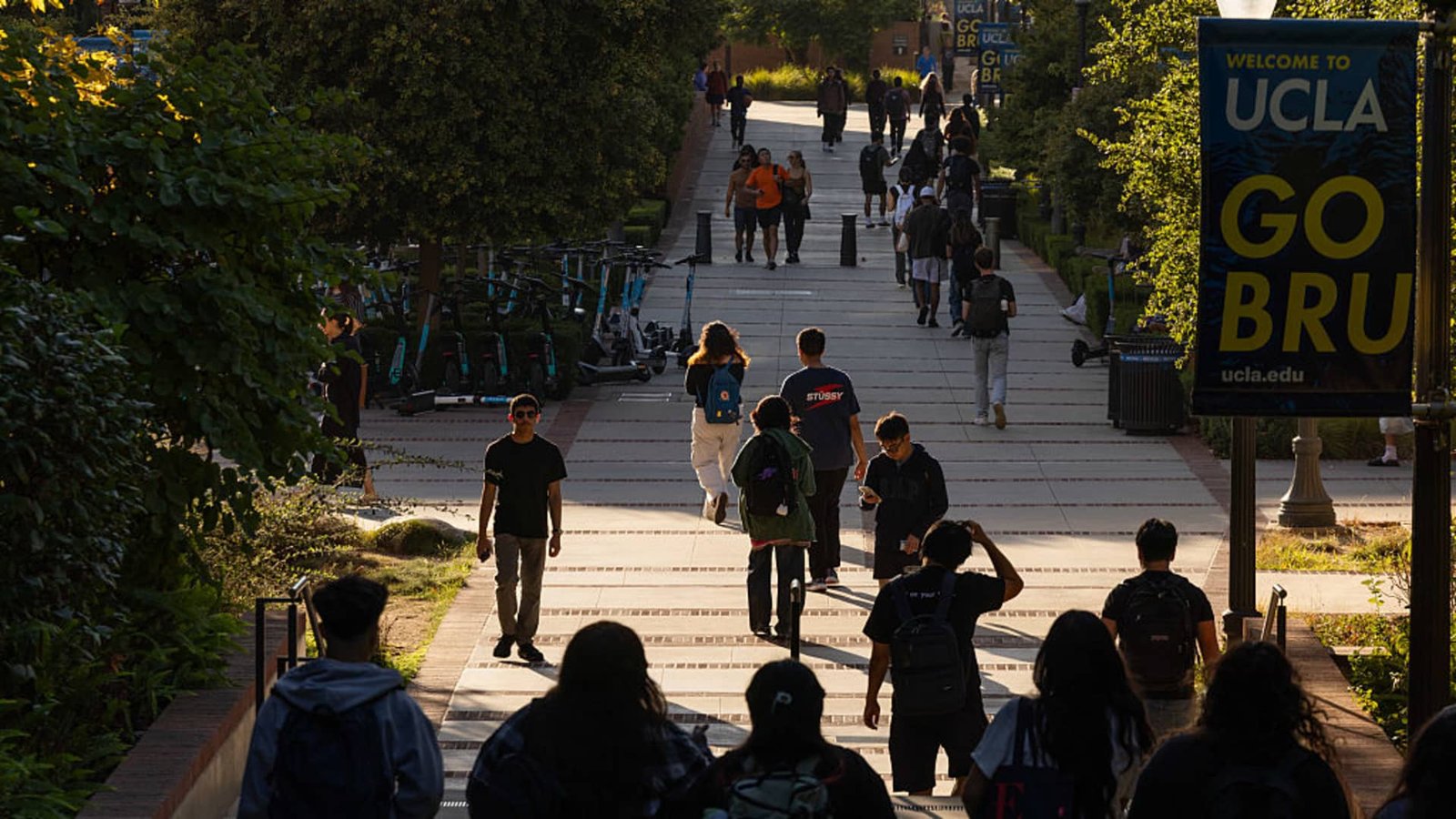
Students walk around the UCLA campus, in Los Angeles, Oct. 7, 2025.
Juliana Yamada | Los Angeles Times | Getty Images
Amid changing visa policies and rising degree costs, significantly fewer new international students enrolled at U.S. colleges this year — a shift that could have financial repercussions for colleges, students and the broader economy.
In the fall 2026 semester, the tally of new international students studying in the U.S. fell 15% compared with the prior academic year, according to a fall snapshot released Monday by the nonprofit Institute of International Education.
Over the 2025-26 academic year, the number of new international students in the U.S. fell more than 17%, largely because fewer graduate students came from countries such as India and China, the IIE’s report found.
A growing number of U.S. colleges said international student recruitment was a top concern, but the report also cited as significant barriers the high cost of a U.S. degree relative to other countries and uncertainty around new rules ending the traditional “duration of status” system and limiting most F-1 and J-1 visas to four years.
Even though the Department of Homeland Security’s new visa restrictions are currently on hold under a federal court injunction, experts say questions about the changing policies may have already discouraged some prospective international students.
“At a time when countries around the world are competing for talent, the United States should be strengthening our ability to attract the best and brightest, not creating new barriers to it,” Fanta Aw, executive director and CEO of NAFSA: Association of International Educators, said in a Sept. 14 statement after a federal court temporarily blocked the Department of Homeland Security’s new visa rules.
Foreign students typically pay full tuition, making international enrollment an important revenue source for colleges and universities, according to Robert Franek, editor-in-chief of The Princeton Review.
With fewer tuition dollars coming in, there are fewer resources for U.S. students, particularly for financial aid, he said: “There are going to be fewer research dollars, fewer scholarship dollars for students here in the states.”
The economic fallout
International students also contributed nearly $40 billion to the U.S. economy during the 2025-26 academic year, according to a NAFSA analysis. This year’s enrollment decline is expected to cost the economy roughly $2.4 billion.
“The data again reflect the harsh reality that the barriers the U.S. government is putting in place to block talented international students are having a real impact,” NAFSA’s Aw said. “All Americans will feel the effects as international students’ tuition payments, local spending, and contributions to U.S. excellence in research and innovation diminish.”
Although the fallout extends well beyond college campuses, other research shows that colleges and the students they serve will bear the brunt of the impact.
An analysis by Fitch Ratings released in August said recent changes to F-1 student visa rules could heighten financial risks for some U.S. colleges and universities, particularly those that rely heavily on students from abroad.
“Sustained drops in new international student enrollment can have outsized revenue effects, as international students often pay full tuition or receive less institutional aid than domestic students,” Fitch analysts said in the report. “Lost revenue is hard to replace quickly.”
Specifically, universities with large graduate and STEM — science, technology, engineering and math — programs, in which time to degree completion can exceed four years, will have a harder time sustaining the enrollment pipeline and “may incur higher costs to address overseas recruitment challenges,” the analysts wrote.
Most international students — 57% — study in STEM fields, according to IIE’s report, so enrollment declines can have an outsized financial impact on schools with large engineering and computer science programs.
Underscoring the importance of those students, 91% of colleges and universities said recruiting international students in STEM fields is now a key priority, according to IIE’s fall snapshot, which was based on a survey of 809 institutions.