What servicers can learn from this year JD Power survey
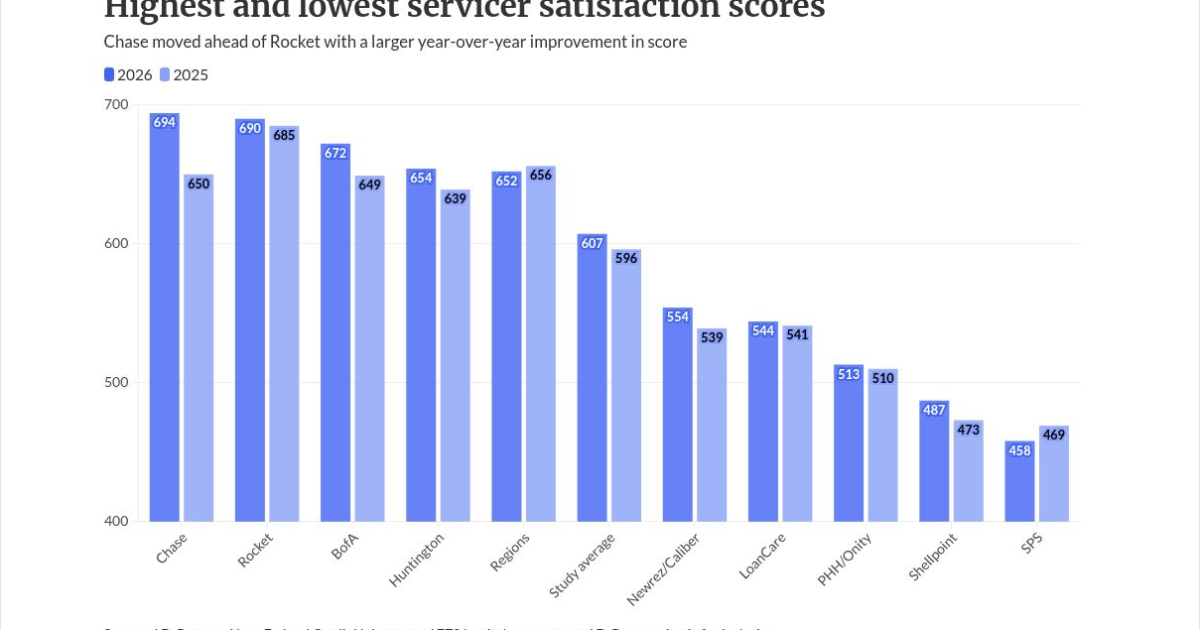
Mortgage servicers posted higher customer satisfaction scores across the board this year, and for the first time, a bank — Chase — edged out Rocket Mortgage for the top spot, according to J.D. Power’s 2026 U.S. Mortgage Servicer Satisfaction Study.
Processing Content
The 2026 industry average of 607 was a gain of 11 points
This year, servicers as a whole saw a rebound in customer satisfaction, with the industry average back to where it was two years ago, said Bruce Gehrke, senior director of lending intelligence at JD Power.
What changed year-over-year
Last year was a bit of an anomaly with
The difference today, “is we’re seeing servicers first of all execute very effectively, I think more effectively than ever in delivering service, in making themselves available to their customers when they need them,” Gehrke said.
They have been investing in technology, so digital interaction is better, self-service capabilities have improved and even the payment technologies are enhanced.
The industry has been focused on building better relationships with their customers and this is seen in the results on recapture potential, he said.
The survey found 86% of consumers “probably will” or “definitely will”
This gives servicers the opportunity to strengthen their retention and recapture efforts, Gehrke said. But they have to earn their customers’ loyalty, which is why what happens on the servicing end is a driver of future lending relationships.
The survey did cover what is holding customers back from seeking a new home, and the response was split almost evenly between the high price of existing properties for sale, and the rising interest rate environment.
Are rates holding people back or has their behavior changed?
With a high percentage of people on the sidelines,
“Is it just interest rates and prices that are holding people back, or has that market sort of changed behavior going forward?” Gehrke asked rhetorically. “I think across the industry a lot of people are interested in that.”
Another reason why servicers need to be proactive is an increase in financial stress, which historically has been a drag on satisfaction.
Borrowers under stress on the rise
The share of borrowers classified by Power as financially healthy fell to 41% this year, from 52% in 2022. Over the same four-year time frame, slightly more borrowers, 16% versus 14% incurred a late payment fee on their mortgage.
Meanwhile 30% of borrowers now believe they are at risk for foreclosure, up from 17% four years ago. It’s not a guarantee, just a perception and thus it is something which is more important for servicers to understand in terms of communications, Gehrke said. The key remains being able to reach customers early and servicers communicating their availability if the borrower gets into financial difficulties.
As
Approximately three-quarters of the servicing customers have an escrow account, with more than half, 58%, experiencing an increase in the T&I portion of their monthly mortgage payment.
Servicers need to give consumers better tools to understand why those costs change. This resonates with the borrowers, he said. Those who currently do so are more likely to earn higher ratings for trust (35 percentage points) as well as get a repeat customer (33 percentage points).
New leading reason for changing servicers
In the past, J.D. Power asked if a customer was able to do, and realizing it is a difficult process, why would they change servicers?
Up until this year, the leading reason was lower mortgage rates. This year for the first time, the top answer was better customer service, Gehrke said. This was cited by 41%, with only 30% responding to lower rates and fees.
It also asked consumers what they would like to see in
The top answer was data security. “It’s our number one single element now.” Gehrke said. “How confident I am that my servicer is protecting my data.”
Next was using AI to find ways to save customer money. Third, was having an AI system in place so the customer can speak to a live person faster when needed. While self-service has been a mantra for satisfaction in the past, “those folks who are picking up the phone really want to talk to somebody,” he said.
This year’s servicer ranking
J.D. Power scored 31 servicers for the list this year, same as last year, with one additional servicer mentioned but not eligible.
Chase, ranked fourth in 2024, had a 694 score this year, or 54 points over the 650 it posted then.
Rocket’s 690 was a 5-point year-over-year increase.
Mr. Cooper, which
This year, it had a 566 score, only 2 points higher than 564 one year ago.
In fact, out of the top 10 servicers, seven are depositories, including four of the first five.
When it comes to the depositories, the relationship is the key. Those borrowers have a greater level of trust with the institutions, and they give the depository a higher score, versus someone who only has a mortgage, he said. Plus, banks invest a lot in their digital interactions across all products, which gives them a bit of an advantage.
Non-banks tend to have a higher percentage of their servicing portfolio coming from outside their origination footprint, which is a negative for satisfaction; Rocket is an exception in this area.
A lender which goes through the whole process, from origination to servicing, is likely to score better than those who bring in loans for their portfolio, he said.
Of the companies involved in
CrossCountry was 20 points lower, to 586 from 606 in the 2025 survey. RoundPoint, at 559 this year, is up from 545 last year.
Cenlar, in the
Remaining at the bottom of the table were Select Portfolio Servicing, with a 458 score (469 in 2025); Shellpoint Mortgage Servicing at 487 (473 a year ago); and PHH/Onity at 513 (versus 510).