Fed’s Goolsbee says AI spending resembles demand shock

Bloomberg News
Processing Content
- Key insight: Federal Reserve Bank of Chicago President Austan Goolsbee, a key vote on the Federal Open Market Committee next year, is making the case for more restrictive monetary policy.
- Expert quote: “This stuff with the AI data center build out is just, to my eyes, starting to look like old fashioned demand overheating where you get inflation coming from — [for example] everyone trying to hire an electrician at the same time and then you start seeing the prices go up.” — Federal Reserve Bank of Chicago President Austan Goolsbee
Many see artificial intelligence as a positive supply shock for the economy that will increase productivity and bring down prices. But one top Federal Reserve official said investment in the technology looks like an entirely different kind of shock.
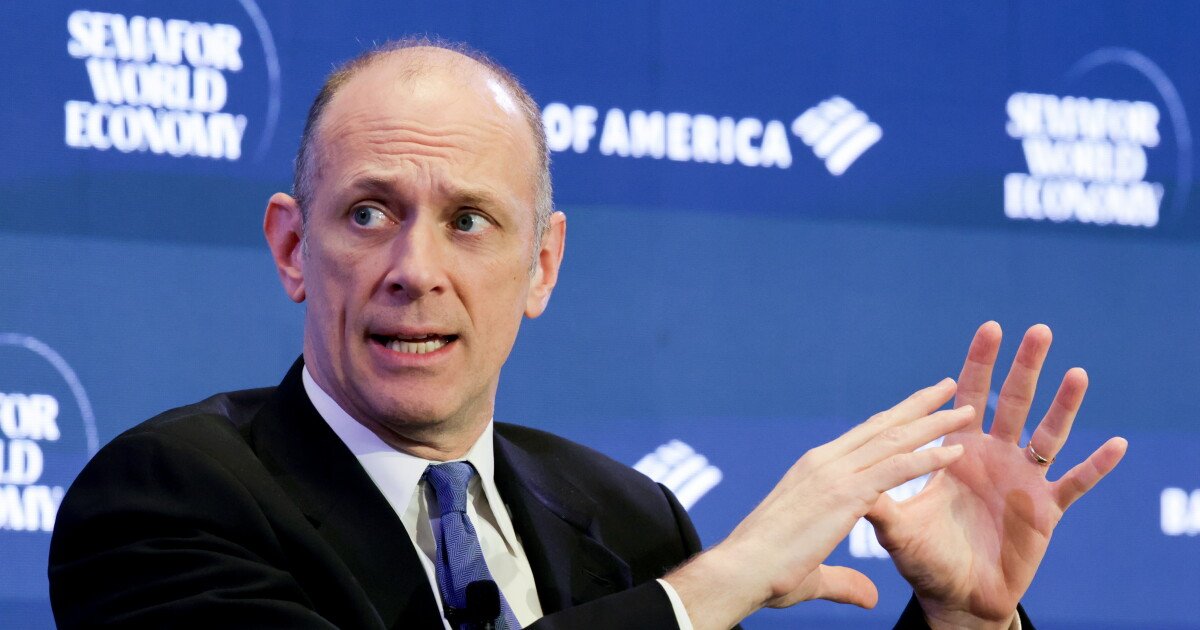
Federal Reserve Bank of Chicago President Austan Goolsbee Monday morning said the AI build-out bears many of the hallmark signs of a demand shock, causing too many resources to chase a limited number of productive uses.
While Goolsbee did not endorse a specific course of action, his
“In the Fed world, the bigger the hype, the more nervous I am that we are going to overheat above what the economy is capable of in the next six months,” Goolsbee said, noting that he frequently hears complaints from the private sector about high costs of land, labor, utilities and raw materials that go into data centers. “That’s the market telling you where the constraints are and the more we’re running into constraints, the more that’s demand overheating and there’s no question what the Fed has to do or what any central bank has to do in a circumstance like that.”
Speaking at an event hosted by the nonprofit Leadership Greater Chicago, Goolsbee said conventional central banking wisdom suggests that supply shocks — be they positive like a sudden decline in energy prices or negative like a trade bottleneck — should be left alone to resolve on their own, while demand shocks should be addressed by changing rates.
Goolsbee noted that the U.S. economy has been hit by multiple supply shocks in recent years, including ever-changing
“It was supposed to have gone away by now, and we’re starting to see inflation kicking up in areas that probably weren’t from oil prices and tariffs, like a bunch of services,” he said. “This stuff with the AI data center build out is just, to my eyes, starting to look like old fashioned demand overheating where you get inflation coming from, [for example], everyone trying to hire an electrician at the same time and then you start seeing the prices go up.”
Goolsbee is not a voting member of the Federal Open Market Committee in 2026, so while he will be part of the discussion during the group’s final monetary policy meeting of the year next month, he will not have an official say over
Another incoming FOMC voter, Richmond Fed President Tom Barkin, also spoke publicly on Monday. He said the combination of a healthy economy with persistently high inflation makes the committee’s course of action “relatively straightforward.”
Yet, Barkin, who spoke at a chamber of commerce event in Greer, South Carolina, also said that he sees AI as a wild card that could shift the balance of the Fed’s attention back to the employment side of its mandate in multiple ways.
“The path of AI feels particularly consequential. If it underdelivers, business investment could pull back, stock prices could follow, and so too could asset-fueled consumer spending,” Barkin said. “The risk runs the other way, too. AI could overdeliver and displace more workers than expected, resulting in a pullback in spending. Either scenario would move attention to the maximum employment part of our mandate.”
Goolsbee said the history of central banking suggests policymakers should respond to demand-side shocks forcefully and promptly, because once they become entrenched in the economy, they become harder to address without causing job losses.
“If you get the economy overheating, the conventional wisdom there is: be aggressive up front to never let the economy overheat because once it gets overheated it’s extremely painful to get rid of that kind of overheating,” he said. “So I think we’ve got to watch out in that space.”
Read more:
The complicating factor, Goolsbee said, is that AI technology could one day lead to disinflation by increasing productivity — the output per hour worked across the entire economy. Yet, he said, the gains from such a boost may have already been priced into stock prices, a development that is only driving more spending by people and companies who feel wealthier.
Consumer spending, Goolsbee said, has been the driving force behind the continued expansion of the U.S. economy, which grew at an annualized rate of 3.4% during the third quarter of this year. At the same time, consumer sentiment about the trajectory of the economy remains pessimistic.
The Federal Reserve Bank of New York’s latest monthly Survey of Consumer Expectations, released on Monday, shows participants expect prices will rise 3.9% over the next year — nearly double the Fed’s 2% target — while wages increase by only 2.6%. Respondents also expressed a greater concern about losing their job during the next 12 months, with the mean expectation of unemployment in the year ahead rising to 45.3%, the highest reading since April 2020.
During his remarks, Goolsbee said dour consumer sentiment has long been linked to changes in gas and grocery prices but, over time, it has become less indicative of actual economic declines.
“There’s been a break between consumer sentiment and consumer behavior which is not just in the last three to five years, but has gotten the most extreme it’s ever been in the last three to five years,” he said. “It used to be that if consumer sentiment plunged, it meant in very rapid order that consumer spending was going to plunge. Consumer sentiment has been in the toilet now for a long time and consumer spending has been the main driver of growth in the economy.”