Nifty Smallcap index saw over 20% intra-year declines in 12 of 20 years: What history reveals about timing the market
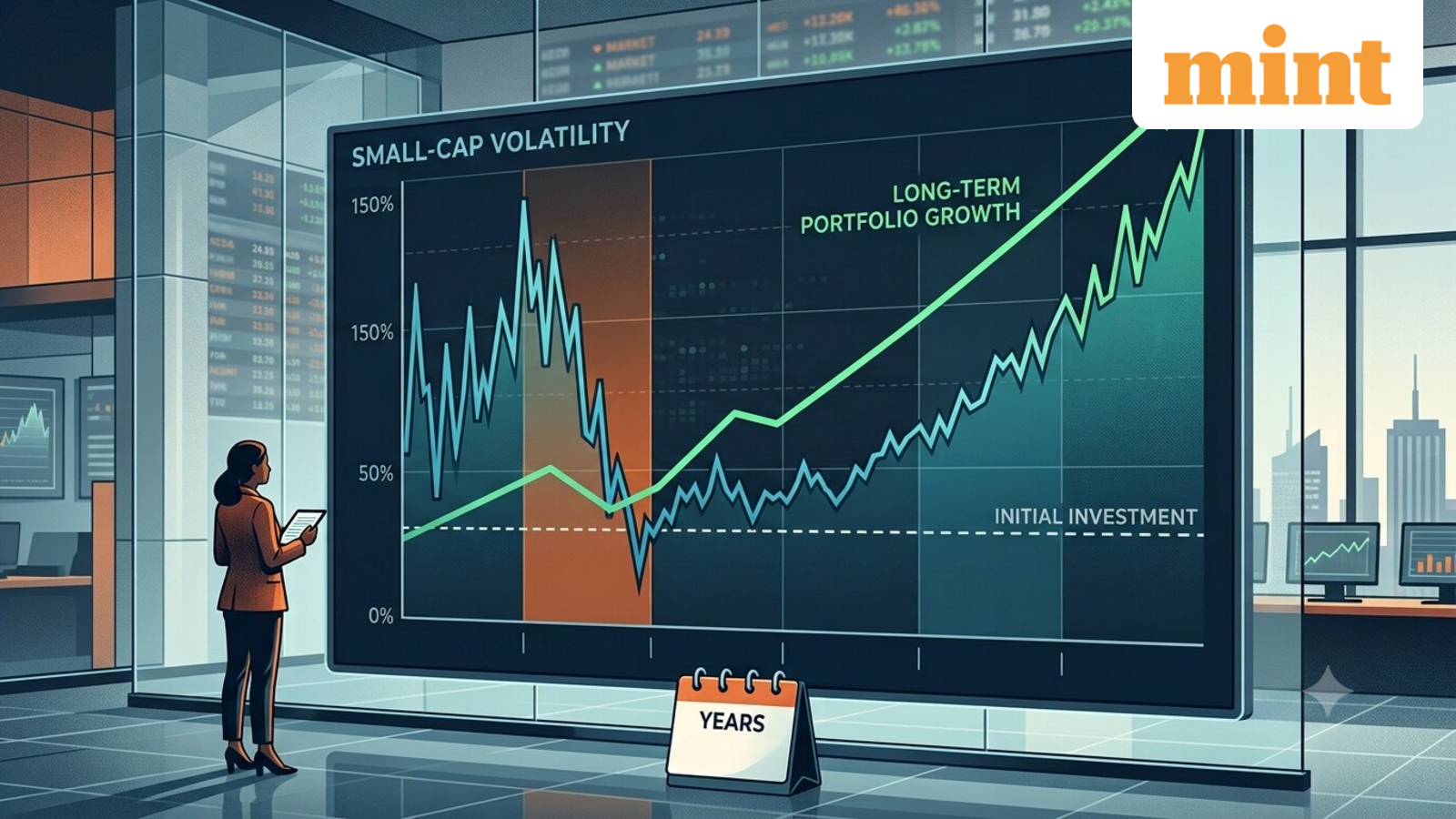
Small-cap investing is often associated with higher return potential, but it also comes with much sharper and more frequent declines than large-cap investing.
A new study by DSP Mutual Fund highlights this trade-off, showing that steep corrections have been a recurring feature of the Nifty Smallcap 250 Total Return Index (TRI) as compared to the Nifty 50 TRI.
The study highlights that while market corrections can be unsettling, the eventual outcome for long-term investors has historically depended less on market timing and more on remaining invested through periods of volatility.
Sharp corrections have been common in small caps
Sharp corrections have been far more frequent in the small-cap universe than among large-cap stocks over the last 20 calendar years (2005–2025).
In 12 of the last 20 calendar years, the Nifty Smallcap 250 TRI recorded an intra-year decline of more than 20%, measured from its highest point to its lowest point during the same calendar year. This means that the index has experienced such sharp falls almost once every two years.
However, the Nifty 50 TRI, which tracks India’s 50 largest listed companies by market capitalization, experienced similar declines in only four of the20 calendar years.
| Index | No. of years with 20%+ intra-year drawdowns | Roughly |
| Nifty 50 TRI | 4 | Once every 5 years |
| Nifty Smallcap 250 TRI | 12 | Once every 2 years |
*Source: DSP Mutual Fund; Data as on 31 March, 2026; Based on intra-year peak-to-trough drawdowns in 2005 to 2025, not calendar-year returns
Market timing had a big impact on returns
The study illustrates that the final value of a ₹1 lakh investment in the Nifty Smallcap 250 TRI varied considerably depending solely on when the investment was made.
| Investment entry point | ₹1 lakh became | CAGR |
| Just before the 2008 financial crisis | ~ ₹4.3 lakh | ~8% |
| At the 2008 market bottom | ~ ₹17.7 lakh | ~18% |
| Before the Covid-19 correction (Jan 2020) | ~ ₹2.9 lakh | ~19% |
| At the Covid-19 market bottom (Mar 2020) | ~ ₹5 lakh | ~31% |
| 10-year SIP | — | ~16% |
*Source: DSP Mutual Fund; CAGR from each entry point to 31 March 2026; 10-Year SIP return shown is the median SIP return over 10-year periods since inception of Nifty Smallcap 250 TRI
The investment outcomes in the Nifty Smallcap 250 TRI varied significantly depending on the entry point, even when the investment amount was the same.
For example, an investment of ₹1 lakh made just before the 2008 global financial crisis would have grown to around ₹4.3 lakh by March 2026, translating into an annualized return of about 8%.
However, investing the same amount at the market bottom during the 2008 crash would have resulted in a corpus of nearly ₹17.7 lakh by March 2026, with an annualized return of around 18%.
A similar pattern emerged during the COVID-19 market correction. ₹1 lakh invested in January 2020 would have grown to about ₹2.9 lakh by March 2026.
However, the same investment made at the March 2020 market bottom would have become approximately ₹5 lakh by March 2026.
A 10-year SIP in the Nifty Smallcap 250 TRI delivered a median annualized return of around 16% across all rolling 10-year periods since the index’s inception.
While one-time investments can produce very different outcomes depending on market timing, systematic investing reduces the dependence on getting the entry point exactly right by spreading investments across different market cycles.
Disclaimer: This is purely for educational/ informational purposes and should not be taken as any sort of investment advice. Always consult a SEBI-registered advisor before making any investment decisions.