How New Jersey’s First Bank approaches new payments tech
- Key insight: New Jersey’s First Bank taking a more hands-on personal relationship approach to retain small business customers.
- Forward look: The bank is considering new tools such as advanced AI as its clients’ needs evolve.
As
Processing Content
“We have to make sure we’re not making things inconvenient for [customers],” First Bank President and CEO Patrick Ryan told American Banker. “But we’re not trying to win on bells and whistles.”First Bank has made it easier for its mostly small business clients to access digital services, but it’s not diving headlong into the cutting edge, taking a more traditional approach at a time when many large banks are spending more money on AI, digital assets and real-time payments than First Bank’s total size.
“There’s a segment of small businesses that are making their decision based on relationships more than tech,” Ryan said. “Our customers are a little bit older so we’re relying on those connections.”
In the neighborhood
Ryan helped found the Hamilton, N.J.-based bank in 2007. First Bank has $4.05 billion in assets, up 0.5% from 2025, making it the 11th largest of the 49 banks headquartered in New Jersey. It has branches in the Philadelphia suburbs in New Jersey and Pennsylvania, and has a presence in Florida. The bank has $3.32 billion in deposits, up 4.9% from 2025; and $3.33 billion in loans, up 1.1%.
The majority of the bank’s business is with small companies in its footprint. In its marketing materials, it

First Bank
“If we have done a good job building quality relationships, nobody will jump quickly for another bank or a fintech,” Ryan said.
In an effort to stay relevant, First Bank has added AI tools to make it easier for customers to sign up for online banking, or to apply for loans, so “they don’t need to come into a branch,” Ryan said.
The bank also recently added new middleware from Cordex to augment its core banking technology from Fiserv. This enables First Bank to embrace embedded payments, and to eventually add more digital payments and e-commerce options that are available through fintechs.
The bank is additionally preparing its payment systems to support FedNow and the Clearing House’s real-time payment rails. I’s well behind the typical adoption pace for FedNow and the RTP network, but Ryan said client demand for these options among its users is still evolving, so there’s no rush. “Being a fast follower is a prudent strategy,” Ryan said. “Some of these changes will become table stakes.” First Bank is also still learning about agentic AI, and has a strategy—though Ryan said that its small business client base does not have an appetite for the new form of AI right now. “This is one of the areas where we want to make sure our customers really want this before we move,” Ryan said.
Small bank challenges
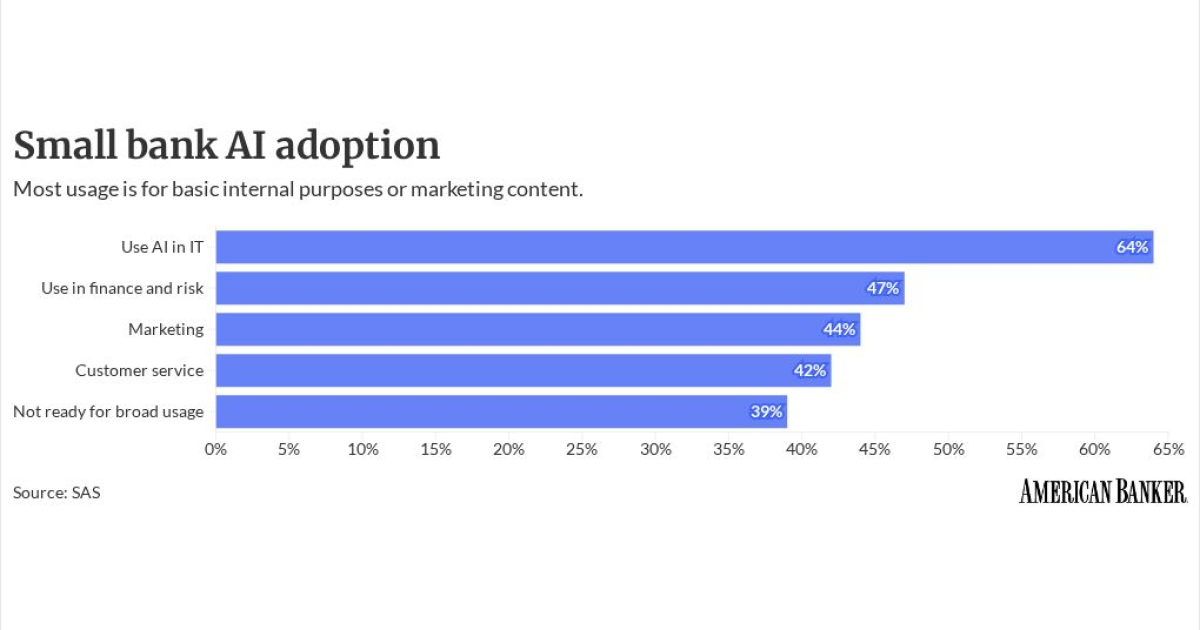
Ryan is not alone among small banks that are choosing their spots when it comes to new payments and banking technology. Small financial institutions are using AI, for example, but in a very limited way. Sixty-four percent of small financial institutions use AI in IT, compared with 47% in finance and risk, 44% in marketing, 42% in customer service and 39% in product development, according to a survey IDC conducted on behalf of
Shawn Main, executive vice president and chief business architect for the $5.4 billion-asset Vantage Bank, made his case for collaboration among small banks and credit unions at
Along with Custodia Bank, Vantage Bank is one of the partners that developed
Elizabeth Gujral, a director at Cornerstone Advisors and co-author of the report: Speed Is a Revenue Strategy: How AI Agents Accelerate Bank Marketing, commissioned by Persado, said that while AI has made it easy to produce content quickly, there’s still a compliance burden.
“At one $3 billion-asset institution we worked with, a single person supported marketing reviews on top of other compliance duties,” Gujral said. “A larger bank can staff that queue. A smaller one can’t, so faster content creation mostly means a longer backlog. An agent that acts on a customer’s signal in real time only helps if review keeps pace.”
Read more:
Data connectivity is also a challenge, Gujral said that one $3 billion credit union Cornerstone interviewed spent eight months connecting its analytics platform to core data and its marketing system before it could run a handful of always-on campaigns. “Smaller institutions have fewer people to do that integration work,” Gujral said.
However, there is one advantage smaller financials have. They can restructure staff faster than a large bank can, according to Gujral.
“One marketing leader we spoke with is embedding a compliance team member inside marketing so campaigns are shaped before they reach formal review,” she said.