Why cyber readiness could become the next muni credit differentiator
| Thesis: Infrastructure creditworthiness is evolving beyond traditional financial metrics, placing greater emphasis on cybersecurity readiness, disclosure transparency, AI implementation and operational adaptability. |
| Observation: As infrastructure demands become more complex and technology-dependent, an issuer’s ability to manage emerging risks, communicate effectively and demonstrate institutional preparedness is becoming an increasingly important source of differentiation |
| Call to action: Municipal stakeholders should elevate cybersecurity, modernize disclosure practices, responsibly integrate AI and establish measurable benchmarks that demonstrate operational resilience, distinguish stronger credits and identify areas for mispricing in an increasingly competitive market. |
The Bond Buyer’s Market Intelligence team fielded its annual infrastructure survey between Aug. 21 and Sept. 8, 2026. Responses were received from 109 municipal finance industry professionals, addressing wide-ranging themes, concerns and expectations evolving across the municipal infrastructure landscape.
Processing Content
Survey questions were designed to capture candid responses to cybersecurity preparedness, AI data center expansion with cost allocations and capital planning, future issuance activity, credit implications and risk mispricing.
Our third installment focuses on the issuer. Quite possibly, the next generation of infrastructure credit differentiation may be determined not simply by what an issuer owns or finances, but by how effectively it anticipates risk, deploys technology and communicates its capacity to withstand disruption.
Infrastructure assets lack adequate cyber protection: Risk assessment and capital planning play a critical role in infrastructure financing. Cyber threats are identified as a leading industry risk.
Top of mind for muni stakeholders are the deficiencies surrounding cyber-threat preparedness. These commonly identified pain points are routinely discussed at industry conferences and other forums. In my
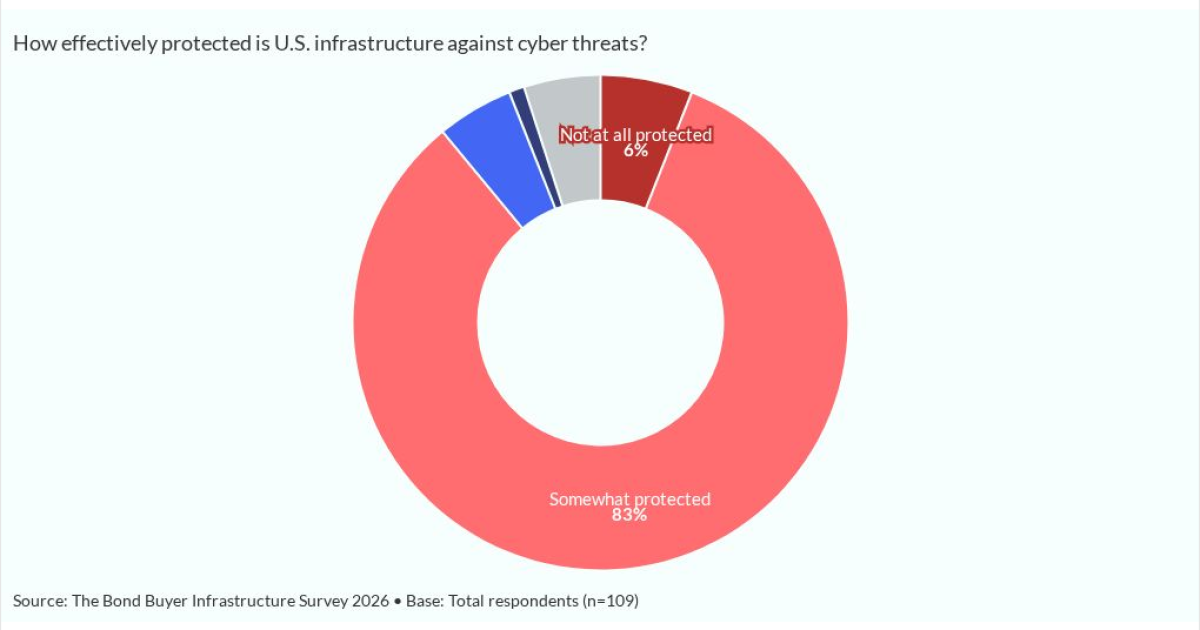
Survey respondents validated the lack of suitable protection against cyber attacks with 89% saying U.S. infrastructure is no better than somewhat protected against cyber threats, and only 6% labeling it well protected or better. Interestingly, survey results reveal issuers have the closest correlation to aggregate responses in terms of positing U.S. infrastructure is no better than somewhat protected against cyber threats (90%) and only 6% of issuers feel the nation’s infrastructure is well protected or better. Unsurprisingly, buyside cohorts tend to be more circumspect as they see 96% of U.S. infrastructure no better than somewhat protected against cyber threats, and zero percent well protected.
The survey queried stakeholder cyber concerns across key infrastructure sectors. While every public infrastructure sector is rated a high cyber risk, water and wastewater was identified as the highest cyber-risk sector with healthcare and public power sectors close behind. Airports and mass transit facilities, and state and local governments followed, with higher education identified as the sector least vulnerable to cyber-risk.
Not all issuers are seen as sophisticated and employing the most state-of-the-art cyber-prevention infrastructure and protocols. In fact, I would argue most issuers are ill-prepared to both plan for and respond to cyberattacks, leaving themselves vulnerable to potential litigation, elevated borrowing costs and reduced capital market access. This is particularly relevant for conduit issuers. The fragmented nature of the municipal market — having many issuer types and non-uniform state and local statutes, laws and regulations — can be challenging for technological integration.
Cyber security concerns are a growing part of the investment narrative and will only intensify across municipal governments and their enterprise units. The risks to municipal credits are rising, especially where cyberattacks are fueled by financial gain. Rating agencies have included cybersecurity attack and preparedness factors into their overall risk assessment, and certain sectors are more closely linked to national security interests than others.
Better issuer disclosure needed
Despite recognition as a broad industry threat, cyber-risk disclosure is inadequate. The Bond Buyer’s infrastructure survey shows 76% of respondents call upon issuers with a strong to urgent need to improve their secondary market cyber-related disclosure.
Two-thirds of pollees indicated a strong to urgent need to improve disclosure for asset condition assessments and deferred maintenance. Climate vulnerability and adaptation plans and capital improvement programs received a better-than-50% endorsement for a strong to urgent need for enhanced disclosure.
Cyberthreats represent a long-term challenge to issuers and cyberattack preparedness should be top of mind in every conversation with issuer clients, and must be part of the overall credit discussion with rating agencies.
Investors should not be complacent regarding operational and disclosure standards surrounding cybersecurity. Accepting anything less exposes retail and institutional portfolios to valuation losses, liquidity erosion and even debt service disruption.
In my opinion, cybersecurity planning must be ongoing, with recognition that a cyberattack can occur at any time. Issuers must be vigilant and stand at a high state of alert. If I were a municipal advisor, I would pose this question to an issuer: “In the event of a cyberattack are you prepared to maintain operations and meet debt service obligations?”
State and local governments and their enterprise units attract cyberattacks given the potential population reach and financial harm. A hospital system, for example, warehouses sensitive patient information that could be a target, or perhaps there is a desire to collapse billing, scheduling, diagnostic, supply chain or life-saving surgical activities. Specifically targeted cyberattacks could prevent the timely payment of debt service on different types of bonds.
Most issuers are responsible for confidential or classified data for taxpayer records and should have appropriate systems in place to guard against a potential cyberattack. A bond sale can be targeted, as active communication is shared among deal team participants and funds are often moved around throughout the process. A breach of confidentiality and corporate emails could expose the transaction to fraudulent wire instructions.
Artificial intelligence is expected to be accretive to the near-term credit process. When asked to what degree will AI predictive modeling enhance infrastructure credit analysis, 53% of the respondents believe AI will have a material impact.
AI will impact all aspects of the economy, touching virtually every business vertical, and reshaping and differentiating the views currently held by many public finance stakeholders. The dynamics of AI require innovation, a process that will continue to evolve.
Given that the muni market is backdropped by a number of inefficiencies — not the least of which is the range of over 50,000 issuers — integrating AI into best practices will be challenging given the associated costs, the need for learning tools, the overall selection and management of the data, the importance of preserving market competitiveness, efficiency and risk mitigation, and expectations for enhanced regulatory oversight.
For market stakeholders, the question is “how will we take all of this data and assimilate it into something that is far more analytically powerful?” I see AI having a significant impact upon many sectors of the muni bond market, particularly surface transportation, higher education, healthcare and airports.
Moving forward, better clarity as to the types of roles issuers will play in developing AI infrastructure and just how much capital market access would be required should emerge. As I see it, AI is a nascent concept in terms of muni market engagement, yet I expect to see a quickly expanding narrative.
Risk mispricing and issuer differentiation show some counterintuitive results
Cyber risk is a leading investment risk, yet such risk is visibly underpriced by the market. The survey asked stakeholders to rank various infrastructure risks based on how consistently they are underpriced by the municipal bond market. Seventy-three percent of respondents assigned cybersecurity preparedness to the top three risk tiers having the most consistent underpricing. Climate/resiliency costs and deferred maintenance are also materially underpriced according to the pollees.
Interestingly, the survey shows that deferred maintenance is the second ranked macro trend expected to generate the heaviest activity of municipal infrastructure debt issuance over the next one to three years. This suggests that deferred maintenance is identified as being underfunded, with implications as a financial liability and for exposing system vulnerabilities. As previously mentioned, stakeholders are calling for better disclosure surrounding deferred maintenance.
Staying with the cyber sentiment, the survey asked participants to rank certain factors in terms of their ability to drive issuer differentiation across the municipal infrastructure ecosystem. Only about one-third of respondents placed cyberthreat readiness in the top three tiers of key factors for issuer differentiation. In my view, cyber-readiness needs to evolve to a higher ranking in terms of its position as an issuer differentiator.
This amplifies other poll results showing a narrow correlation between perceived risk of cyber preparedness and actual market distinctions. Cyberthreat readiness significantly trailed capital planning discipline and execution track record (89%), adoption of best-in-class infrastructure asset management practices (80%), and disclosure transparency, data integrity and reporting (71%) as an issuer differentiator. While AI-driven analytics is seen as a credit process differentiator, it ranks last as an issuer differentiator.