Forgiveness or permission? Why businesses need to know about the Voluntary Classification Settlement Program
With a gutted workforce, reduced enforcement funds, an ever-expanding tax gap and mounting deficits, the IRS still needs to collect revenue, and it will look first for low hanging fruit. Worker classification is a prime candidate.
Processing Content
Treating workers as independent contractors rather than employees shifts responsibility for Social Security and Medicare taxes from the business to the worker, eliminates withholding obligations and reduces payroll administration. However, those savings are also why the IRS scrutinizes this issue and directs valuable resources to determine if a business’s independent contractor classifications are proper. For tax advisors and accountants, the question is not only whether a client’s classifications are correct, but how the client defends those classifications, or resolves them efficiently before or during an IRS audit.
What triggers an employment tax audit
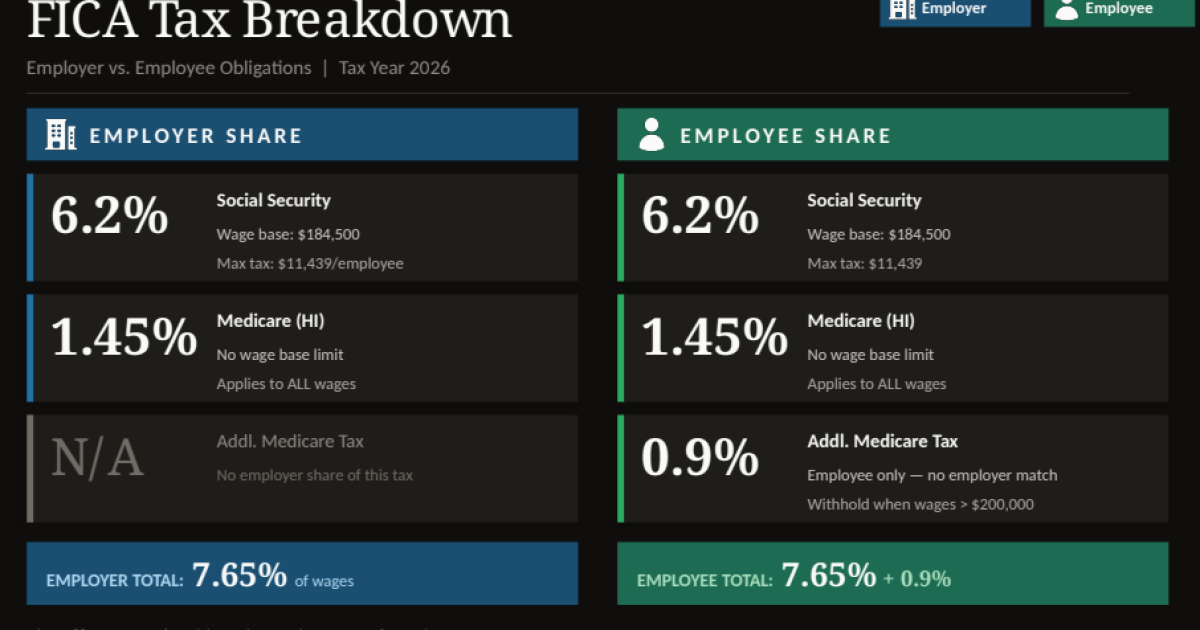
Employers must withhold and remit FICA taxes (Social Security and Medicare) and federal income tax, report them quarterly on Form 941, and deposit them on a schedule tied to payroll size. Penalties and interest begin accruing the moment a deposit or filing is late. In contrast, a business paying an independent contractor who is properly classified as such generally needs only to issue a Form 1099-NEC while the worker pays self-employment tax. The temptation for cash-strapped or new businesses to treat everyone as a contractor is real, and the IRS knows it — presenting significant risks to businesses.

Common red flags that can trigger IRS scrutiny include information-return mismatches, such as large payments reported on Forms 1099 relative to modest W-2 wages, or an individual receiving both a W-2 and a 1099 for the same tax year. Industry targeting is another trigger: Where employee labor is the norm, independent contractor classification invites a closer look from the IRS.
Many audits start with the workers themselves. An independent contractor who files Form SS-8 requesting a status determination, or a Form 8919 submission by an independent contractor refusing to pay self-employment tax effectively flags the business for IRS review. So does a former independent contractor who applies for unemployment benefits or workers’ compensation — benefits that are typically only available to employees — since state agencies often share information with the IRS. Fair Labor Standards Act claims by plaintiffs’ attorneys who stand to collect fees for misclassification and Department of Labor investigations can also lead to an IRS referral. Finally, an income tax examination can expand into employment tax, and a business that did not comply with prior audit results is a natural target.
Once an audit begins, a business with questioned classifications has three principal defenses:
(1) the common law test;
(2) Section 530 relief; or
(3) the Classification Settlement Program
Before an audit, businesses have a fourth, proactive option: the
Defense 1: the common law test
FICA defines the term “employee” to include: (1) corporate officers, (2) common law employees, (3) certain “statutory employees” and (4) state and local government officials.
For most businesses, the issue is whether workers are common law employees, which depends on the facts and circumstances. Many look to the 20-factor test of Rev. Rul. 87-41. The Supreme Court in Nationwide Mut. Ins. Co. v. Darden, 503 US 318 (1992) cited the 20-factor test with approval. The test isn’t exhaustive but provides a good framework,
(1) behavioral control, (2) financial control and (3) relationship of the parties.
Behavioral control. Does the business dictate when, where and how the work is performed? A contractor typically controls the means and methods and is judged on the finished product.
Financial control. Does the worker have a significant investment in tools or facilities, the opportunity for profit or loss, and the freedom to offer their services to others? Flat-fee or project-based pay rather than hourly wages also supports contractor status.
Relationship of the parties. How do the parties perceive their relationship? Written contracts, the absence of benefits, the expected duration of the engagement, and whether the services are a key aspect of the business’ regular operations all bear on this category. A contract label alone is not enough, but it can provide evidence of intent. Frequently, though, it’s all the facts and circumstances that will drive the analysis, irrespective of the description of the relationship on paper.

Because the common law inquiry is highly fact-specific and considers all of the relevant facts and circumstances, any genuine dispute about classification requires weighing the evidence and the hazards of litigation. That is, the IRS must analyze the business’s likelihood of success if it litigated a classification dispute before the relevant U.S. Court of Appeals. Unfortunately, revenue agents lack authority to settle a classification dispute by reference to the hazards of litigation. The business must instead file a protest with the IRS Independent Office of Appeals or await a Notice of Determination and then file a petition challenging that determination in Tax Court. That is why Section 530 is often the faster path to relief.
Defense 2: Section 530 relief
Section 530 of the Revenue Act of 1978 (Pub. L. No. 95-600, 92 Stat. 2763 et. Seq.) is not part of the Internal Revenue Code, but it is one of the most powerful tools in an employment tax controversy. Section 530 provides safe harbors that protect businesses from having to reclassify workers as employees. To be eligible for Section 530 relief the business must meet three requirements:
- Filing consistency. The business must have timely filed all required federal tax returns, including Forms 1099, consistent with the non-employee treatment;
- Substantive consistency. The business must have treated the worker, and any workers holding substantially similar positions, as non-employees; and
- Reasonable basis. The business must have had a reasonable basis for not treating the workers as employees.
Any reasonable basis for contractor treatment will suffice including, but not limited to, published rulings, judicial precedent, or industry practice. A copy of Section 530 and all amendments is attached to
One amendment, Section 530(d), excluded technical services workers such as engineers, computer programmers, systems analysts and similar skilled workers from safe harbor relief.
Another amendment, Section 530(e), reinforced protections for businesses by requiring the IRS to provide businesses under audit with IRS
Defense 3: The Classification Settlement Program
Once an audit is initiated, the business receives notice of the audit and should receive information about the Section 530 safe harbors. If the safe harbors apply, the worker classification issue ends there. If not, the outcome of the audit turns on the employer’s level of compliance, which dictates whether reduced rates are available under Section 3509(a) or (b). Although the Voluntary Classification Settlement Program discussed below is unavailable during an audit, the Classification Settlement Program outlined at Internal Revenue Manual
If the business filed all Forms 1099 and reasonably believed Section 530 applied, but for some reason it does not, the business may get reduced employment tax rates under Section 3509(a). If the business failed to file all Forms 1099, the higher (though still reduced) employment tax rates of Section 3509(b) apply. If the misclassification was intentional, Section 3509 does not apply at all. Worst of all, the audit could reach every open year — that is, years not closed due to the statute of limitations — and unlike the VCSP, the taxpayer will still owe penalties and interest on all open-year deficiencies.
If the IRS and taxpayer do not agree at the end of the audit, the IRS will issue a Notice of Determination, which the taxpayer can challenge in the United States Tax Court.
The Voluntary Classification Settlement Program
The VCSP proves that sometimes it’s easier to ask for forgiveness than permission. The three defenses above are reactive; they come into play only after the IRS opens an audit. The VCSP is different. It is only available before an audit begins.
The VCSP is for businesses that may have treated workers incorrectly in the past, including those that cannot meet the common law test or Section 530, and that want to correct the problem going forward. The VCSP’s benefits include:
- Paying only 10% of the employment tax liability due on worker compensation that would have been due for the most current year calculated using reduced rates under Section 3509(a);
- No interest or penalties on the VCSP payment;
- The IRS will not audit earlier years that are still open under the statute of limitation; and
- The business is assessed only on the most recent tax year’s compensation and thereafter treats the reclassified workers (and all workers in the same class) as employees.
VCSP eligibility requirements are outlined in the Internal Revenue Manual at
To apply for the VCSP, the business must file
What happens in practice
Of course, some employers prefer to do nothing at all — to simply wait and see whether a worker classification issue ever surfaces. For those with a strong argument that their workers are common law employees, or for those businesses that already meet the Section 530 safe harbors, the passive approach may hold up. But for businesses that know they are treating employees as independent contractors and are simply hoping to avoid the cost of treating them as an employee, the strategy amounts to playing the audit lottery — and the consequences for those who lose are far steeper than the cost of getting it right before any audit.
The VCSP is a known, manageable cost for businesses that want to avoid being picked off as low-hanging fruit. Back tax owed is limited to just 10% of the amount that would otherwise be due under the reduced rates of Section 3509, and the employer does not need to satisfy any of the Section 530 requirements to qualify. Most importantly, the business will owe no interest and no penalties. Compare that with the uncertainty of an IRS audit.
Advisors that are uncertain whether a business’s workers would qualify as contractors under the common law test or Section 530 should give serious consideration to the VCSP. The alternative for noncompliant businesses is higher tax rates, audits spanning multiple open tax years, and interest and penalties. Business owners and their advisors should review worker classification issues now. Once an audit starts, the options narrow considerably. The best time to evaluate the VCSP is before the IRS knocks on the door.