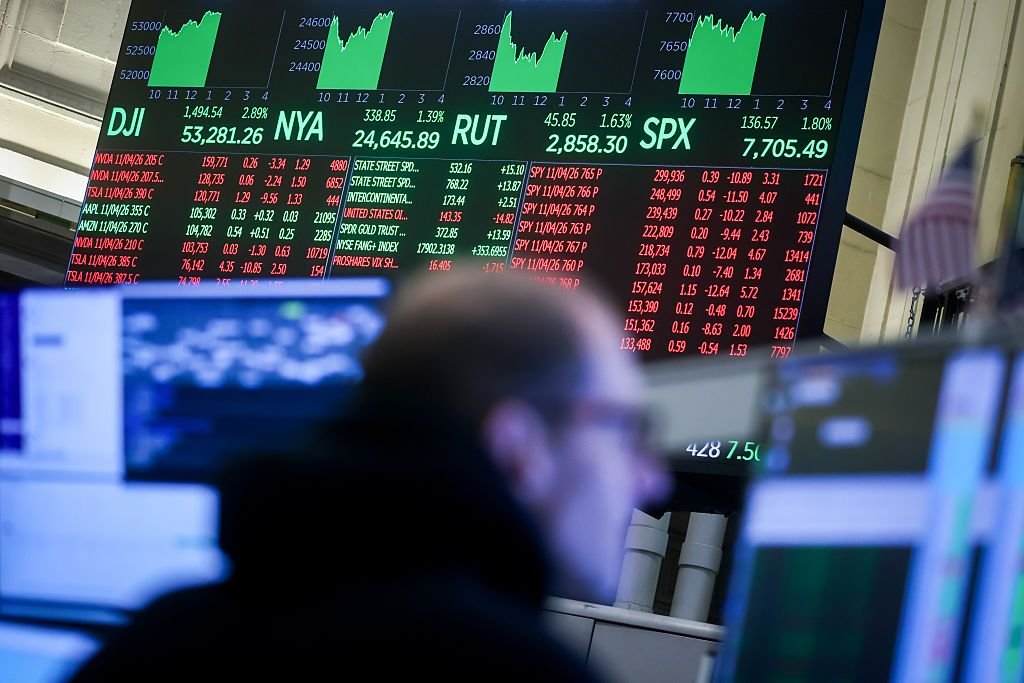
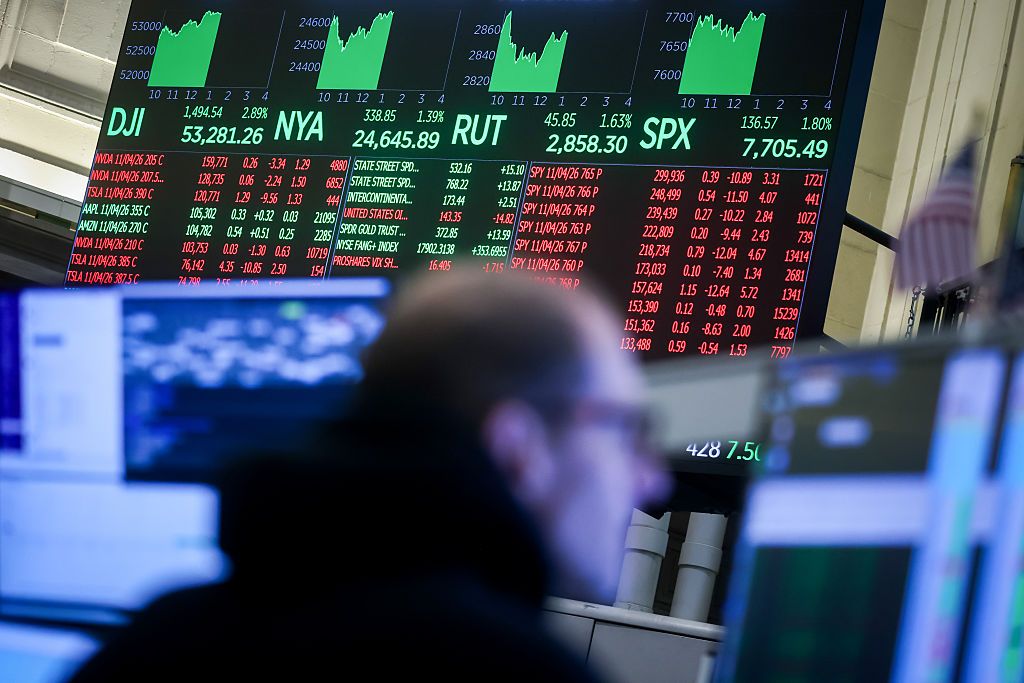
Despair in Asia over the Democrats’ sweep of the US Congress turned into cautious bullishness as Wall Street woke up on Wednesday. Investors in East Asia, a region at the centre of the AI chip supply chain, interpreted the vote as a clear rejection of AI. Japan’s Nikkei index touched a five-month low, with shares in SoftBank falling nearly 9% in intra-day trading, say Peter Landers and Gunjan Benerji in The Wall Street Journal. South Korean and Taiwanese indexes also sold off.
An NBC exit poll showed that 56% of US voters regarded data centres as a “crucial or major factor” in how they voted. Texas and Georgia, which have both elected Democratic governors, together account for “about a third of all AI data-centre spending and projects”, says Tapas Strickland of Moomoo ANZ. “The fear is that the pace of the AI infrastructure roll-out could slow, potentially quite markedly in Texas,” where Democrats want a moratorium on new data-centre development.
Still, more red tape may not burst the AI bubble. “State-level restrictions could have implications for specific” companies and data centres, but ultimately ‘data-centre projects will probably shift to friendlier states”, Gil Fortgang of T Rowe Price tells the Financial Times. The Democrats may slow data-centre development, but won’t want to “kill the goose that lays the golden eggs”, says Alicia Garcia-Herrero of Natixis.
Start your trial of MoneyWeek today
Get unparalleled financial insight, analysis and expert opinion you can profit from.
Start your trial
Sign up for MoneyWeek’s free twice-daily newsletter.
Join more than 165,000 subscribers and keep yourself informed with latest financial news, insights and expert analysis to help you understand what really matters when it comes to your finances.
Join more than 165,000 subscribers and keep yourself informed with latest financial news, insights and expert analysis to help you understand what really matters when it comes to your finances.
Democrats’ victory leaves glass half full for markets and investors
Markets bounced back on Wednesday as analysts encouraged a glass half-full view. First, Republicans did not contest the legitimacy of the US election results (no longer a given in the US). Second, a divided US government – with one party in the White House and another in Congress – is historically good for investors. “Control of Congress really only has implications for the economy if it means significant legislation can be passed,” says Daniel Morris of BNP Paribas Asset Management. We’re actually in the opposite scenario – gridlock is likely and hence no new regulation.
This is “the best possible outcome for markets”, says Nannette Hechler-Fayd’herbe of Lombard Odier. History suggests that, on average, the US equity market performs best in the third year of a presidential term, says Russ Mould of AJ Bell. Double-digit returns have been the norm since World War II, with only one presidential third year bringing losses.
But there is nervousness about how Donald Trump will react to a setback. Gold rallied 3% to $4,040 (£2,999) an ounce, suggesting investors are fearful. The vote will have “big implications” for US and global politics, but economically the direct implications won’t be huge, says Christopher Hodge of Natixis. Corporate earnings and the economic cycle are more decisive factors for investment returns.
This article was first published in MoneyWeek’s magazine. Enjoy exclusive early access to news, opinion and analysis from our team of financial experts with a MoneyWeek subscription.
AI agents for cash management in payment systems – Journal of Financial Market Infrastructures Skip to main content End of drawer navigation content Assistant-level AI agents can reproduce basic cash-management heuristics, including precautionary liquidity management, payment prioritization, and liquidity–delay trade-off in stylized RTGS scenarios. The agent’s responses are broadly consistent in simple settings, but consistency…
Anthropic will invest $100 million into an academy for training AI talent, working with companies to integrate artificial intelligence into their operations. The investment will fund a program called the Claude Frontier Academy, which aims to train 10,000 “frontier deployed engineers” drawn from companies that are part of Anthropic’s Claude Partner Network by the end…
The Finance Industry Development Council (FIDC), the self-regulatory organisation (SRO) for the non-banking finance company (NBFC) sector, is set to flag divergent concerns among lenders over the Reserve Bank of India’s (RBI’s) proposed ban on revolving credit products, with the industry arguing that the move could create regulatory arbitrage in favour of banks. …
After months of delays, fast fashion behemoth Shein went public on Tuesday at a fraction of its peak valuation. On Monday, the Singapore-headquartered retailer priced its IPO at 48.56 Hong Kong dollars, or $6.19, per share, offering about 280 million shares. It raised more than HK$13.2 billion in the IPO. Its valuation at the IPO…
Opinions expressed by Entrepreneur contributors are their own. Key Takeaways In a growing company, it’s tempting to stay involved in everything. But the volume makes that impossible. The more important question becomes whether you’ve built a team that can make good decisions without you. Delegating a decision is much harder than delegating a task. People…
Fintel reports that on September 23, 2026, Bernstein initiated coverage of Amphenol (NYSE:APH) (BIT:1APH) with a Outperform recommendation. The company’s stock closed at $82.19 on the day of the initiation, September 23, 2026, following a close of $82.84 on the previous session of September 22, 2026. Amphenol Corporation is an electronics manufacturing industry participant based…