Lenders paint bleak picture of consumer credit in 3Q survey
- Key insight: Consumer-finance firms reported a steep decline in credit trends in the third quarter, along with the expectation of further challenges through March.
- Supporting data: Funding costs were the weakest measure in the quarterly survey, with a “net improving index” of -63.2 reflecting lenders’ largely negative outlook.
Business conditions for consumer-finance firms eroded sharply during the third quarter, and the six-month outlook remains negative, as lenders face rising funding costs, softer loan demand and worsening loan performance, especially among borrowers with subprime credit scores.
Processing Content
Firms that participated in the American Financial Services Association’s latest consumer-credit trends survey reported a broad deterioration in overall business conditions. The survey tracked companies’ viewpoints about the business environment from July through September, and also gauged how it will likely evolve through March.
The results paint a grim picture. Every current-condition metric tracked came in negative during the third quarter, and each one declined from the second quarter. Respondents were far more downbeat than they were just three months ago, when
Among the banks, mortgage providers, credit-card companies, auto lenders, student-loan financers and installment-loan providers that participated, more than 47% said overall business conditions worsened either “somewhat” or “considerably” between the second and third quarters.
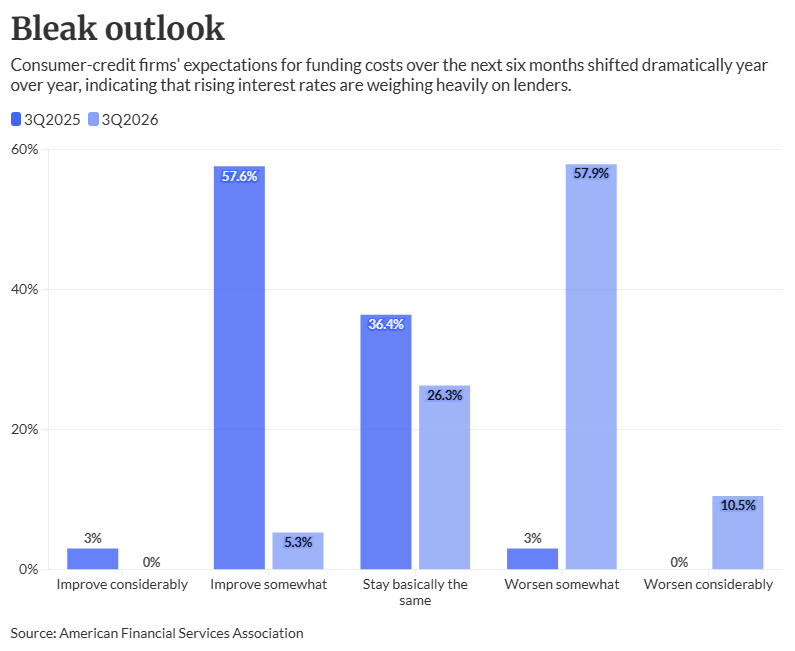
The interest-rate environment appears to have been a key driver, pushing up the firms’ actual and anticipated funding costs. Among the survey’s 38 participants, more than 63% said funding costs were worse in the third quarter than in the second quarter, and more than 68% said they expected funding costs to worsen over the next six months. A year ago, about 60% of respondents said they expected funding costs to improve over the next two quarters.
The results align with findings from a recent survey conducted by IntraFi, a service provider for banks, which found that the vast majority of bankers it polled in October
“There’s been a sea change in interest rates and interest-rate expectations since the beginning of the year,” Timothy Gill, AFSA’s chief economist and vice president of research, told American Banker. Based on the survey data, lenders’ outlook shows “higher interest rates and stubborn inflation are going to continue to be an issue through the early part of next year,” he added.
It is widely assumed that the Fed will raise interest rates again in December and possibly next year as well, due to persistent inflation. The latest personal consumption expenditures index, released last week by the Bureau of Economic Analysis, showed that
The American Financial Services Association, a trade group for consumer-credit companies, launched its survey in 2024. Its questions focus on the cost of funds, loan demand and loan performance. AFSA aims to capture lenders’ perspectives about how certain conditions have changed from the prior quarter and how they may unfold in the next six months.
The third-quarter 2026 results hit new lows, reinforcing lenders’ negative takes on consumer-credit trends. For instance, the “net improving index” for overall business conditions in the third quarter fell to -39.5 from -5.3 in the second quarter and
The index for cost-of-funds conditions dropped from -33.3 in the second quarter to -60.5, marking the lowest current-conditions index recorded in the survey’s 11-quarter history. The outlook for cost of funds was even more bleak, with an index of -63.2, down from -25 in the second quarter. A negative result means that more survey participants reported, or expect, worsening conditions than improved conditions.
As for where the funding-cost pressure, both actual and anticipated, could show up, Gill said it will likely be evident in what lenders charge customers to borrow money.
“We don’t specifically ask lenders what they’re charging, but one would expect that an increase in funding costs would ultimately feed through to the rates they’re charging their borrowers,” he said.
The survey also found that loan demand declined during the third quarter, a change from rising demand during the second quarter. The index for loan demand tumbled from 26.3 in the second quarter to -15.8 in the third. The index for loan demand over the next six months went into negative territory, -13.2, for the first time in the survey’s history.
Meanwhile, the index for overall loan performance in the third quarter moved further into negative territory, dropping from -18.4 in the second quarter to -29.7. The index for subprime loan performance specifically fell to -51.7 from -41.4 in the second quarter.
Those declines suggest that a growing number of consumer lenders are facing an uptick in credit-quality pressures related to household budgetary challenges, according to the report.
Read more:
Still, the U.S. economy appears to be resilient, at least for now, Gill said. Time and time again, predictions about the unraveling of the economy haven’t materialized, in part because of the “magnitude of business going into AI,” which has become a huge growth driver, he said.
And depending on what happens in the next few months with interest rates and inflation, there’s reason to expect that consumer-credit trends will shift, especially once the Fed stops raising rates, Gill added.
“Certainly the six-month outlook suggests that the current conditions for the next couple of quarters would be on the weak side,” he said. “But I think the cycle can turn fairly quickly.”