Bonds see gains after Democrats’ rout
Municipals richened Wednesday following Democrats’ rout in the midterms, as U.S. Treasuries saw gains and equities ended up.
Processing Content
Muni yields were bumped one to five basis points, depending on the scale. UST yields fell five to eight basis points at a 3:45 p.m. reading.
Munis were firmer Wednesday, a result of USTs getting a “lift” from midterm election results and the slowdown in supply for the rest of the week, said Jamie Iselin, head of the municipal fixed income team and a senior portfolio manager at Neuberger.
Currently, the market feels like it’s moved past the worst of the technical factors people expected in September and October that played out, he said.
“We’re going to take our cues from the Treasury market, and as long as it’s stable or the path is lower, that’s probably going to be a pretty good backdrop for munis,” Iselin said. “Other than a reversal and a backup in rates again, I think the market is going to be on pretty firm footing for the rest of the year.”
ICI data
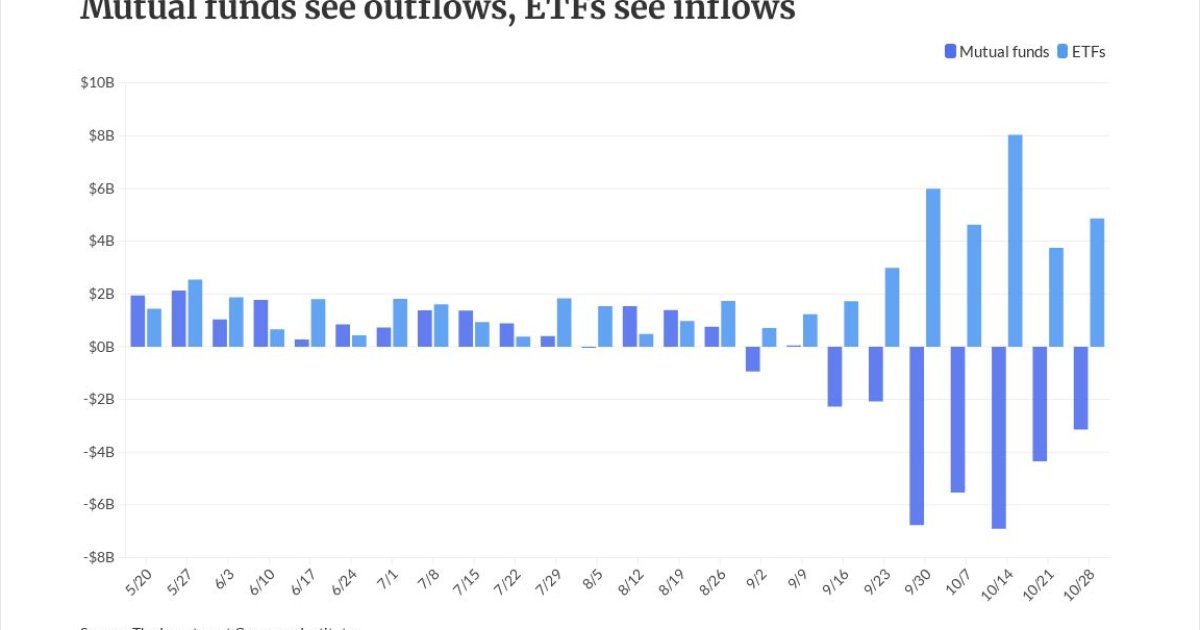
The Investment Company Institute Wednesday reported outflows of $3.142 billion for the week ending Oct. 28, following $4.348 billion of outflows the previous week. Outflows have topped $1 billion each of the past seven weeks.
Exchange-traded funds saw inflows of $4.862 billion after $3.749 billion of inflows the week prior, per ICI data. ETF inflows have exceeded $1 billion for the past eight weeks.
Primary market
In the primary market Wednesday, Goldman Sachs priced for the California Community Choice Financing Authority (Aa2///) $1.654 billion of green clean energy project revenue bonds, Series 2026J, with 5s of 9/2039 at 4.80% and 5s of 2040 at 4.85%, callable 6/2040.
Midterms redux
Markets carried a positive tone Wednesday, potentially because investors had de-risked before the elections and may now get back into markets — stocks and bonds alike, said Gene Tannuzzo, Columbia Threadneedle’s global head of fixed income, though he notes this could be short-lived.
Midterm results were consistent with market expectations, “mitigating the risk of significant short-term price dislocations in bonds or equities,” said Jeremy Richardson, senior portfolio manager for global equities at RBC Global Asset Management.
Divided congressional and presidential loyalties will likely lead to “short-term policy stasis that will reduce regulatory uncertainty for equity investors and dampen oversupply risks for bond investors,” he said.
However, the most consequential impact in the medium term could be how the midterms shape policy agendas for the 2028 presidential election, Richardson said.
Additionally, in the medium term, several issues will shape the bond market’s direction: whether the Democrats find any common ground with Trump, how data center infrastructure gets approved in this environment, and whether this result amplifies actions that the president can take unilaterally, Tannuzzo said.
“The biggest potential market implications could be if, with the midterms now out of the way, [Trump] decides to escalate in the Middle East,” said Mike Bell, head of BlueBay Market Strategy at RBC Global Asset Management
This could hurt bonds and stocks if geopolitical tensions escalate and energy prices then move higher, he said.