Wearable payments get a boost from new market entrants
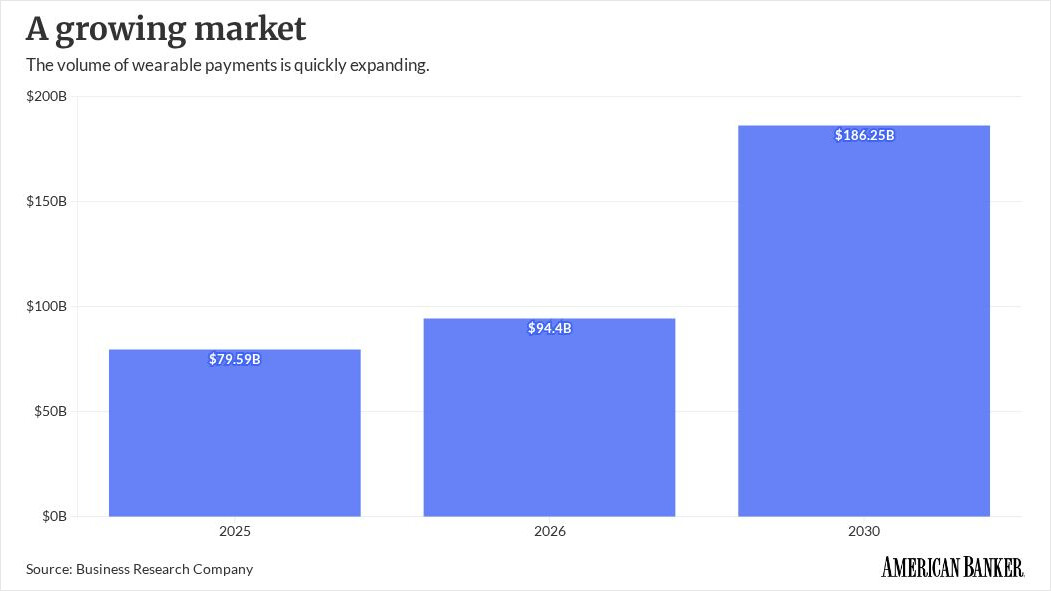
- Key insight: Wearables are a small part of the payments market, but are growing quickly.
- Expert quote: “There are all sorts of things that are increasingly possible.” —Celent’s Gareth Lodge.
The
Processing Content
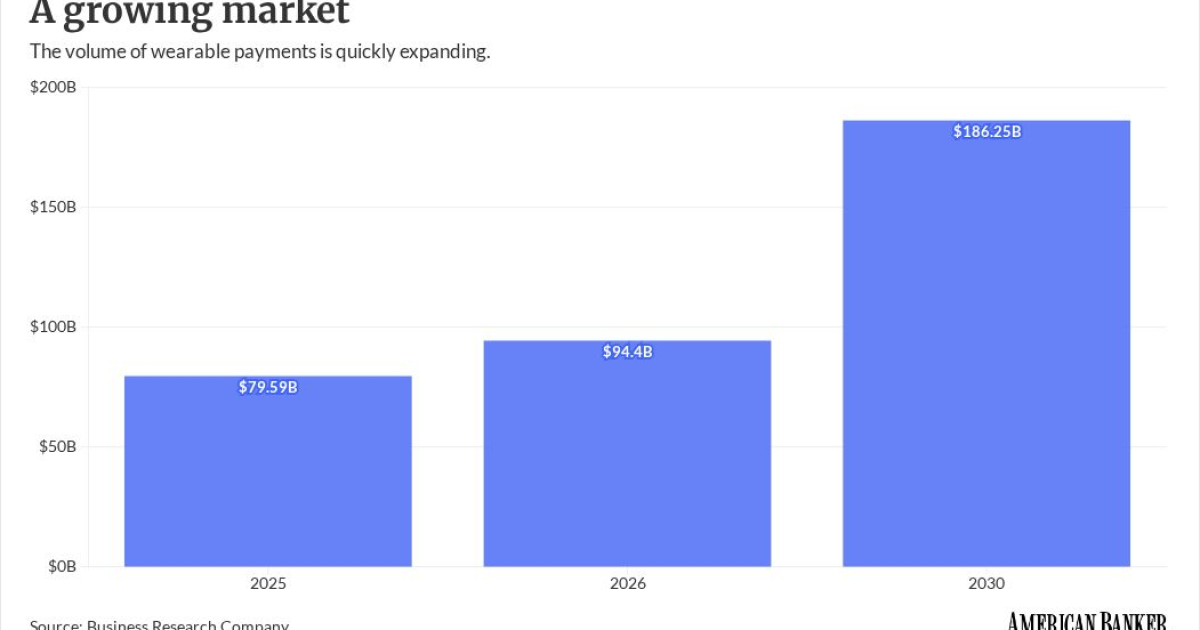
A report from the Business Research Company valued the global market for wearable payments at $79.59 billion in 2025. The global market research and consulting firm predicts the market will grow to $94.4 billion in 2026, with expectations to reach $186.25 billion by 2030 at a compound annual growth rate of 18.5%. North America was the largest region for growth last year, with the Asia-Pacific region growing the fastest.
To be sure, use of wearables for payments pales in comparison with credit cards or mobile phones, but that could change over time as AI improves, wearable devices become more readily available, and with sufficient consumer, bank, and merchant education, Gareth Lodge, principal analyst at Celent, told American Banker. “There are all sorts of things that are increasingly possible,” he said.
Here’s what banks need to know about
Factors influencing growth
The Business Research Company expects several factors to drive growth, including growing adoption of contactless payments, the ongoing expansion of payment-enabled wearable devices, advancements in secure payment technologies, and expanding use of tokenization and secure authentication.
For instance, DIGISEQ, a wearable payment technology company, announced last year that it was adding Visa tokenization, expanding beyond its existing Mastercard token provisioning for a range of wearable devices, including rings, bracelets, cards and key fobs.
“Although the market faces certain challenges, including the need for alternative authentication methods for screenless devices such as rings, uneven issuer support across countries, and variations in transit acceptance, these constraints are manageable,” according to Business Research Company. “Rather than limiting overall market growth, they are likely to influence the pace of adoption and determine which wearable payment form factors achieve wider market penetration first.”
Which devices show the most promise
Smartwatches are expected to remain the largest segment through 2030, supported by their established user base, integrated authentication features, and well-developed payment ecosystems, including Apple Pay, Google Wallet, and Samsung Wallet, according to Business Research Company.
Payment opportunities are also emerging within smart rings, which are expected to notch the fastest growth, according to Business Research Company. Circular, for instance, recently announced its new Circular Ring 3 series at IFA, the consumer tech show in Berlin.
Other opportunities exist in payment bands and wristbands and smart glasses, which may also progress from early stage adoption to a more established market segment, with Asia-Pacific potentially leading this development, according to Business Research Company.
AI glasses from several Chinese big tech companies, including Alibaba, have payment functionality, according to a January equity research report from Barclays. Also, Rokid, which specializes in lightweight, AI-powered smart eyewear, recently partnered with Ant International to enable payment functionality on its smart glasses.
Even so, it’s still an up-and-coming product set. “AI glasses remain far from maturity,” according to Barclays. “The industry’s expansion will be closely tied to continuous improvements in AI functionality and product usability. Users primarily focus on AI features such as AI interaction, translation, and photo/video capture. Also, product usability remains critical, where consumers care about weight, lens display quality, product design, and battery life due to daily usage,” Barclays wrote.
The future is unwritten
Product-makers need to consider the potential for widespread adoption, Lodge told American Banker. “Phones can do so many different things already. Whenever something new comes along, it has to be as good or do something better than what’s existing.”
A lot hinges on consumers’ appetite for these products. “As long as you trust the company that’s offering it with your personal data, it would be a good growth market for payments,” Deb Baxley, partner at payment consultancy PayGility Advisors and member of the U.S. Payments Forum’s Steering Committee, told American Banker. “Just adding payments increases the utility of it.”
Certainly, other wearable makers could eventually push into the payments space. Amazon, for instance, earlier this month announced the availability of Bee Frontier, its next-generation AI wearable that can be worn on a person’s wrist or clipped to clothes. It’s equipped with dual microphones with advanced noise filtering, so it can take notes on important meetings, plans, or help users remember to make purchases.
While the Bee Frontier doesn’t have payment capabilities today, some industry watchers suggest it could be on the horizon. Alexa never drove the shopping that Amazon expected it to, but a product like Bee Frontier could, Celent’s Lodge told American Banker. Amazon did not respond to a request for comment.
Meta, which last year acquired Limitless, the maker of the Limitless Pendant, is reportedly working on an upgraded AI-powered wearable pendant. Meta did not respond to a request for comment about whether the pendant would be equipped with payment capabilities.