Freddie Mac’s loan acquisitions top Fannie’s as rates rise
- Key Insight: See why Freddie Mac’s new loan acquisitions moved ahead of Fannie Mae’s in the third quarter.
- What’s at Stake: Competition between Fannie and Freddie could make them more willing to open up the credit box for lenders who sell loans to them.
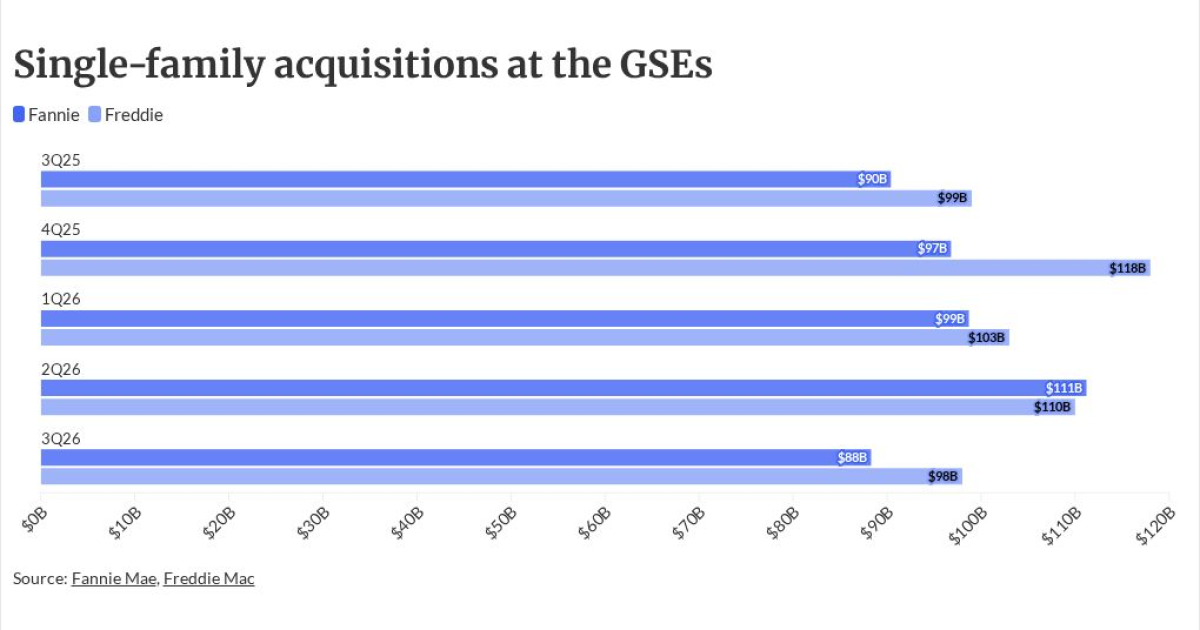
A profitable Freddie Mac regained its lead over larger competitor Fannie Mae in single-family loan acquisitions during the third quarter as higher rates intensified competition between them.
Freddie, which is the smaller of the two government-sponsored enterprises when it comes to its outstanding portfolio size, reported Thursday that it acquired $98 billion in home mortgages during the fiscal period. Fannie Mae, in comparison, purchased $88 billion in single-family loans.
Processing Content
These and other numbers in their recent earnings raises the question of what Freddie is doing to capture more loan acquisitions and whether it’s opening up the credit box to do it.
The latest underwriting indicators in earnings show Freddie’s credit score and loan-to-value ratio tolerances are slightly higher, but the growth in credit reserves and some elevated delinquency measures at both GSEs suggests both will be cautious about the size of their credit boxes.
“We are growing our financial strength, applying disciplined decision-making and risk management, and continuing to invest in the capabilities that can make the housing system work better,” Freddie Mac Chief Financial Officer Jim Whitlinger said in the GSE’s earnings call.
What underwriting indicators show
Whitlinger reported that Freddie’s weighted average current loan-to-value ratio was 54% and the equivalent credit score was 755 in the company’s third-quarter earnings call. Fannie’s equivalent credit score number was 753 and its mark-to-market loan-to-value ratio was 51%.
Current or mark-to-market LTVs on the outstanding portfolios account for property value changes and paydowns on loans over time. Weighted averages for original LTVs are generally higher and have averaged more around 78%, according to Fannie.
The underwriting metrics for new acquisitions are a subset of the broader portfolio numbers. Whitlinger and others have indicated there may be more caution in that part of the market because slight increases in certain delinquency buckets have been driven by newer vintages.
“The year-over-year increase was primarily driven by higher serious delinquency rates for loans originated during 2022 through 2024,” Whitlinger said during the call.
Both Fannie and Freddie have seen some delinquencies inch up in both their single- and multifamily book, calling for broader risk management.
With risk growing, Freddie had to manage a larger-than anticipated shift from a $900 million benefit for credit losses to a $800 million reserve during the quarter, analysts at BTIG noted. Fannie also recorded a shift from a benefit for credit losses to a reserve in the period.
All this suggests that for the time being, Freddie and Fannie are keeping an eye on credit, which may limit how much leeway in underwriting they want to use to compete.
But they still want to offer some additional support to help consumers afford homes to the extent their delinquency rates and overall financials allow. While some types of arrears are rising, the single-family serious delinquency rate is still historically low at less than 1% at both GSEs.
“Financial strength matters because of what it enables us to do,” Whitlinger said. “It gives us greater capacity to provide liquidity throughout the economic cycle, support sustainable homeownership and help make housing finance more efficient and affordable.”
Examples include a lender option that both GSEs now offer to use the modernized VantageScore 4.0 credit metric for loan pricing, which some mortgage companies have said helped them get certain borrowers approved. This was used for 6% of the loans Fredddie bought in the third quarter, Whitlinger said.
Other key financial metrics to watch
The GSEs so far have shown that they are financially strong from a net income perspective and have sustained the long run of profitability that followed their 2008 move into conservatorship.
So long as that financial strength persists, they might do more to expand some underwriting selectively with offsetting, more conservative adjustments in other areas in line with the trend seen in the condo market.
Freddie reported that quarterly net income rose by around 17% on the year to $3.2 billion, and Fannie announced a day earlier that its strongest net revenues since 2023 drove an 8% increase during the same period to $4.2 billion.
The smaller GSE’s $3.2 billion in growth for the quarter also brought its total net worth to $81 billion, helping to close a regulatory capital gap that’s also essential to their financial soundness and an eventual conservatorship exit. Fannie also reported improvement in this area.
“Excluding buffers, our capital shortfall was $98 billion at the end of third quarter 2026, largely because the $73 billion of senior preferred stock does not qualify,” Whitlinger said in a reminder that an exit would need to address this, a key point prominent GSE investors have emphasized.
Adjusted for the SPS, this means capital is around $21 billion below its statutory minimum level, Keefe, Bruyette & Woods analysts noted in a report on Freddie’s earnings.
“FMCC’s capital remains subordinate to the government’s senior preferred shares and liquidation preference, so any privatization would have to include either forgiveness or conversion,” the KBW analysts wrote.
Both Freddie and Fannie’s shares were trading higher on the day at press time on Thursday, with the former’s stock up by a little over 12% at $4.09 per share and latter’s around 8% at $4.48.