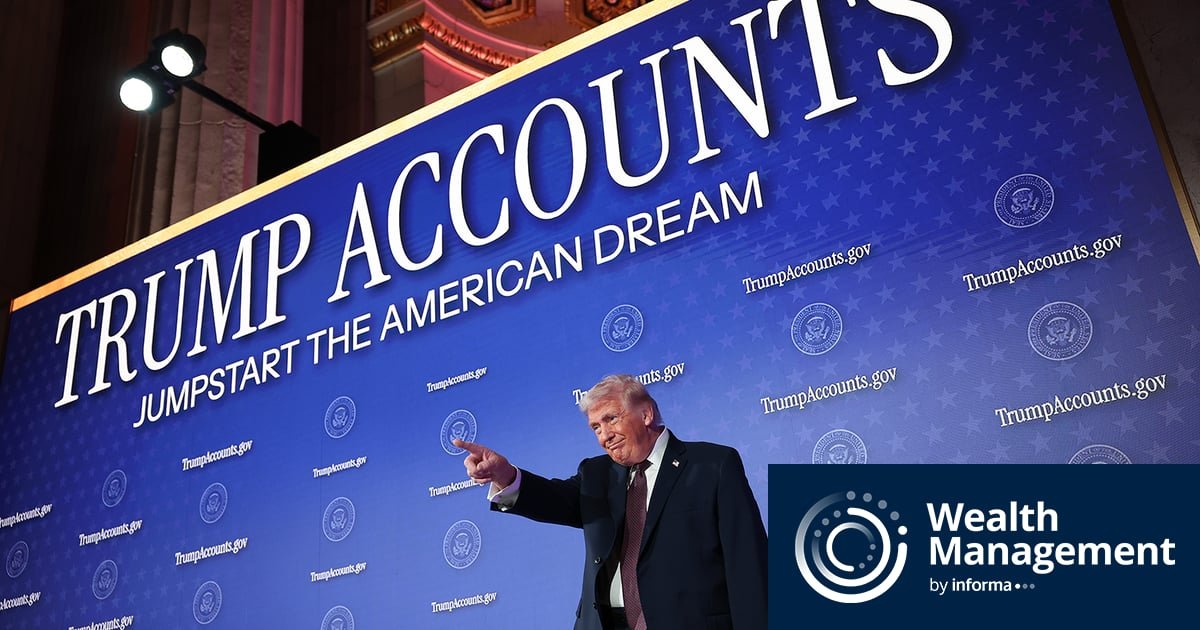
Trump Accounts Become New Tool for Wealthy Giving
From giving dimes to the Giving Pledge, the way wealthy individuals give has evolved over time. Most recently, Trump accounts officially opened for contributions on July 4, 2026, presented to the American public as a broad-based wealth-building vehicle—a government-seeded savings account designed to give a leg up in the investment process, with babies born between 2025 and 2028 receiving an automatic $1,000 deposit. By mid-October 2026, Internal Revenue Service Commissioner Frank Bisignano told CNBC that up to 25 million accounts could be funded, signaling mass adoption. But increasingly, the conversation has pivoted as financial advisors, wealth managers, and others have begun asking whether Trump accounts are quietly becoming a powerful new philanthropic and tax-planning tool for America’s wealthiest families.
How Trump Accounts Function
The architecture of Trump accounts creates a multi-source contribution structure that, on its surface, appears democratic. Individuals can make after-tax contributions of up to $19,000 in 2026. Employers and government entities can contribute pre-tax dollars, introducing a significant incentive for businesses to participate. Family members and other direct contributors share a $5,000 annual contribution limit, which applies alongside employer contributions, with employers capped at $2,500 per account. The Treasury’s $1,000 seed deposit for eligible individuals ensures that even those with no means to contribute still have something. The stated goal is universal participation. Proponents compare it to the Social Security program that served as a safety net for unemployed or older Americans in the 1930s. Tech investor Brad Gerstner is credited with conceiving the program, which was then sold to the White House.
“Interestingly, we have seen more clients considering this type of gifting not only for their own families, but also for their employees and their employees’ children. For many successful business owners, it’s an opportunity to give back to the people who helped build their businesses while encouraging long-term savings and financial security for the next generation,” said Jason Stephens, Founder and Managing Partner at Evertern Wealth.
The “charitable” contribution channel, noted in the program’s design as a pre-tax contribution pathway alongside employer and government contributions, however, is now drawing scrutiny from critics who are flagging this new “social contract” of sorts as both a political stunt (the program is named after President Trump) and just another means for the wealthy to achieve significant tax advantages. For high-net-worth individuals accustomed to donor-advised funds (DAFs), private foundations and charitable remainder trusts, this new contribution method may be just another tool in their tax-planning toolbox.
Just Another Tax Advantage for the Wealthy?
The proposal generating the most controversy is a White House consideration to permit billionaires to donate appreciated stock directly into Trump accounts in exchange for substantial charitable tax deductions. As the Wall Street Journal reports, some of the world’s richest are already embracing this new form of giving. Elon Musk and Michael Dell are among the billionaires who are pledging cash or shares to kids to seed the new Trump accounts.
Under traditional philanthropic structures, donating appreciated securities to a qualified charitable organization allows the donor to deduct the full fair market value while avoiding capital gains tax on the appreciation.
Rather than selling shares, realizing capital gains and then contributing after-tax proceeds, ultra-wealthy individuals holding a portfolio of highly appreciated stock could potentially transfer the stock directly and claim both the charitable deduction and the capital gains exclusion. The recipient, in this case, wouldn’t be a traditional Internal Revenue Code Section 501(c)(3) charity but a government-structured individual savings account, potentially one belonging to a family member, an employee or even the contributor themselves through allowable allocation mechanisms.
How Contributions Work
The program essentially allows wealthy donors to bypass traditional giving to organizations and causes, with the cash or stock instead going directly to the beneficiaries—the kids. As the mindset around giving continues to shift, for example, with data showing that younger donors are demanding exact breakdowns of where their capital is deployed and how success is being measured, shifting away from simply handing money over to legacy entities, this new program of redistributing wealth has the potential to gain traction among donors.
For donors interested in seeding these accounts, the questions from clients are practical, according to Matt Cavanaugh, Managing Partner, Director of Investments at XXI Wealth.
“Can I aim this at my hometown? It must cover at least 5,000 kids. Should it go through my foundation or my DAF? How does it fit with the rest of our giving? The families who enjoy giving the most are the ones who can see the impact, and this lets them do that,” said Cavanaugh.
Philanthropy or Gifting Strategy?
So, is this program real philanthropy, or a gifting strategy with a charitable label? “Honestly, it’s both, and that’s not a knock on it. The best charitable planning has always worked for the donor and for the people receiving the gift,” explained Cavanaugh.
“America has a long history of people helping their neighbors and their communities, and this is a modern version of that. A child in a lower-income ZIP code doesn’t care whether the donor received a deduction. They care that they now own a piece of the American economy and have a reason to start saving. If good tax policy gets more capital to more kids—that’s a feature, not a flaw. No gift is perfect, but a funded account that a child has to pay some tax on later beats an empty account.” Cavanaugh added.
Whether anything will come of the rumored talks around expanding what can be contributed to the Trump accounts to include stock donations could also play a role in how this potential new avenue of giving shakes out.