
Ariel Emerging Markets Value And Emerging Markets Ex-China Q3 2026 Shareholder Letter
MicroStockHub/iStock via Getty Images
Dear Clients and Friends
For the quarter ended September 30, 2026, the Ariel Emerging Markets Value Composite returned -0.52% gross of fees (-0.70% net of fees), while the Ariel Emerging Markets Value ex-China Composite returned -2.41% gross of fees (-2.61% net of fees). Both composites trailed their respective benchmarks: the MSCI EM Index which declined -0.37%, and the MSCI EM ex-China Index which fell -1.32%.
The modest index declines masked a sharp rotation in market leadership. Technology stocks traded down on the heels of exceptional second-quarter gains. During the third quarter, investors reassessed the durability of artificial intelligence (AI) capital spending against a higher cost of capital. Much of that weakness was offset by a strong rally in financials, which benefited as global interest rates moved higher.
Emerging Markets Banks: Priced Through the Rearview Mirror
Emerging market financials are often priced through a single risk lens: past crises, local geopolitics or perceived customer risk. That framing can obscure the factors that we believe ultimately drive returns: stronger balance sheets, better capital allocation, rising credit penetration and disciplined risk management rooted in local knowledge. We see buying opportunities emerge when these franchises evolve faster than investor perceptions, creating a gap between improving business fundamentals and valuations still anchored to the past.
Greek banks are still judged by the sovereign crisis they survived: Lion Finance Group plc (LNFGY) by Georgian and Armenian geopolitical and currency risks; Shriram Finance, Ltd. by the perceived fragility of its small Indian transport operator customers; and Kaspi. kz JSC by the assumed limits of Kazakhstan’s relatively small home market. We think these are established franchises, not undiscovered businesses. The opportunity is not discovery but recognition: current valuations remain anchored to past risks, with little recognition given to these businesses today. The following examples examine where there is still investor doubt and those catalysts that could close the gap between valuation and sentiment.
In our view, Eurobank SA (EGFEY) and National Bank of Greece SA (NBGIF) are still viewed through the lens of the 2009 sovereign crisis, even though their businesses have moved well beyond repair. After more than a decade of deleveraging, both institutions are now once again extending credit, collecting fees and returning excess capital to shareholders. Private-sector borrowing remains low relative to the economy, leaving room for loan growth to outpace GDP for years. Asset quality has normalized, capital is ample and results increasingly depend on lending volumes, fee income and distributions rather than reserve releases. Although the crisis has passed, investors seem to be less convinced that attractive returns can persist and growth can materialize. By our estimates, our Greek banks trade at roughly 9–10x fiscal 2027 earnings, despite expected returns on tangible equity near 17%. We forecast annual earnings-per-share (EPS) growth to be 20% over the next two years, with around 40% upside to our valuation estimates. Our catalyst is not another dramatic restructuring; it is mounting evidence of loan growth, fees and capital returns.
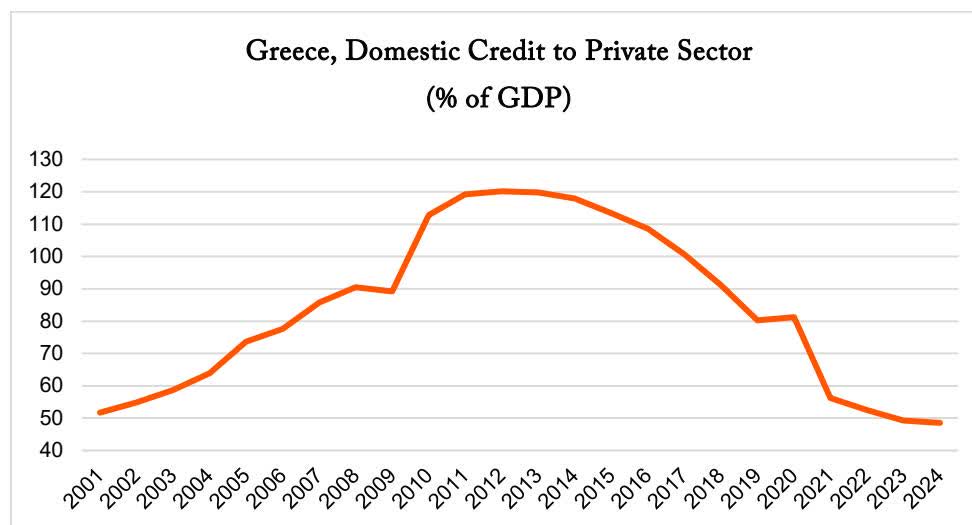
Source: World Bank Group (7 October 2026) “Domestic credit to private sector (% of GDP)” The World Bank Group, DataBank, World Development Indicators, World Development Indicators | DataBank
For Lion Finance Group plc, a leading Georgia-based banking group, geography dominates the valuation debate. Georgia and Armenia are small, less familiar markets for global investors, with geopolitical, currency and external-funding risks that warrant a higher return hurdle. The central question is not whether a discount is justified, but whether it is too wide relative to the quality of the franchise. We believe Lion’s acquisition of Armenia’s Ameriabank CJSC illustrates the opportunity. Rather than chase weaker-quality lending in a maturing Georgian market, management acquired a leading Armenian institution below book value, gaining an established deposit base, distribution network and customer franchise. Lion can now apply the digital tools, product expertise and operating discipline honed in Georgia to deepen Ameriabank’s relationships and improve efficiency. Our thesis does not assume country risk disappears. It rests on Lion’s ability to allocate capital across underpenetrated markets without weakening credit standards. Evidence should emerge through continued credit performance, stronger customer engagement and operating improvement at Ameriabank. Success in Armenia could eventually create a path into other markets such as Uzbekistan, offering further upside to our investment thesis. Lion trades at approximately 0.7x fiscal 2027 earnings, against our forecasted 28% return on equity and around 20% annual EPS growth over the next two years. Our valuation implies almost 35% upside. Current pricing, in our view, places too much weight on the risks attached to Georgia and Armenia and too little on management’s ability to compound capital across markets.
At Shriram Finance Limited, one of India’s largest non-bank lenders, we think the perceived risk sits with the customer. The company finances used commercial vehicles for small transport operators, including borrowers with limited credit histories. With uneven cash flows that can be tied to the freight cycle, Shriram’s dependence on external funding adds another layer of concern. Yet, the market’s focus on the borrower can obscure the discipline of the lender. Shriram has built a local, asset-backed system designed to understand both. Customers typically contribute 30–40% of the vehicle’s value, giving them meaningful equity from the start.¹ Field officers inspect the collateral, assess repayment capacity and remain involved through collections. Distribution stays in-house and incentivizes reward pricing and asset quality rather than origination alone. This model creates an information advantage that a centralized credit score is unlikely to replicate. The 20% equity investment by Japan-based MUFG Bank strengthens the balance sheet and should broaden funding access, lower borrowing costs and reduce refinancing risk.² The path to value recognition is measurable: sustained asset quality, more efficient funding and evidence that Shriram can scale without weakening underwriting. In our view, the market still sees a risky borrower base more clearly than the specialized lending franchise built to effectively serve them.
Kaspi. kz JSC, Kazakhstan’s leading digital payments, commerce and banking platform, is often valued as a mature payments business constrained by a relatively small home market. We see a broader franchise with room to deepen its economics. Payments bring customers into the ecosystem; each transaction generates data that supports commerce, deposits and credit. As payment penetration matures, marketplace adoption and additional merchant services can increase the value of each customer relationship without relying solely on user growth. We believe Turkey is the next test of whether that model can travel. Through Hepsiburada’s marketplace, Hepsipay’s payments business and Hepsı Bank, Kaspi already owns the building blocks of a similar network in a much larger market. Our catalyst is integration: connecting the three businesses so payments drive commerce, commerce generates better data and that information supports additional financial services. Replication will require investment and disciplined execution, but success could materially extend the company’s earnings runway. We think agentic commerce offers further upside. Kaspi’s shopping assistant, Kasper, is an early effort to combine customer data, shopping and payments in a single experience. We view this as potential upside, not a core assumption in our thesis, because the earnings contribution has yet to be demonstrated. We are tracking payment activity, marketplace adoption, merchant engagement and progress integrating the Turkish businesses. In our view, the market is still pricing Kaspi on the limits of its home market rather than the broader platform it is building. Our current valuation implies more than 40% upside.
Looking Forward
Across these holdings, the advantage comes from putting local knowledge to work at scale—through capital, data, distribution and years of underwriting experience. As more households and businesses enter formal financial channels, these institutions can deepen customer relationships, operate more efficiently and expand across additional products and markets.
The risks remain real, and our thesis does not depend on their disappearance. It rests on the ability of these franchises to navigate them and generate attractive returns for longer than current valuations imply. Investors are beginning to look beyond the crisis, the geography and the borrower profile. As execution and earnings make the strength of these businesses harder to ignore, we expect the gap between perception and reality to narrow. The rearview mirror still shapes the price, but the road ahead is increasingly visible in the results.
Sincerely,
Henry Mallari-D’Auria, CFA®
Chief Investment Officer | Global and Emerging Markets Equities
References
¹Shriram Finance (24 April 2026) “Investor Presentation – Q4 & FY26” Shriram Finance, pp. 10, https: //cdn. shriramfinance. in/sfl-kalam/files/2026-05/SFL_Corporate-Presentation-March-2026. pdf
²The Economic Times (8 April 2026) “Japan’s MUFG Bank acquires 20 pc stake for Rs 39,618 cr in Shriram Finance” The Economic Times, Japan’s MUFG Bank acquires 20 pc stake for Rs 39,618 cr in Shriram Finance
Editor’s Note: The summary bullets for this article were chosen by Seeking Alpha editors.