Gold prices jump from ₹432 to ₹1.42 lakh in 50 years: Should you sell inherited gold jewellery, exchange it or keep it?
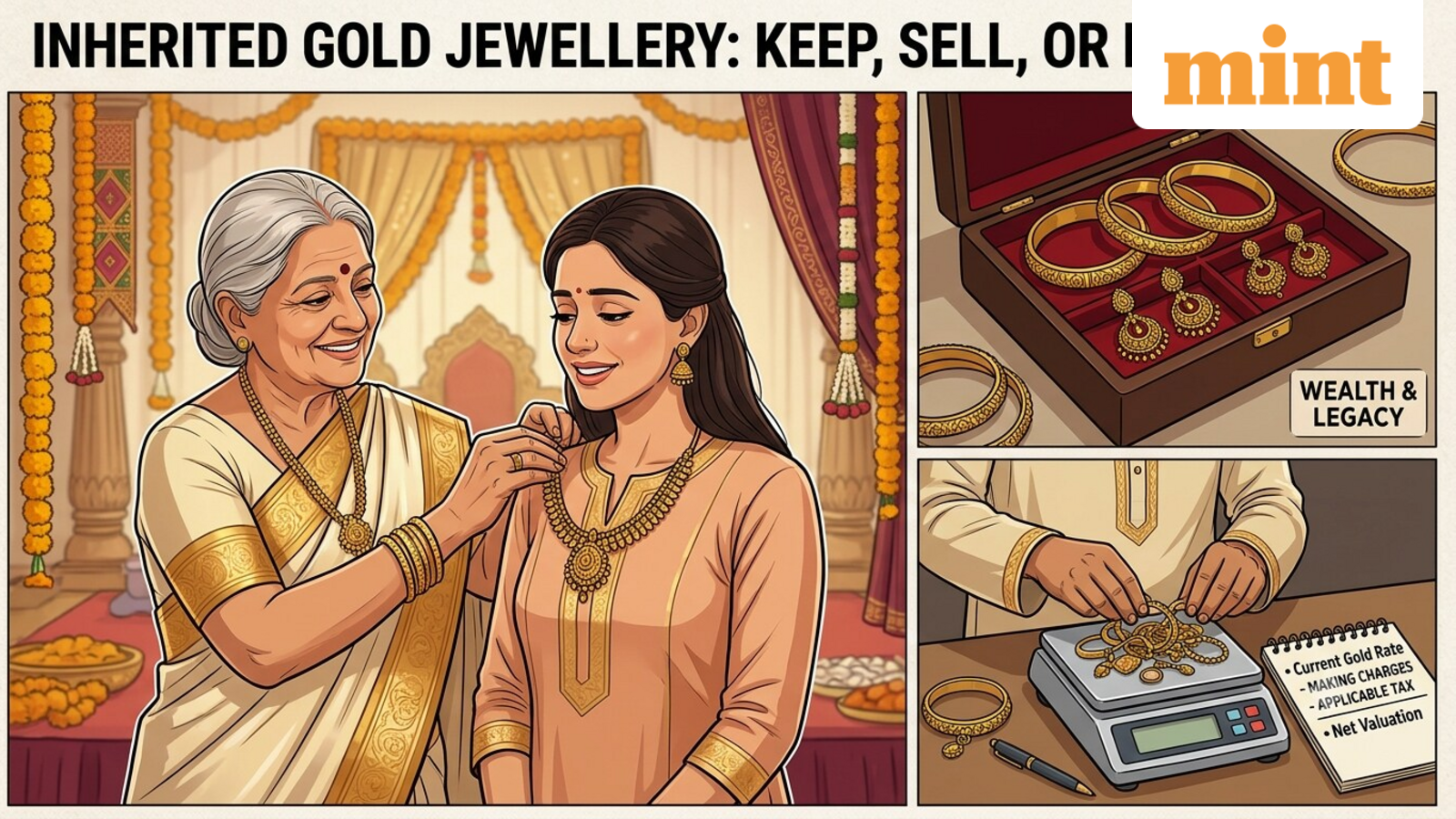
Gold prices have risen sharply over the years, making inherited jewellery worth revisiting. A necklace passed down by a parent or a pair of old bangles may hold both financial and sentimental value. But should you sell the jewellery at current prices, keep it for future use, or exchange it for a new design?
According to Bullion data, gold prices today stand at ₹1,42,500 per 10 grams for 24-karat gold. In 2016, the price was around ₹28,624 per 10 grams, while 20 years ago, in 2006, it was ₹8,400. In 1976, 50 years ago, the gold price was just ₹432 per 10 grams, according to Bankbazaar data.
But the decision to sell inherited gold involves more than the prevailing gold rate and returns. Purity, resale value, family significance, exchange deductions, and tax implications can all affect the outcome. Here are six things to check before deciding what to do with inherited gold.
1. Check purity and net gold weight
Do not value jewellery only by its total weight. Stones, pearls and other non-gold components must be excluded, while purity determines the applicable rate. Check the hallmark and get the jewellery tested if its purity is uncertain.
2. Consider its sentimental and financial value
A necklace inherited from a parent may have significance beyond its resale price. Consider whether the piece is likely to be worn, preserved, or passed on. Antique craftsmanship may also warrant a separate valuation before selling it as scrap gold.
3. Compare the actual selling price
The market rate is not necessarily the amount a jeweller will pay. Ask for the rate applied, net gold weight, and every deduction. Compare written quotations from multiple buyers before finalising the sale.
Example: If the assessed gold weighs 20 grams and the applicable rate is ₹13,070 per gram for 22-karat, its indicative metal value is ₹2,61,400. If the jeweller deducts ₹5,000, the payout would be ₹2,56,400.
4. Calculate the full cost of an exchange
Exchanging old jewellery can reduce the amount payable for a new piece, but making charges and applicable GST add to the bill.
Example: If a jeweller offers you ₹2,56,400 for your old gold and the new jewellery of the same weight (20 grams) in 22-karat gold costs ₹2,96,166, including 10% making charges and 3% GST, you will have to pay an additional ₹39,766. Compare the making charges across jewellers and the total bill rather than just the current gold rate.
5. Check the tax implications before selling
Receiving gold through inheritance is generally not taxable at the time of receipt. However, at the time of selling, it will attract capital gains tax on the profit you make. Gold held for more than 24 months is generally treated as a long-term capital asset, with gains taxed at 12.5% without indexation. Short-term gains are taxed at applicable slab rates.
For calculating capital gains, the cost of acquisition is generally taken as the original purchase price paid by the owner. If the gold was acquired before 1 April 2001, its fair market value (FMV) as of that date will be considered.
Example: Suppose a person inherits gold jewellery that their parent purchased for ₹50,000 in 2006. If the jewellery is sold today for ₹2 lakh, the capital gain would be ₹1.5 lakh, assuming no deductible transfer expenses or improvement costs. If the gain qualifies as a long-term capital gain, the tax at 12.5% would be ₹18,750, excluding applicable cess and surcharge.
6. Keep ownership and valuation records
Retain available purchase bills, inheritance documents, valuation reports, and transaction receipts for reporting capital gains in your income tax return (ITR) or claiming any eligible tax exemption.
These documents can help establish the jewellery’s ownership and acquisition history, particularly when calculating capital gains.
Keep, sell or exchange inherited gold jewellery: What should you consider?
If you want to realise gains from the rise in gold prices, selling may be an option, but account for the potential capital gains tax first. If you plan to buy new jewellery this year, selling old pieces could help fund the purchase, but compare the exchange value, making charges, and other costs.
If the jewellery holds emotional significance or you wish to preserve it for long-term family use, keeping it may also be worth considering. Ultimately, the decision depends on your financial needs, the jewellery’s sentimental value, and the costs involved.
Disclaimer: This is for informational purposes only. Assess your financial needs and goals before making any decisions.