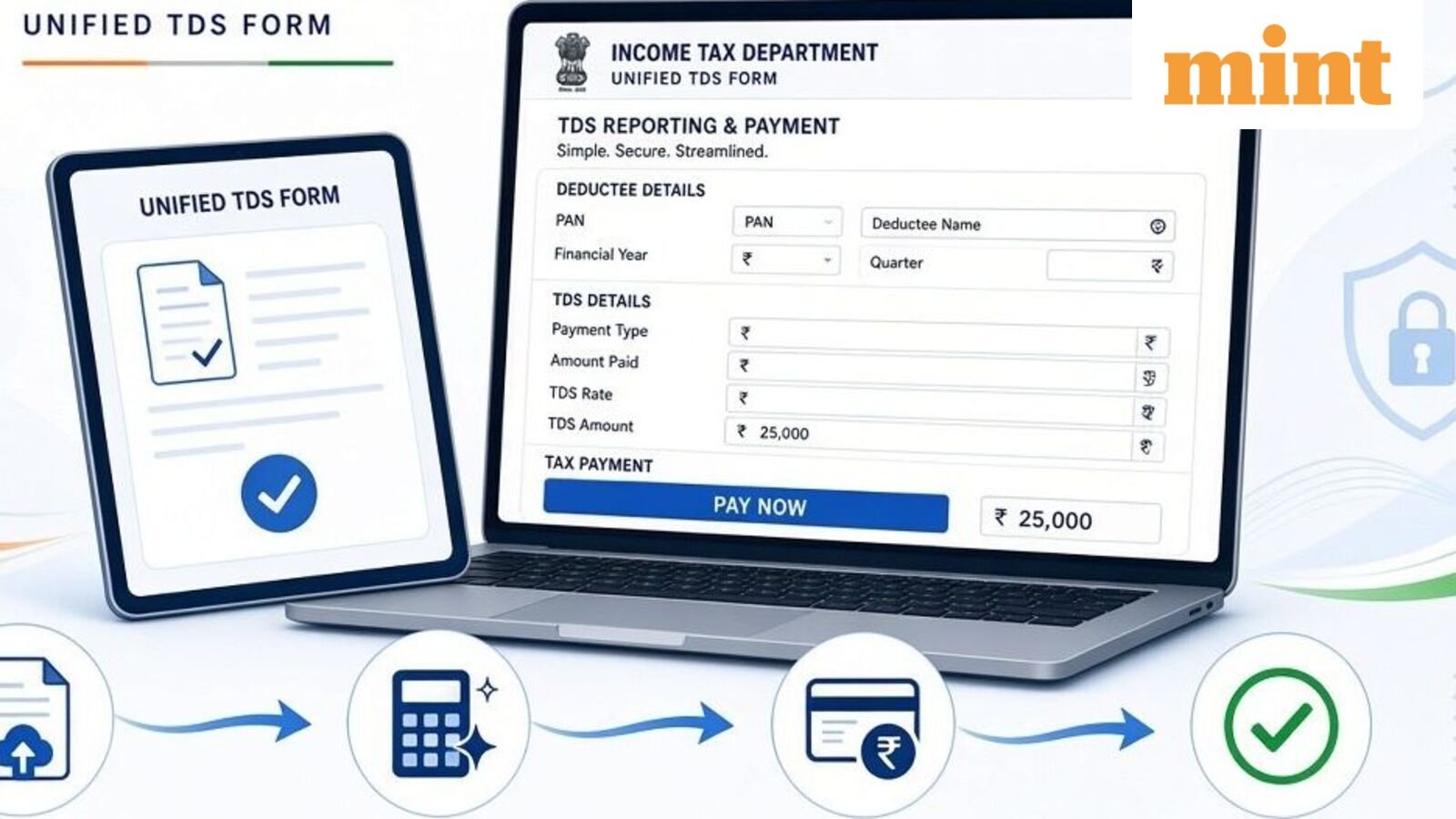
Income Tax Form 141 covers property sales, rent, contractor payments and more: Details here
The Income Tax Department has introduced Form 141, a unified challan-cum-statement for reporting tax deducted at source (TDS) on specified transactions under the Income Tax Act, 2025. The new form replaces four earlier forms — Forms 26QB, 26QC, 26QD and 26QE — that were used under the Income Tax Act, 1961.
Form 141 is intended to streamline TDS reporting and payment for transactions involving immovable property, rent, payments to contractors or professionals, and transfers of virtual digital assets (VDAs).
However, a single Form 141 cannot be used to report all types of transactions. Taxpayers must file a separate form for each transaction category and select the relevant schedule.
What is Form 141?
Form 141 is a consolidated challan-cum-statement introduced under the Income Tax Act, 2025, to report TDS on specified transactions covered by Section 393(1).
It brings together the reporting requirements previously handled through Forms 26QB, 26QC, 26QD and 26QE under the Income Tax Act, 1961.
The department says the unified form is designed to make TDS reporting and payment easier and provide taxpayers with a more streamlined filing experience.
Form 141 must be filed through the taxpayer’s PAN-based login on the Income Tax Department’s e-Filing portal. According to the department’s guidance, it applies only to resident deductees.
Which types of transactions can be reported in Form 141?
Form 141 has four schedules, each corresponding to a specific category of transaction:
– Schedule A — Rent payments: TDS on rent paid by an individual or Hindu Undivided Family (HUF).
– Schedule B — Immovable property transfers: TDS on the transfer of immovable property.
– Schedule C — Contractor and professional payments: TDS on payments made by an individual or HUF to contractors or professionals.
– Schedule D — Virtual digital assets: TDS on transfers of VDAs by an individual or HUF.
These schedules consolidate the reporting of specified transactions previously covered by the four older TDS forms.
Can a single Form 141 report all types of transactions?
No. Form 141 allows taxpayers to report only one type of transaction in each filing. A separate form must be submitted for every transaction category.
For instance, if a taxpayer needs to report TDS on a property transfer as well as rent payments, separate Form 141 filings are required for the two categories.
The department has also specified conditions for including multiple deductees in a single form. Multiple deductees can be reported together only if they belong to the same deductee category and the month of deduction is identical.
Therefore, while Form 141 consolidates four earlier forms into a unified reporting framework, it does not permit taxpayers to combine different transaction categories in one filing.
Who can file Form 141?
Form 141 applies only to resident deductees and must be filed using a PAN-based login on the Income Tax Department’s e-Filing portal.
Taxpayers should identify the applicable transaction category, select the corresponding schedule and follow the department’s filing instructions. For transactions involving non-resident sellers, the applicable requirements should be verified against the official instructions, as the form’s general guidance specifies that it applies only to resident deductees.