Installment lender Splitit plans to offer a card for banks
- Key insight: Installment lender Splitit plans to offer a credit card to banks and credit union clients, which have thus far avoided BNPL.
- What’s at stake: Fintechs and larger banks are gaining share of BNPL, which has become popular with consumers looking to avoid revolving credit card debt.
With economic stress bringing more borrowers to
Processing Content
That’s why it planned a new card that enables some preset purchases to be split into monthly installments that are embedded in an existing card account.
“Small banks and credit unions are under pressure from national banks with larger budgets, and also the fintechs that are taking younger consumers,” Nandan Sheth, SEO of Splitit, told American Banker.
New card
Splitit in 2027 plans to release a white-label Mastercard that enables monthly financing for what it calls “everyday spending.” This comes as BNPL loans are increasingly being used for
“There is a market share erosion and an impact to profitability for smaller financial institutions due to BNPL,” Sheth said. “These institutions can offer more loans or debit cards, but these products don’t really meet the needs of a modern consumer.”
Splitit’s planned card, the Splitit World Mastercard, enables consumers to set a threshold in the participating bank’s app. Purchases over that amount are split into monthly installment payments, while smaller amounts are paid in full. Cardholders later can switch purchases from an installment plan to pay in full after the point of sale.
Splitit, which has existing small-business and credit union clients through its “installments as a service” product, says it has about three hundred prospective users for the pending white-label credit card, though it plans to cast a wider net. There is no monthly or annual fee for the card, but there will be a fee for transactions that produce revenue that Splitit will share with the bank or credit union.
“The addressable market is very large, and there’s not a big tech project involved for the banks to get it live,” Sheth said.
A ‘better mousetrap’?
Splitit’s installment lending is not the same as BNPL lending through a fintech app, though there’s an overlap in why and how the products are used. In both cases, consumers are trying to finance a purchase while avoiding the revolving debt of a credit card. Splitit’s model differs from other BNPL lenders in that Splitit enables consumers to use available, unused balances on their credit cards.
At checkout, Splitit places an authorization hold for the full transaction amount on the shopper’s card to guarantee repayment, gradually converting the total into smaller, monthly interest-free payments without the cardholder having to fill out a new loan application or incur separate interest charges from Splitit. BNPL lenders in effect create new credit lines at the point of sale.
By using Splitit, consumers maintain their credit card rewards points and perks, and the monthly installments appear directly on their regular bank card statement. Splitit also developed limited installment options for debit cards (often capped at smaller purchase limits, such as $400 over three installments) to accommodate budget-conscious buyers.
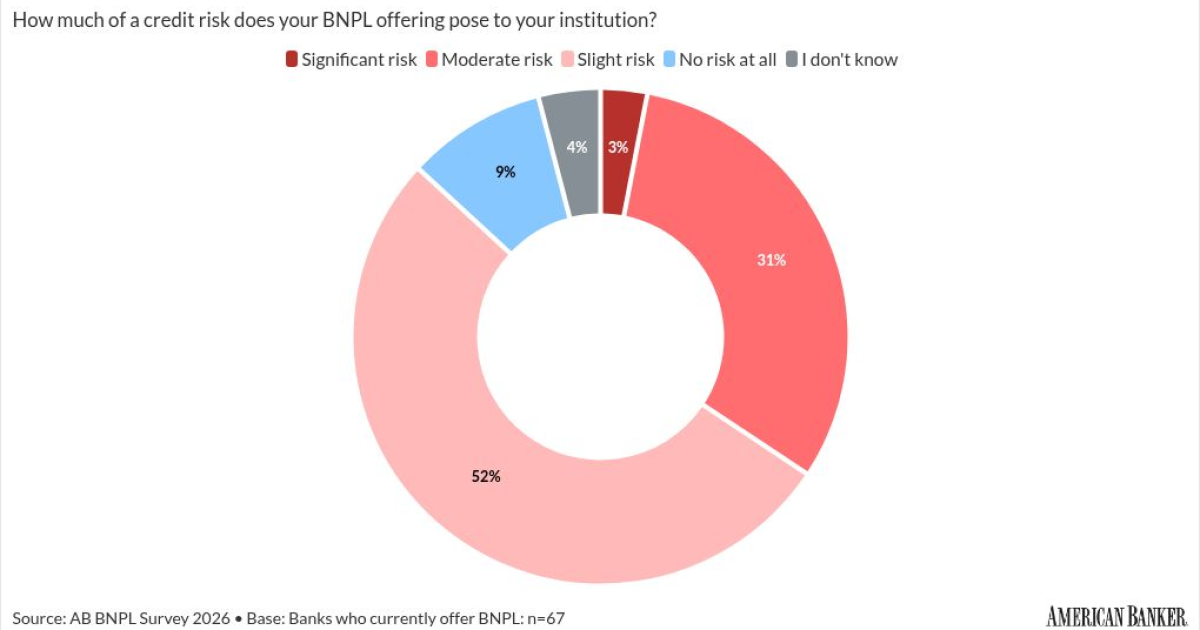
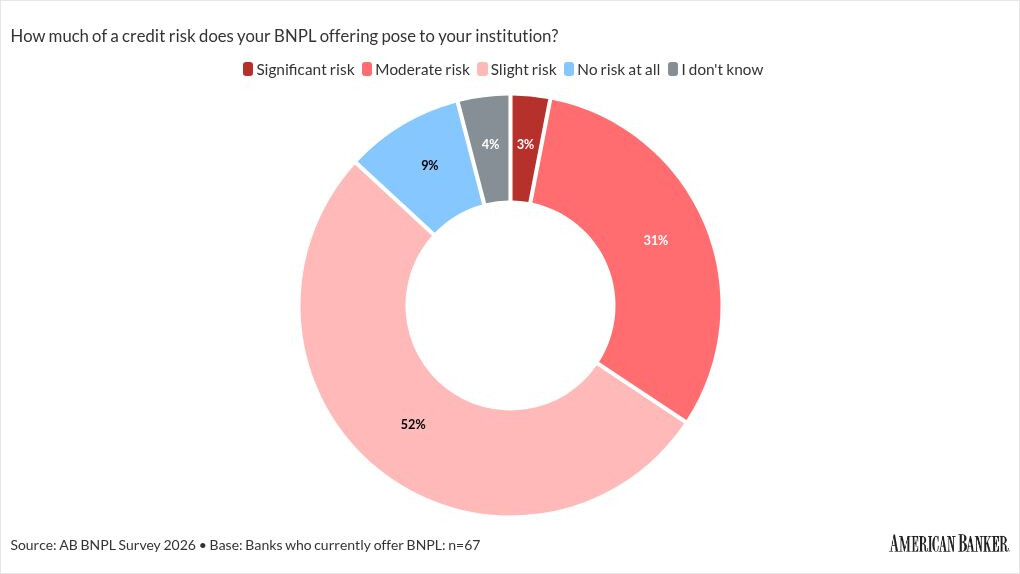
Splitit is betting the “unused balance” approach will be attractive to institutions that are on the fence about BNPL, given that most community banks and credit unions are concerned about the credit risk of BNPL, according to
Regardless of the model, there is an appetite for alternatives to traditional credit cards among consumers, creating market share risk for banks or credit unions that don’t offer the product.
Sixteen percent of consumers took out a buy now/pay later loan in 2025, a number that has been steadily increasing since 2021, according to a Federal Reserve report that analyzed data from its 2025 Survey of Household Economics and Decisionmaking. Women were more likely to use BNPL than men, with 19% of women saying they used the lending product in 2025, compared with 14% of men. Young adults, adults without bachelor’s degrees, and Black and Hispanic adults were also more likely to use BNPL.
“[BNPL/installments] is a better mousetrap than traditional credit cards,” Tony DeSanctis, a vice president at Cornerstone Advisors, told American Banker. “The young generation especially seems to be using BNPL as their primary borrowing tool and leveraging credit cards for rewards.”
Read more:
The fixed term and rate and the ability to tie it to one particular transaction is perceived to be a better solution for folks who are not planning to pay their bill in full, according to DeSanctis.
“The merchants also will subsidize short-term BNPL solutions, which makes them a free benefit for consumers,” he said. “We are seeing more banks and credit unions are looking to offer BNPL as a way to attract new and young customers to their checking offering.”