Frank Lloyd Wright Home Taliesin West Is Closed Indefinitely After Fatal Accident
Famed architect Frank Lloyd Wright’s Scottsdale, AZ, home is closed indefinitely after a visiting dignitary was killed in a freak accident.
Rogério Renato Mateucci, 55, a top official at Pontifical Catholic University of Paraná in Brazil, was on a walking tour of Wright’s renowned Taliesin West home on Friday when, around 2 p.m., he was struck by roofing material that has been dislodged by strong winds, according to the Scottsdale Fire Department.
Fire crews said that Mateucci died instantly due to the freak accident and was pronounced dead at the scene, AZ Family reported. Police are investigating the death as as weather-related accident, and no foul play is suspected.
The National Weather Service reported east winds of 22 mph in Scottsdale on Friday afternoon, with gusts up to 32 mph.
As a sign of mourning, the university cancelled its Saturday and Monday classes, and a mass in memory of Mateucci was scheduled for Monday evening, according to an Instagram post.
Out of respect for the loss, the Frank Lloyd Wright Foundation declined to reveal details of the incident or the foundation’s preservation plans moving forward.
“The Foundation extends its deepest condolences to the family and loved ones of the individual who died Friday, October 16, following an accident at Taliesin West in Scottsdale, Arizona,” reads a statement from Joe Spector, CEO of the Frank Lloyd Wright Foundation, shared with Realtor.com. “The Scottsdale Police Department is aware of the incident, and no further details will be shared out of respect for privacy and to allow officials to complete their work. The property is closed to the public until further notice.”
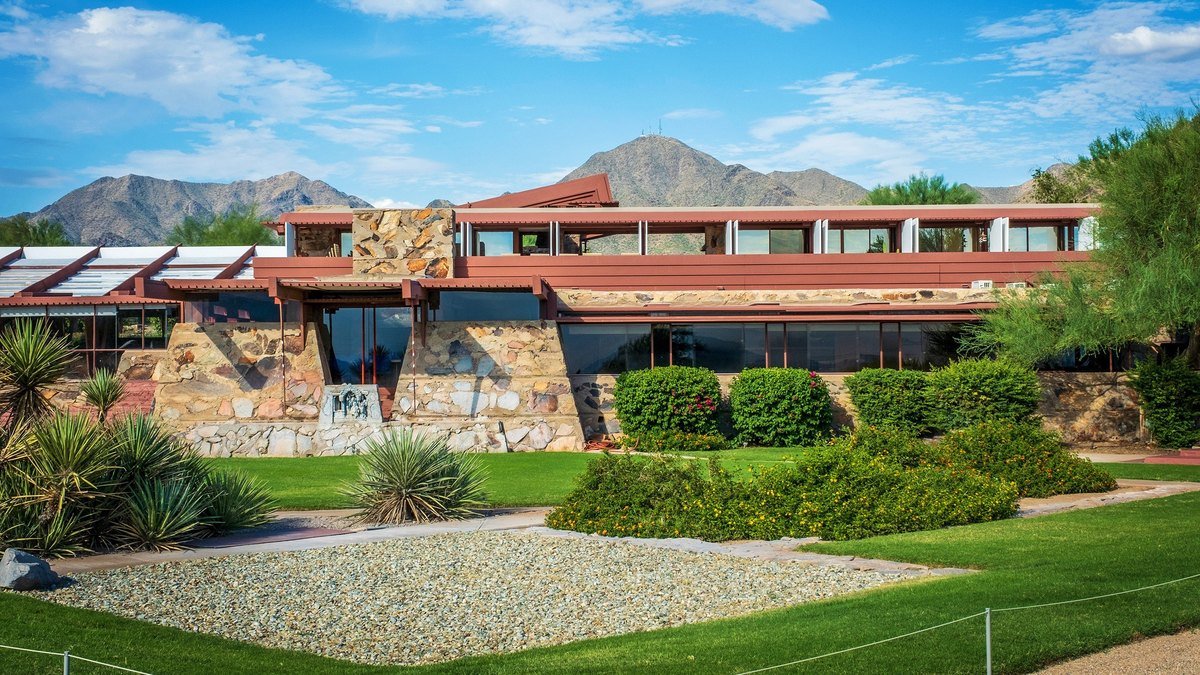
Taliesin West, established in 1937, was where Wright spent his winters in the later years of his life.
The campus of low-slung buildings was designed and constructed to reflect the desert landscape. It was built mainly using wooden beams and local rock bound by a mixture of cement and desert sand, according to the Frank Lloyd Wright Foundation.
“It’s a phenomenal architectural design resource in the Scottsdale community,” Douglas Sydnor, a Scottsdale architect, historian, and author, told Realtor.com. “What Frank Lloyd Wright did there, coming out to the desert and purchasing that property and seeing what composed the desert: its rock formations and color of landscape. It reflects extremely well in that project.”
When it was first constructed, the roof of Taliesin West was comprised of rectangular canvas panels, rather than traditional materials. The canvas was lightweight, translucent, and could be opened and closed to control air flow and temperature, according to the Taliesin Institute’s Director of Preservation, Rebecca Barron.
Because the home was more of a winter getaway than permanent residence, the roof panels were removed seasonally, then reinstalled and repaired as needed before Wright and his apprentices returned.
“It’s always been a place that incurred experimentation and inventive ways of construction, so it kind of grew and changed over time. And most of that occurred during Frank Lloyd Wright’s life until he passed away in 1959,” said Sydnor. “After that, the Taliesin Fellowship took over. They continued to experiment and do such things, but some with mixed results.”
After Wright’s death, changes were made to allow Taliesin West to be occupied year-round. Updates included enclosing interior spaces, installing air conditioning, and replacing the canvas roofing panels with insulated acrylic panels in the 1990s.
For roughly a decade, architects at Taliesin West have been exploring ways to return to a fabric roof system. While the same canvas Wright used during his lifetime would be unsustainable for the home’s current use, they have explored new materials, such as PTFE fabric, as a modern alternative, Barron shared in a May article about the project.
“They’ve removed some of the editions and changes that just weren’t in keeping with the original spirit of what Wright had evolved there,” said Sydnor. “The challenges continue with restoring the property because the cost to do it throughout is quite a staggering figure.”
Authorities have not identified what roofing material was involved in the accident or established any connection to the Institute’s preservation work.