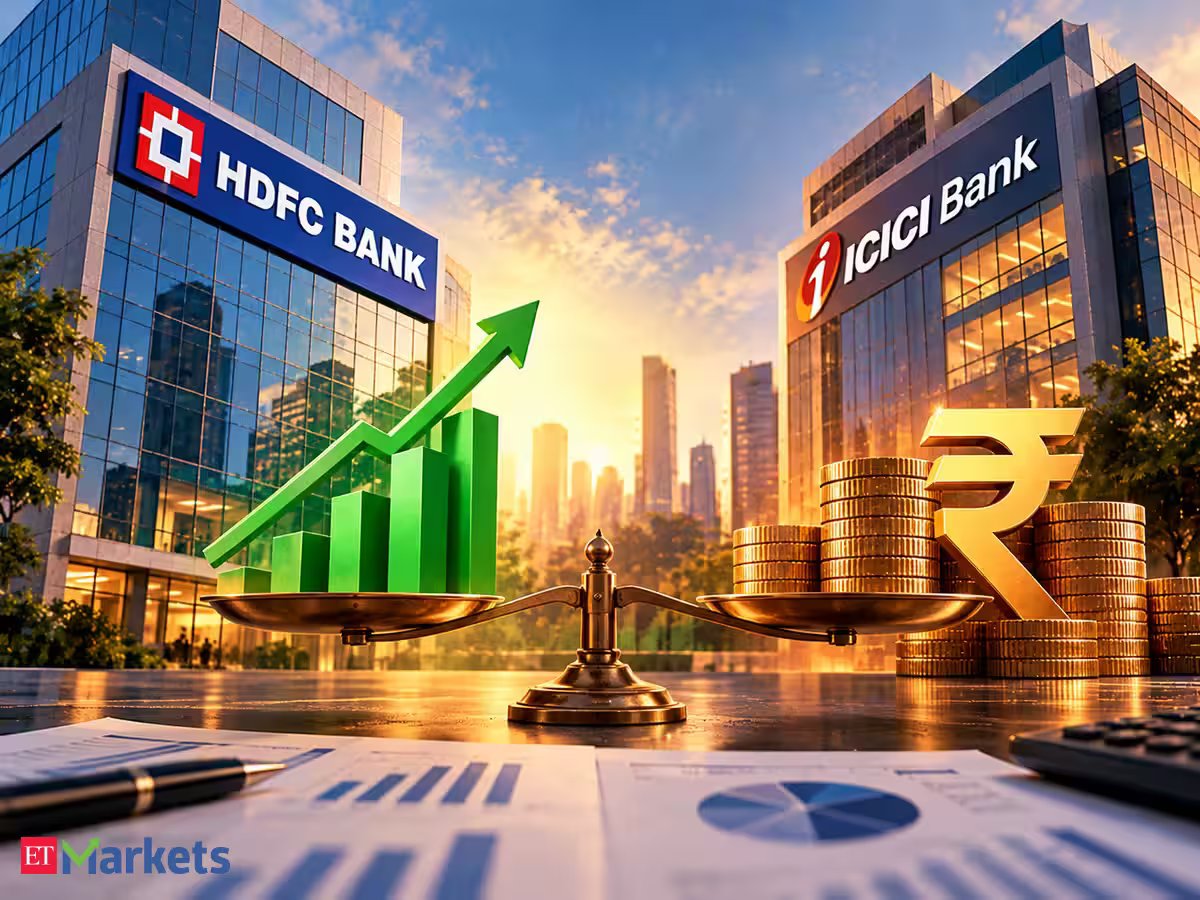
HDFC Bank vs ICICI Bank: One has the growth, the other has the valuation edge. Which stock to buy?
ICICI Bank reported a 20% year-on-year (YoY) increase in second-quarter profit to Rs 14,800 crore. HDFC Bank’s profit rose 5% to Rs 19,500 crore. HDFC remains the larger bank by earnings, but ICICI is expanding at almost twice the pace.
ICICI Bank’s loans grew 30%, and deposits rose 27%. Even after excluding FCNR(B)-linked lending, loan growth stood at 24%, while deposits excluding FCNR(B) increased 17%.
HDFC Bank’s loan growth was 16.4%, falling to 14.4% after excluding FCNR(B)-related lending. Deposits increased 18.8%, but the bank’s retail funding momentum continues to lag its larger peers.
That gap is at the centre of the HDFC Bank debate. Anand Rathi said HDFC Bank has struggled to close the post-merger gap with ICICI Bank across key operating metrics. With CASA growth continuing to trail loan growth, the brokerage expects it will take longer for HDFC Bank to narrow its funding cost disadvantage.

ICICI Bank’s growth, however, has been partly fuelled by the mobilisation of around $18 billion in FCNR(B) deposits. The bank deployed a substantial portion of the funds into loans, including a sharp increase in its overseas book.
That helped accelerate the balance sheet but also created near term pressure on margins. Overseas assets earn around 1%, compared with more than 4% on domestic assets. ICICI Bank’s reported net interest margin declined 18 basis points sequentially to 4.18%, and management expects further moderation in the third quarter before recovery from the fourth quarter.HDFC Bank’s reported NIM on assets stood at 3.16%, down 10 basis points sequentially. Its margin pressure came from FCNR(B) flows, funding costs and a lower CASA ratio. The bank’s CASA ratio fell to 31.6%, compared with 36.1% for ICICI Bank.
The difference is that HDFC Bank’s margin recovery could become the next catalyst. About 70% of its loan book is linked to floating rates, and analysts expect benefits from the recent rate hike, the deployment of FCNR(B) deposits and the run-off of high cost borrowings.
Anand Rathi said HDFC Bank’s margins may have bottomed out. It expects the bank’s return on equity to remain around 14% over the medium term, while maintaining a buy rating and a ₹966 price target.
JM Financial has also upgraded HDFC Bank to buy from add, citing attractive valuations after the stock’s correction. It expects around 15% loan growth and 14% earnings-per-share growth over FY26-29.
Also Read | ICICI Bank share price target after Q2 results: What are Jefferies, other analysts saying?
Valuation gap between ICICI, HDFC
The valuation gap explains why the two stocks continue to attract different kinds of investors. ICICI Bank is being valued at a premium because of its stronger growth and execution. Anand Rathi considers its consistent outperformance sufficient to justify premium valuations and has a ₹1,865 price target. JM Financial values the bank at 2.4 times estimated FY28 core price-to-book value and has a ₹1,710 target.
HDFC Bank, in contrast, is valued at 1.8 times estimated FY29 price-to-adjusted book value by Anand Rathi. Its target implies a larger potential recovery from the current price, even though its expected growth and return ratios remain below those of ICICI Bank.
Asset quality does not provide a decisive advantage to either lender. HDFC Bank’s gross NPA ratio declined to 1.11%, compared with 1.20% for ICICI Bank. ICICI Bank’s net NPA ratio was lower at 0.30%, against 0.37% for HDFC Bank.
ICICI Bank’s credit cost fell to 0.20%, helped by lower slippages and a large corporate recovery. HDFC Bank’s credit cost rose slightly to 0.46%, although gross and net slippages declined sequentially. HDFC also carries a contingent provision buffer of about ₹49,500 crore, or roughly 1.5% of loans.
The leadership transition adds another variable for HDFC Bank. Anup Bagchi’s appointment has reduced uncertainty around the top job, but potential exits of senior executives, including Kaizad Bharucha’s request for early cessation, could create some business disruption, according to Anand Rathi.
Also Read | HDFC Bank shares fall 2% after Q2 results. What are Jefferies, Motilal Oswal analysts saying?
For ICICI Bank, the key risk is that FCNR(B)-fuelled growth keeps margins under pressure for longer than expected. For HDFC Bank, the challenge is more structural as it must close the gap in deposits, funding costs and returns without compromising asset quality.
The market is currently paying for ICICI Bank’s growth and execution. HDFC Bank’s sharp correction has created a valuation opportunity, but its rerating will depend on evidence that margins have bottomed and the post-merger growth gap is narrowing.
(Disclaimer: This article has been written by Nikhil Agarwal, who is not a SEBI-registered Research Analyst or an Investment Adviser. Nikhil Agarwal and his/her ‘relative(s)’ (as defined under Section 2(77) of the Companies Act, 2013) do not hold any financial interest in the companies mentioned in this article as of the date of publication. The views/recommendations mentioned in this article, wherever applicable, are those of the respective SEBI-registered Research Analyst/brokerage and have been reproduced/reported with due attribution. They should not be construed as the views or recommendations of The Economic Times Digital or the journalist. Readers are advised to consider the original research report and make their investment decisions based on their own assessment. Brokerage disclaimers here)