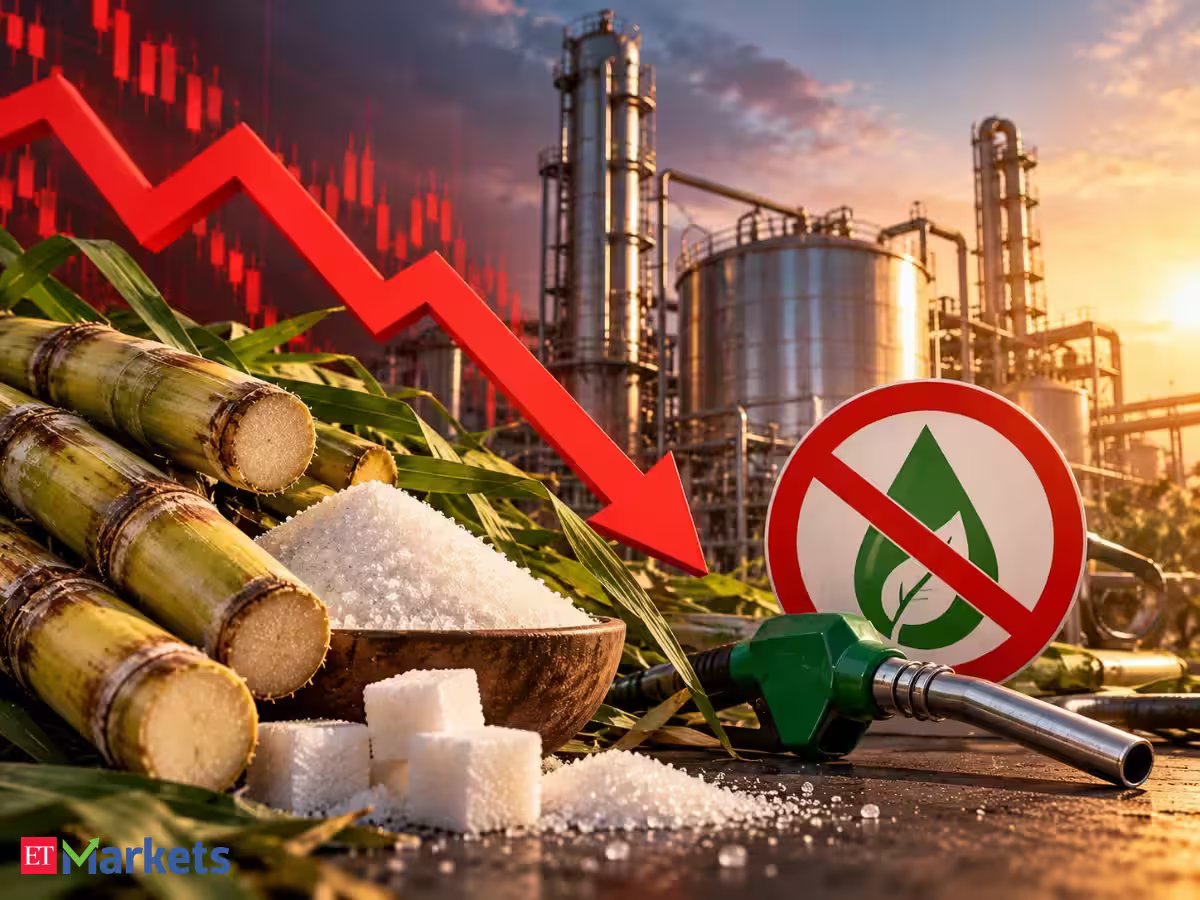
Sugar stocks Balrampur Chini, Bajaj Sugar, others crash up to 7% as centre stops diversion to ethanol
In Monday’s trade, Bajaj Hindusthan Sugar led the losses, falling over 7%, followed by Shree Renuka Industries, which declined more than 6%. Balrampur Chini Mills dropped 4% and Triveni Engineering and Industries fell over 3%, while EID Parry and Dhampur Sugar shed over 2% each.
The government’s decision restricts mills’ ability to shift sugarcane and molasses between sugar and ethanol production based on market conditions, potentially weighing on margins and returns from investments in ethanol capacity. The move aims to increase domestic sugar availability and ease prices that have reached record highs in India, the world’s largest sugar consumer.
The decision also reflects the government’s focus on safeguarding domestic food supplies amid concerns that weak rainfall in key producing states could affect sugar output, Reuters cited Motilal Oswal and Choice Broking analysts.
Sugar demand outlook

India’s sugar demand typically rises between August and November as festivals such as Ganesh Chaturthi, Dussehra and Diwali drive consumption of sweets, biscuits and other confectionery products. Ahead of the festive season, the Centre reduced the period for which sugar dealers can hold stocks to 15 days and capped their holdings at 1,000 quintals. The restrictions, effective from October 15 to November 30, 2026, are intended to prevent hoarding and ensure supplies continue to move through the market.
Also read: 11 years, zero net FII flow: How a $64 billion outflow erased 9 years of equity buying
Supply concerns have also intensified globally, particularly in Brazil, the world’s largest sugar producer, which has warned of harvest delays due to adverse weather. Brazil’s suspension of its bi-weekly harvest and production reports has further limited visibility on the supply outlook.
In Europe, heatwaves and El Nino conditions across the EU and the UK have raised concerns about tighter supplies, with regional sugar output estimates trimmed to 14.98 million tonnes. Thailand, the world’s third-largest sugar producer, has also reduced its projected output by 15.6% to 9.5 million tonnes.
These production concerns have shifted expectations for the global sugar market. While a surplus was anticipated at the start of the year, weather-related risks have raised the prospect of supply falling short of demand.
According to Bloomberg, sentiment among sugar traders has turned more positive. Commodity Futures Trading Commission (CFTC) data as of September 29 showed that net short positions in raw sugar had declined to their lowest level in more than 21 months, indicating that large speculators had significantly reduced their bets on falling prices.
Weather-related disruptions across major producing regions have become a key source of concern for global sugar supplies this year, raising the possibility that production could fall well below initial estimates.
In Brazil, persistent heavy rainfall has disrupted sugarcane harvesting and milling. Green Pool Global has cut its sugar production estimate for the 2026/27 season in Central-South Brazil by 3%. Europe’s outlook is also challenging, with estimates from the EU Monitoring Agricultural Resources Unit indicating that the region’s crop could be around 11% below its five-year average.
Disclaimer: This article has been written by Veer Sharma, who is not a SEBI-registered Research Analyst or an Investment Adviser. Veer Sharma and his/her ‘relative(s)’ (as defined under Section 2(77) of the Companies Act, 2013) do not hold any financial interest in the companies mentioned in this article as of the date of publication. The views/recommendations mentioned in this article, wherever applicable, are those of the respective SEBI-registered Research Analyst/brokerage and have been reproduced/reported with due attribution. They should not be construed as the views or recommendations of The Economic Times Digital or the journalist. Readers are advised to consider the original research report and make their investment decisions based on their own assessment. Brokerage disclaimers here.