NRI’s ₹3.41 crore FCNR deposits flagged as unexplained money after tax officer mistook yen for rupees, ITAT gives relief
The Jaipur tribunal deleted the addition after finding that bank records established the source of two foreign-currency deposits and the tax department had accepted the explanation in the woman’s husband’s case.
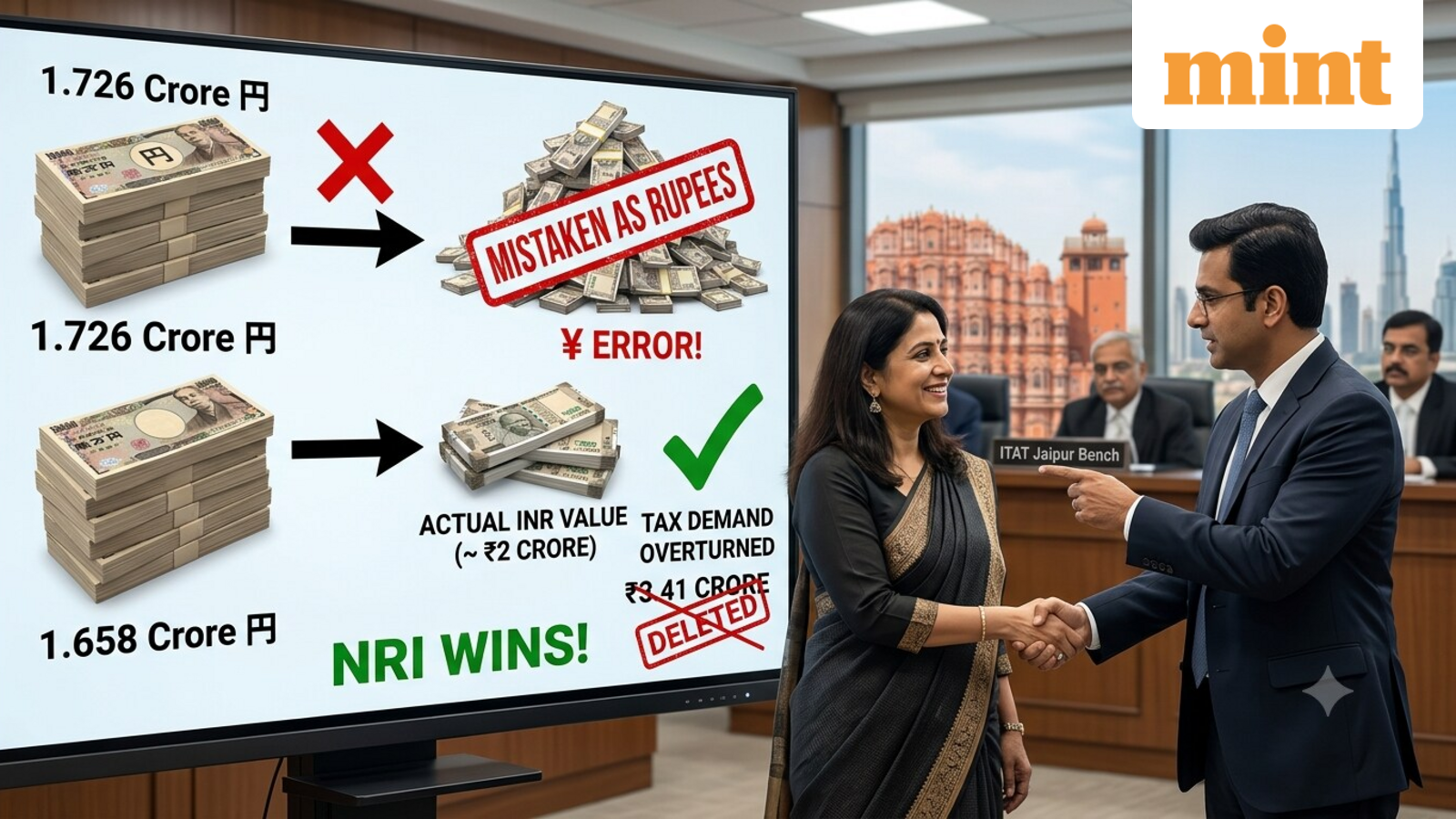
A Dubai-based non-resident Indian (NRI) has won relief from a ₹3.41 crore income tax addition after the Income Tax Appellate Tribunal (ITAT), Jaipur, found that the assessing officer had mistaken Japanese yen figures for Indian rupees while examining two foreign currency deposits.
In its order dated 22 September 2026 in Deputy Commissioner of Income Tax v. Kavita Khanwani (ITA No. 867/JPR/2025, assessment year 2018-19), the tribunal upheld the Commissioner of Income Tax (Appeals)’ decision to delete the addition made under Section 69A of the Income-tax Act, 1961, which deals with unexplained money.
The tribunal found that the deposits were funded through a joint Non-Resident External (NRE) savings account, with bank records tracing the money to transfers made through banking channels. It also noted that the tax department had accepted the explanation for the same deposits in the woman’s husband’s assessment.
How a currency error led to a ₹3.41 crore tax addition
Khanwani, who lives in Dubai, held two Foreign Currency Non-Resident (FCNR) term deposits jointly with her husband, Kishan Chand. He was the first holder of both deposits, while she was the second holder.
The deposits were denominated in Japanese yen. The first, opened on 14 October 2017, had a principal of 1.726 crore yen, while the second, opened on 21 February 2018, had a principal of 1.658 crore yen.
However, the assessing officer treated the foreign-currency figures as rupee amounts and added ₹3.41 crore to Khanwani’s income as unexplained money for assessment year 2018-19.
The tribunal found that the principal of the two deposits was approximately 3.38 crore yen, while the actual rupee amount invested was about ₹2 crore. The addition of ₹3.41 crore did not correspond to any amount in Indian rupees found in the taxpayer’s possession, it observed.
Bank records established the source of the deposits
The tribunal examined statements for the two FCNR deposits and the joint NRE savings account from which they were funded.
The records showed that each deposit was funded through a debit of approximately ₹1 crore from the savings account. Each debit was preceded by a ₹1 crore credit received through the banking channel, with the transaction narration bearing the name of Chand, the first holder of the deposits.
The tribunal also noted that the assessing officer had sought information from IndusInd Bank under Section 133(6) of the Income-tax Act in November 2022. The bank had confirmed the transactions and provided information about the source of the funds.
The department did not dispute the authenticity of the bank statements or challenge the finding that Chand’s explanation for the same deposits had been accepted in his assessment.
“The immediate source is thus identified from the bank’s own record and points to the first holder,” the tribunal observed in its order.
Why the addition could not stand
Section 69A applies when a taxpayer is found to own money but fails to explain its nature and source, or the assessing officer is not satisfied with the explanation offered.
In this case, the tribunal noted that Khanwani was the second holder of the deposits, while her husband was the first holder and had already explained the source of the funds in his own assessment. The department had accepted that explanation.
The same deposits, therefore, could not be treated as unexplained money in Khanwani’s hands when their source had been established and accepted in her husband’s case, the tribunal held.
It also noted that Khanwani’s non-resident status was consistent with her Dubai address and the nature of the NRE and FCNR accounts. Under Section 5(2), a non-resident’s income is generally taxable in India if it is received or deemed to be received in India, or accrues or arises, or is deemed to accrue or arise, in India. The tribunal found that no such income had been identified to justify the disputed addition.
The ITAT dismissed the tax department’s appeal and upheld the deletion of the ₹3.41 crore addition. The ruling relates specifically to Khanwani’s case; her husband’s separate proceedings are not decided by this order.