₹9 lakh in Post Office MIS vs ₹9 lakh in bank FD: Which gives a higher monthly income?
In the current difficult-to-predict geopolitical environment, equity markets in India have underperformed over the last few years. This brings focus to fixed-income instruments such as small savings schemes and bank fixed deposits.
Now, investing ₹9 lakh in a Post Office Monthly Income Scheme (MIS) or a bank fixed deposit (FD) can help an individual generate regular income without facing market-linked volatility.
This regular income will be generated while keeping the principal out of market-linked investments. Still, the monthly income will ultimately depend on the interest rate and payout terms.
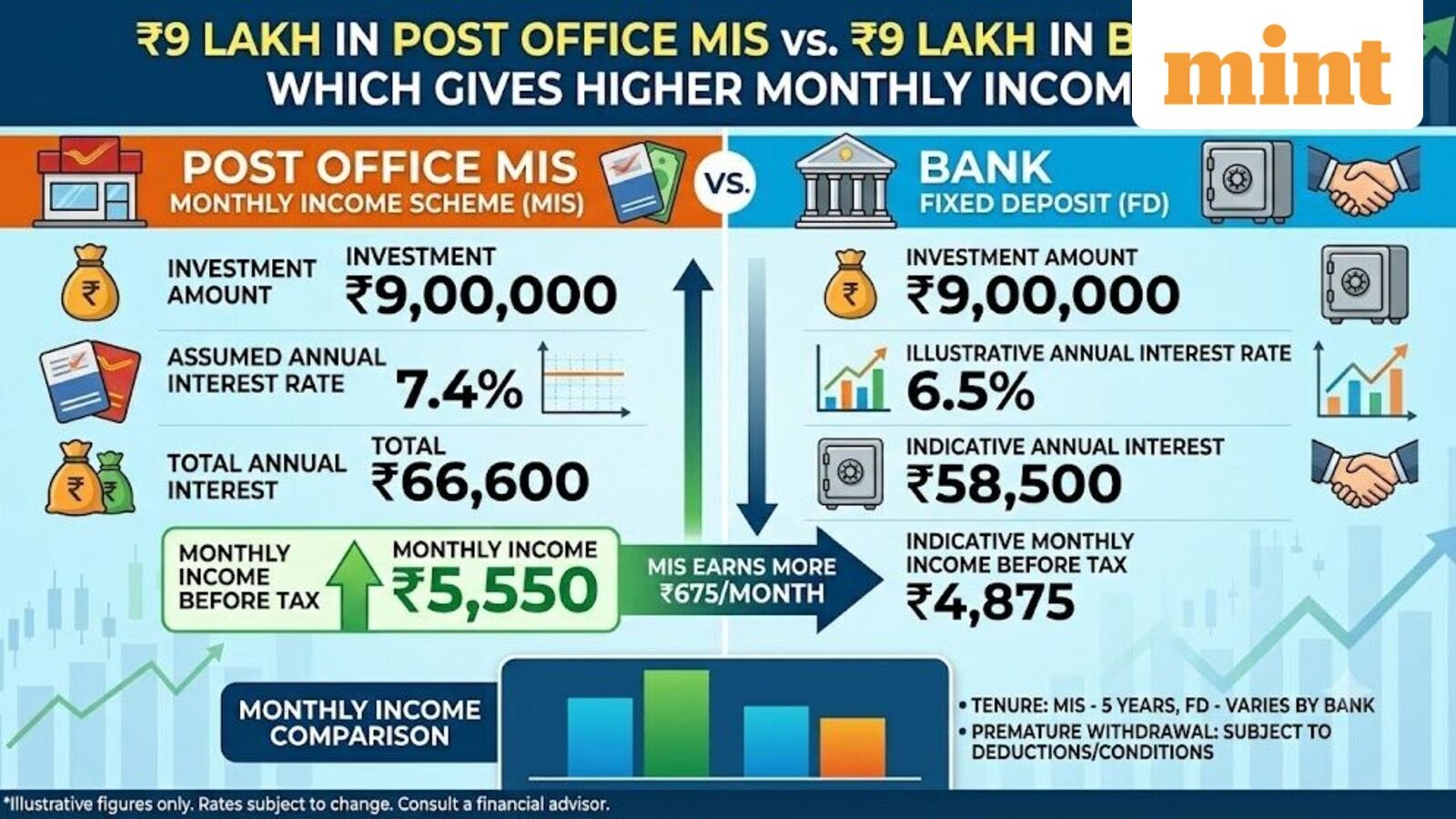
Furthermore, at the current Post Office MIS interest rate of 7.4%, an investment of ₹9 lakh earns ₹5,550 a month before taxation. In comparison, a bank FD offering investors an illustrative annual interest rate of 6.5% will generate an indicative monthly income of ₹4,875 before taxation, subject to the banking institution’s payout calculations.
It is also vital to note that the FD rate taken above is illustrative only. This is because FDs across different lending institutions offer better returns subject to eligibility criteria, tenures, and terms. For example, senior citizens can even get more than 8% on FDs in select small finance banks for specific tenures. Still, the comparison for this particular article is for an FD that normal citizens can do.
Post Office MIS vs bank FD: Monthly income comparison
Here is how the two options compare for a ₹9 lakh investment.
|
Particulars |
Post Office MIS |
Bank FD |
|---|---|---|
| Investment amount | ₹9 lakh | ₹9 lakh |
| Annual interest rate | 7.4% (latest rate as per government) | 6.5% (presumed rate for a common FD) |
| Annual interest | ₹66,600 | ₹58,500 |
| Monthly income before tax | ₹5,550 | ₹4,875 (indicative) |
| Tenure | 5 years | Depends on bank and FD |
| Interest payout | Monthly | Depends on payout option |
Note: The bank FD rate is illustrative. Actual monthly payouts may differ depending on the bank’s terms. MIS rates are subject to government review.
Hence, at these assumed interest rates, the Post Office MIS generates ₹675 more per month, or ₹8,100 more on an annual basis, before taxation.
It is vital to keep in mind that the MIS has a 5-year tenure and returns the principal at maturity. Further, the maximum investment limit for this scheme is ₹9 lakh for a single account and ₹15 lakh for a joint account.
Premature closure of the scheme is allowed after one year, subject to deductions of 2% of the principal if closed before three years and 1% if closed from three years to, before the date maturity.
Which option should investors choose?
The Post Office MIS scheme may suit investors who are seeking predictable monthly income in a hassle-free manner. The current rate offered for the October to December 2026 quarter is 7.4%. A bank FD, on the other hand, may be preferred by those individuals who aspire to invest for a different tenure and also meet the eligibility criteria for higher FD rates offered by other prominent lending institutions and banks.
Senior citizens, for example, may also qualify for higher FD rates, depending on the banking institution. For example, several small finance banks currently offer lucrative rates of more than 8% to senior citizens.
In summary, at today’s presumed bank FD rate of 6.5%, the Post Office MIS offers higher monthly income. Still, investors should compare important factors such as prevailing FD rates, withdrawal conditions, tenures, specific eligibility criteria and tax implications before choosing either option.
In case of doubt, it is wise to seek professional advice from a certified financial advisor and to devise an investment plan in accordance with your long-term financial objectives. This will help ensure that a proper and meaningful investment decision can be made that supports growth and financial well-being.
Disclaimer: This article is for general information only, not investment advice. Investors should assess their financial circumstances and consult a qualified financial adviser before investing.