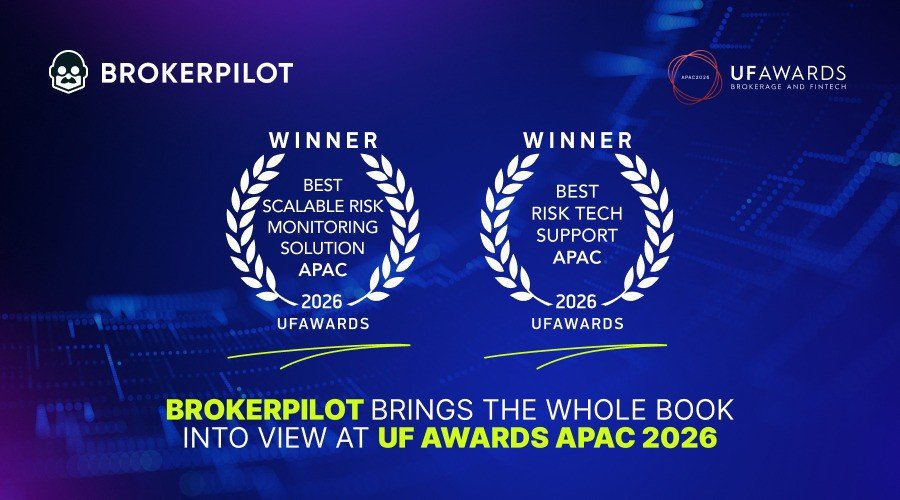
Brokerpilot Brings the Whole Book Into View at UF AWARDS APAC 2026
Brokerpilot, the risk management and dealing automation technology provider for FX and CFD brokers, has been nominated for the UF AWARDS APAC 2026. The nomination brings attention to a central question for institutional risk management: how can a brokerage keep a clear view of its business as its operations become more complex? Find out more on Telegram.
For Brokerpilot, the answer starts with the dealing desk. Its platform brings monitoring, alerts, reporting and AI assistance into one workspace, helping teams understand their exposure and make informed decisions across MT4, MT5 and cTrader. The aim is to extend the capacity of the people responsible for managing risk while keeping their judgement central.
The whole book needs to be visible
A brokerage can expand across platforms, add instruments and attract new clients while still relying on fragmented views of its trading activity. Each system may show part of the picture. The dealing team must then assemble those parts quickly enough to understand what the combined exposure means.
That is where institutional discipline becomes an everyday operational requirement. Owners and chief executives need confidence that growth remains within the firm’s capacity to manage it. Heads of dealing need to understand where attention is required. Risk analysts need information they can investigate without losing sight of the wider book.
Brokerpilot connects to a broker’s trading infrastructure, bringing its operations into a shared risk workspace. Teams can monitor activity across supported platforms without changing their trading stack, creating a consistent starting point for analysis and action.
An alert should help a dealer decide
The value of real-time risk monitoring depends on what happens after a signal appears. Dealers need to understand whether an unusual movement is isolated, whether it is becoming a pattern and how it relates to the exposure they already hold.
Brokerpilot’s alerts chart is designed to help teams distinguish a one-off spike from a developing trend. This gives dealers context for investigating activity and deciding what deserves closer attention.
As the company puts it: “Most losses in a book don’t come from a single big event. They come from what nobody noticed in time. Brokerpilot acts as an always-on chief dealer, surfacing toxic flow and exposure in real time so the dealing team can act before it becomes a loss.”
That philosophy places early visibility at the centre of broker risk management. Monitoring should give experienced people the opportunity to assess a situation while their decisions can still influence the outcome.
Built around the working day
Brokerpilot applies the same thinking to the way information is presented. Its flexible risk board allows panels to be collapsed, expanded and rearranged. Filters sit in a side drawer and appear as visible chips, while critical metrics remain pinned on screen as dealers scroll.
These details serve a practical purpose. As client numbers, instruments and servers increase, the workspace needs to remain readable. A dealer investigating one part of the business should still be able to see the figures that matter across the operation.
The platform also includes an AI hot zone that brings relevant context into view, alongside a digital assistant that dealers can ask for the information they need. Brokerpilot describes this as a “second brain”: support for the team’s analysis and attention, with people retaining responsibility for decisions.
A decade shaped by brokerage operations
Brokerpilot began in 2015 with a focused brief: brokerage risk monitoring. Its first version connected to MetaTrader 4 servers and was tested with three brokerage firms. By 2017, it had added MetaTrader 5 support, developed 25 anti-fraud alert triggers and reached its first ten brokerage clients.
Its development continued through additional controls, account aggregation and industry partnerships. In 2024, Brokerpilot partnered with Spotware, the creator of cTrader. In 2025, its customer base passed 100 brokers worldwide, and it received Best Risk Management Solution – Global at the UF AWARDS.
The APAC 2026 nomination adds a regional dimension to that record. For brokerage decision-makers assessing risk technology, the underlying consideration remains practical: how well does the system support the team using it every day?
Connecting the next stage of growth
Brokerpilot’s next step is to build an ecosystem connecting liquidity, AI, risk management and education. Its stated goal is to make liquidity flows, exposure and dealer decisions visible and manageable within one connected environment as brokerages adopt platforms and hybrid models.
The direction follows the principle behind the original product: give the dealing team an understanding of the business it is responsible for protecting. For brokers, sustainable expansion begins with the ability to see what is changing and respond with confidence.
To explore Brokerpilot’s approach to institutional risk management, book a presentation.
Brokerpilot, the risk management and dealing automation technology provider for FX and CFD brokers, has been nominated for the UF AWARDS APAC 2026. The nomination brings attention to a central question for institutional risk management: how can a brokerage keep a clear view of its business as its operations become more complex? Find out more on Telegram.
For Brokerpilot, the answer starts with the dealing desk. Its platform brings monitoring, alerts, reporting and AI assistance into one workspace, helping teams understand their exposure and make informed decisions across MT4, MT5 and cTrader. The aim is to extend the capacity of the people responsible for managing risk while keeping their judgement central.
The whole book needs to be visible
A brokerage can expand across platforms, add instruments and attract new clients while still relying on fragmented views of its trading activity. Each system may show part of the picture. The dealing team must then assemble those parts quickly enough to understand what the combined exposure means.
That is where institutional discipline becomes an everyday operational requirement. Owners and chief executives need confidence that growth remains within the firm’s capacity to manage it. Heads of dealing need to understand where attention is required. Risk analysts need information they can investigate without losing sight of the wider book.
Brokerpilot connects to a broker’s trading infrastructure, bringing its operations into a shared risk workspace. Teams can monitor activity across supported platforms without changing their trading stack, creating a consistent starting point for analysis and action.
An alert should help a dealer decide
The value of real-time risk monitoring depends on what happens after a signal appears. Dealers need to understand whether an unusual movement is isolated, whether it is becoming a pattern and how it relates to the exposure they already hold.
Brokerpilot’s alerts chart is designed to help teams distinguish a one-off spike from a developing trend. This gives dealers context for investigating activity and deciding what deserves closer attention.
As the company puts it: “Most losses in a book don’t come from a single big event. They come from what nobody noticed in time. Brokerpilot acts as an always-on chief dealer, surfacing toxic flow and exposure in real time so the dealing team can act before it becomes a loss.”
That philosophy places early visibility at the centre of broker risk management. Monitoring should give experienced people the opportunity to assess a situation while their decisions can still influence the outcome.
Built around the working day
Brokerpilot applies the same thinking to the way information is presented. Its flexible risk board allows panels to be collapsed, expanded and rearranged. Filters sit in a side drawer and appear as visible chips, while critical metrics remain pinned on screen as dealers scroll.
These details serve a practical purpose. As client numbers, instruments and servers increase, the workspace needs to remain readable. A dealer investigating one part of the business should still be able to see the figures that matter across the operation.
The platform also includes an AI hot zone that brings relevant context into view, alongside a digital assistant that dealers can ask for the information they need. Brokerpilot describes this as a “second brain”: support for the team’s analysis and attention, with people retaining responsibility for decisions.
A decade shaped by brokerage operations
Brokerpilot began in 2015 with a focused brief: brokerage risk monitoring. Its first version connected to MetaTrader 4 servers and was tested with three brokerage firms. By 2017, it had added MetaTrader 5 support, developed 25 anti-fraud alert triggers and reached its first ten brokerage clients.
Its development continued through additional controls, account aggregation and industry partnerships. In 2024, Brokerpilot partnered with Spotware, the creator of cTrader. In 2025, its customer base passed 100 brokers worldwide, and it received Best Risk Management Solution – Global at the UF AWARDS.
The APAC 2026 nomination adds a regional dimension to that record. For brokerage decision-makers assessing risk technology, the underlying consideration remains practical: how well does the system support the team using it every day?
Connecting the next stage of growth
Brokerpilot’s next step is to build an ecosystem connecting liquidity, AI, risk management and education. Its stated goal is to make liquidity flows, exposure and dealer decisions visible and manageable within one connected environment as brokerages adopt platforms and hybrid models.
The direction follows the principle behind the original product: give the dealing team an understanding of the business it is responsible for protecting. For brokers, sustainable expansion begins with the ability to see what is changing and respond with confidence.
To explore Brokerpilot’s approach to institutional risk management, book a presentation.