AmEx’s Next Step for Agentic Commerce Is a Framework; Forter’s Agentic Verification Move – Digital Transactions
With at least two AI agents available that can make payments on behalf of users, payments companies are preparing for a larger role for agentic commerce. American Express Co. Tuesday published a framework for trusted agentic commerce, something it hopes could be part of a larger standard for the payments industry.
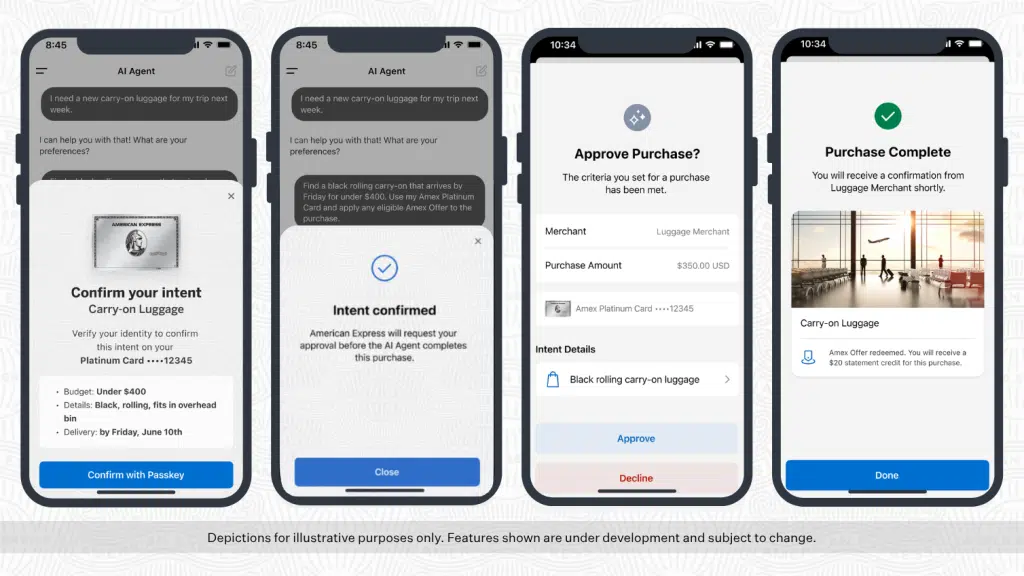
The Intent Intelligence Framework is meant to capture and authenticate a customer’s purchase intent before an AI agent completes a transaction, AmEx says. What makes this framework unique, AmEx says, is that it makes the customer’s authorized purchase intent available to issuers earlier in the transaction lifecycle, before the AI agent actually makes the purchase. The framework complements the issuer’s earlier release of a software development kit called Agentic Commerce Experiences. AmEx is chair of the EMVCo agentic commerce working group.
Initially developed with AmEx’s unique business model in mind—it is the issuer, acquirer, and network for its cards—the framework is flexible to work with other models. Its key trait is its flexibility, says Hannah Bozian, AmEx vice president of agentic partnerships.
That’s important because, unlike in traditional e-commerce transactions, a new third party, the AI bot, is present when it was just the consumer and the merchant previously. So far, AmEx is seeing “thousands” of weekly agentic-commerce transactions through different integrations the network supports, Bozian says.
“That changes in agentic commerce, Bozian tells Digital Transactions News. “You have a customer, a merchant, and now you’ve got an agent.” In some cases the customer might tell the agent to find a product and then purchase it. “It’s really important to establish what it is the customer is looking for and make sure the merchant is fulfilling what the customer wants.”
By sending the customer’s intent earlier in the transaction flow issuers can use that information to make better authorization decisions, she says.
“We think that if issuers have access to this intent data earlier when the customer makes the request and makes their intent to the agent, we can leverage that,” Bozian says. “Whether that is making sure we’re making the right authorization decisions, which hopefully results in increased authorizations while also decreasing fraud, agent, and other risks.

“If we have signals that say this might not be what the customer was asking for, it might be the wrong merchant, it might be too expensive, it might be the wrong size. And so we think that will help by mitigating those risks, [and it] will drive trust in the overall ecosystem.”
Fundamental to the framework is keeping the customer in control of their agentic-commerce purchases, she says. “It’s not just a capability, it’s about keeping the customer in control. And so knowing that they have signed off on this thing, that they— their intent, that they can edit their intent if they want, they can do that via AmEx or via their agent. And then they can cancel an intent.”
The framework has four elements. It starts with the consumer creating and confirming their agentic-commerce purchase intent. The Create Intent API captures these purchase instructions and constraints. Once the customer authenticates their identity, the intent is captured by the agent. The next step is Intent ID, which is a unique identifier created along with a Proof of Intent Token.
This token can then be used at the time of purchase to obtain a secure digital payment credential that the agent uses at checkout instead of actual credit or debit card data.
In the subsequent phase of the purchase journey, the Intent ID and Proof of Intent Token are used as controls and help validate that the purchase request aligns with what the customer authorized while supporting fraud prevention, authorization decisions, and dispute-resolution measures.
If adopted by other payments entities, the framework would work the same, but use that issuer’s network and tokenization services. “It would depend on their implementation,” Bozian says, “but the framework is intended to inform implementation.”
The release of the framework is timely. Others are preparing for potential growth in agentic commerce. Forter Inc., a fraud-prevention specialist, released its Agentic Commerce Engine, a service to enable merchants to verify agentic shoppers and supplies the infrastructure to manage their transaction cycle experience.
Among its capabilities are fraud management, agentic orchestration, and an AI activity dashboard to help merchants monitor agentic-commerce transactions.