SBI Research urges govt to scrap LTCG tax on equities to attract foreign investors
To boost foreign capital flows and provide respite to the equity markets, the State Bank of India (SBI) Research has urged the government to abolish the long-term capital gains (LTCG) tax on equities.
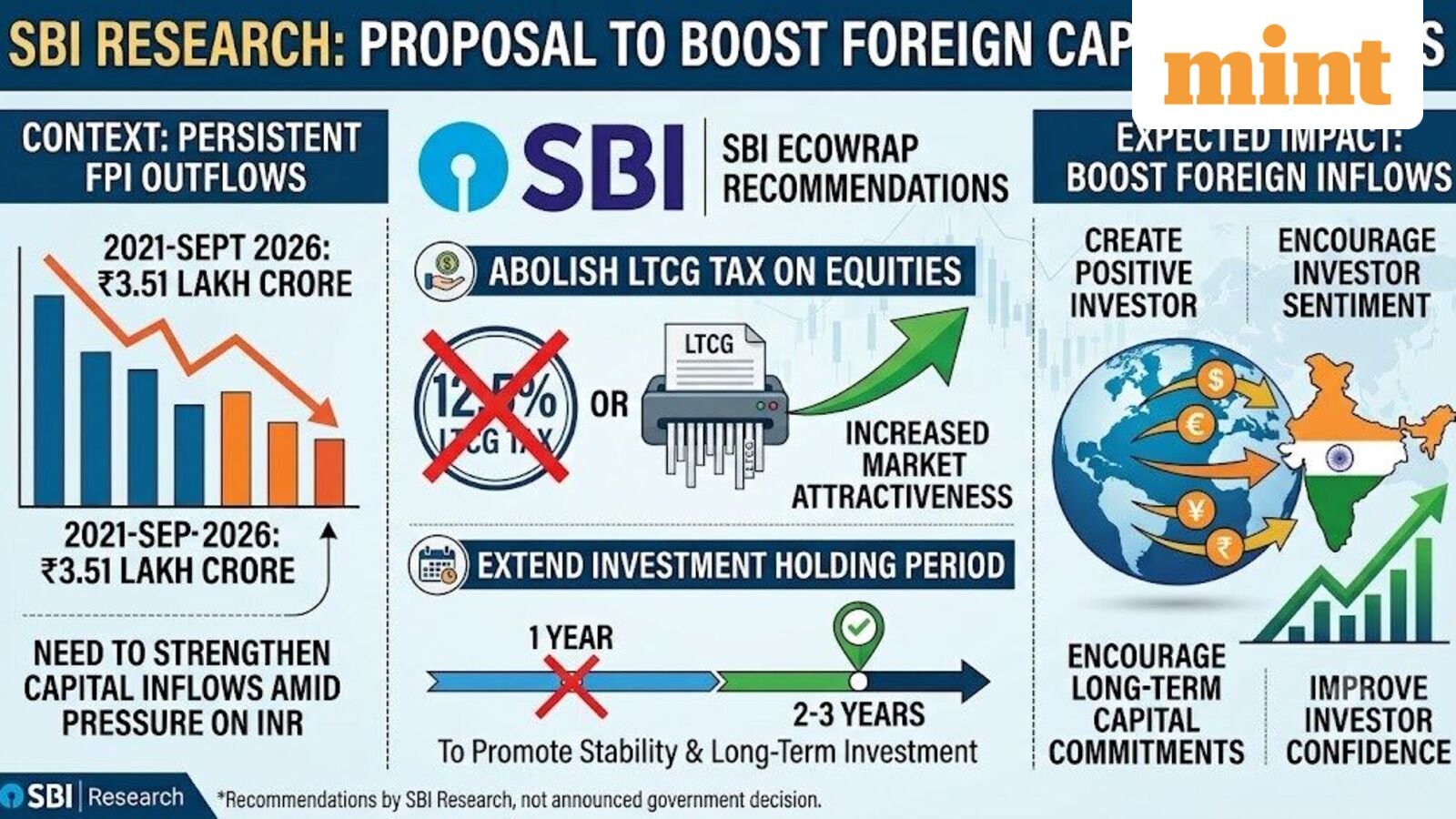
The tabled proposal also calls for extending the investment holding period to two or three years to bring stability, promote long-term investments, and improve investor confidence amid sustained selling by foreign portfolio investors (FPIs).
As per a report by ANI, SBI Research, in its more recent Ecowrap release, stated that the government needs to focus on introducing structural reforms and meaningful changes to strengthen capital inflows. It also underscored that monetary and foreign exchange interventions by the Reserve Bank of India (RBI) alone may not be sufficient to address pressure on the INR.
SBI Research flags persistent FPI outflows
The report also explained how the Indian equity markets have witnessed significant foreign investor withdrawals over the last few years, with FPI outflows totalling ₹3.51 lakh crore between 2021 and September 2026. Not only this, outflows exceeded ₹2.61 lakh crore in 2026 alone, following redemptions of ₹1.66 lakh crore in 2025.
SBI Research elaborated that this trend calls for meaningful changes and measures to make the Indian equity markets more attractive to global investors. It suggested extending the holding period to two or three years while completely removing the LTCG tax on equity investments, primarily to create positive investor sentiment and encourage long-term capital commitments.
The report also noted that India continues to offer investment opportunities through established domestic companies and blue-chip stocks. However, a more favourable taxation framework could help strengthen the country’s competitiveness in attracting foreign capital.
Tax reforms seen as key to attracting capital
SBI Research also called for greater clarity on withholding tax applicable to external commercial borrowings, which currently ranges from 5% to 20%, to improve investor confidence.
The report’s recommendations come amid concerns over the rupee’s depreciation and pressure on India’s balance of payments. Although foreign exchange reserves remain adequate even under stressed scenarios, the balance of payments surplus is expected to narrow to around $55–60 billion in FY27.
The proposals are aimed at encouraging more stable and long-term investment flows and improving the attractiveness of Indian financial markets. However, these are recommendations from SBI Research and do not represent an announced government decision to change the existing LTCG tax framework.