IHC, First Abu Dhabi eye stake in Bandhan Bank promoter
ET was first to report in its March 13 edition that BFSL was looking to give its long term investors an exit.
BFSL, led by Bandhan founder Chandra Shekhar Ghosh, has been working with advisers Jefferies to find strategic investors for 25-32%.
 ET Bureau
Early investors GIC & IFC jointly hold 30% in BFSL, keen to exit
Up to $600m of Stake
That will open up an exit option for GIC of Singapore and the International Finance Corporation (IFC), backers of the firm for more than a decade. Together, these two held 30.3% of BFSL at the end of March, and have been seeking a full or partial exit, said the people cited. Their stake alone could be worth $500-600 million, they said.
Other investors include Small Industries Development Bank of India (Sidbi), which owns 8.1%. Financial Inclusion Trust and North East Financial Inclusion Trust own a total 40.7%. The Bandhan Employees’ Welfare Trust holds 14.6%. If other shareholders also choose to exit, it will lead to a much larger transaction.

Also read: Banks seek clarification on implementation of RBI forex measures
BFSL has two subsidiaries–Bandhan Technologies, an IT services and AI-led technology company, and Bandhan Financial Holdings, the holding company of Bandhan Bank, Bandhan AMC, Bandhan Mutual Fund Trustee, Bandhan Investment Managers (Mauritius) and Bandhan Life Insurance.As of March 31, BFSL owned 59.98% of Bandhan AMC and 97.16% of Bandhan Life Insurance Co. Singapore’s GIC and Chrys Capital are other investors in the asset management firm.
Bandhan Financial Holdings Ltd had a stake of 37.5% in the bank at the end of June. As per the bank’s licensing agreement with the Reserve Bank of India, it must reduce the stake to 26% by 2030.
Banks and sovereign funds have been widely canvassed in the Gulf for a stake in BFSL, said the people cited. They are said to include First Abu Dhabi Bank and Qatar Investment Authority as well as a few PE buyout funds such as Carlyle, EQT.
“We don’t comment on market speculation,” Bandhan Bank chairman Ghosh told ET.
A First Abu Dhabi Bank spokesperson said in reply to ET’s queries, “As a matter of policy, we do not comment on individual client relationships, transactions, or market speculation.”
IHC and other entities cited above didn’t respond to queries.
The discussions are at an early stage and there is no guarantee it will lead to a transaction, said the people cited.
“Discussions are picking up momentum, but the contours are evolving,” said one investor who’s examining the deal. “It’s a complicated one and a lot depends on the regulator too.”
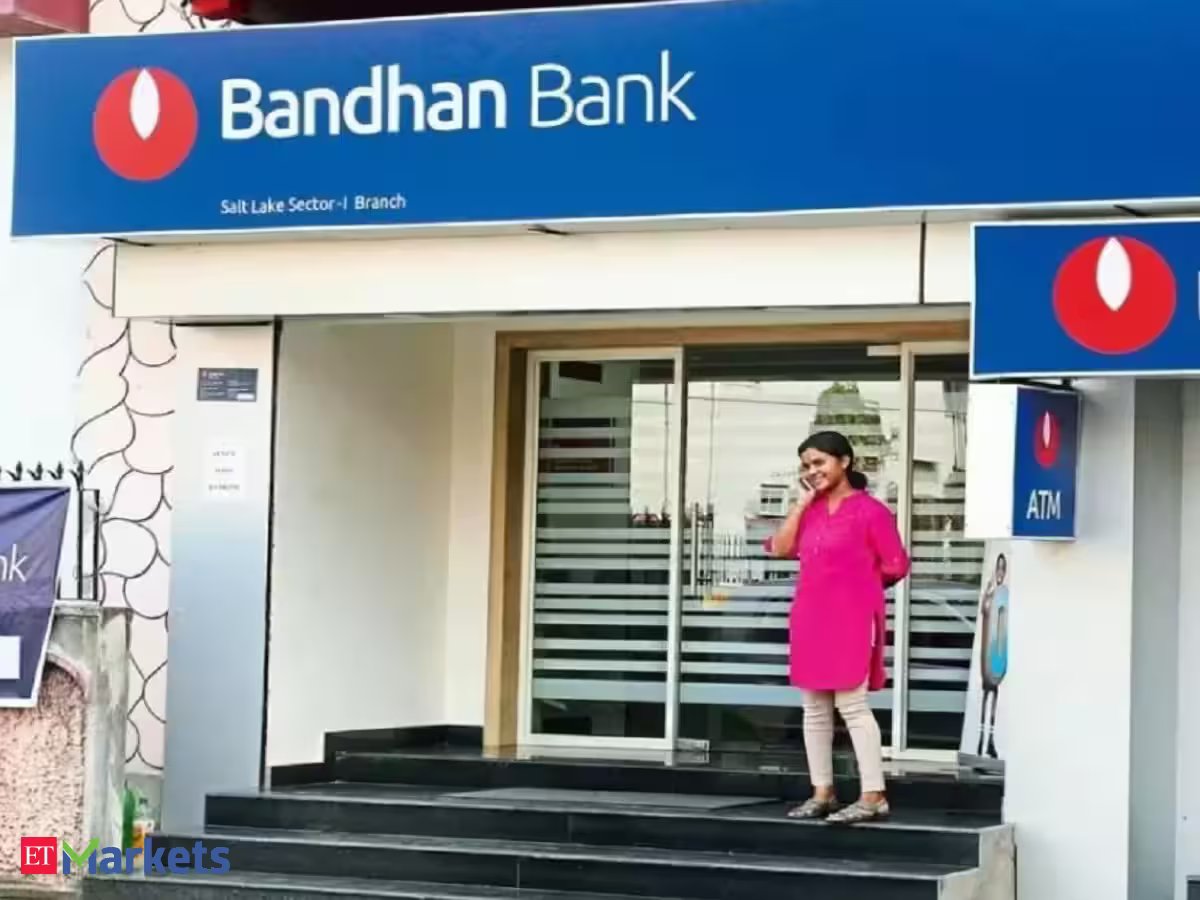
Having started out as a microfinance lender in 2001, Bandhan became a full-fledged private sector bank in August 2015. It has one of the largest microfinance loan books in India–Rs 35,000 crore on June 30. The total loan book of the bank stands at Rs 1.56 lakh crore with total deposits of Rs 1.65 lakh crore. Bandhan has a capital adequacy ratio of 18.2% with common tier 1 ratio of 17.5% on June 30. The bank has 1,988 branches and a total customer base of 31.8 million.
Also read: DBS Chief sees overseas confidence in India despite capital outflow concerns
The bank slashed its FY27 return on assets (RoA) guidance while announcing its June quarter results in July, triggering a 15% plunge in the stock to Rs 177.50, its sharpest intraday decline since the Covid-19 market crash in March 2020. On Monday, it ended at Rs 157, up 13.32% year to date, for a market value of Rs 25,351.40 crore.
The guidance was driven primarily by external factors such as elevated technology cost and moderation in NIM outlook. Also, FY27 loan growth guidance was cut to the lower end of the 14-15% range guided earlier due to a slowdown owing to rising asset quality risk from higher energy costs and supply chain disruptions as well as uncertain monsoons.
“Bandhan underscored that the growth cut was pre-emptive and that on the ground, asset-quality trends remain benign, including improving delinquency trends in both newer as well as older vintages, with the credit cost guidance retained at 1.6-1.8%,” said Anuj Singla and Harsh Wardhan Modi, analysts at JP Morgan. “Guidance cut was the key focus.”
Gulf Corridor
Bandhan Technologies recently opened an office in Abu Dhabi. It also signed a strategic partnership in September 2026 with KMK Group, a subsidiary of the Khalid Al Hamed Group, in Abu Dhabi.
Following the acquisition of RBL Bank by Emirates NBD, West Asian financial institutions have been actively scouting investment opportunities in lending and financial technology services firms. Emirates NBD completed its investment of $2.75 billion in RBL Bank in June after securing regulatory approvals, while IHC has committed $1 billion for a controlling stake in Sammaan Capital.
“The UAE believes in India and is one of our largest foreign direct investment sources of capital. They have already invested $25 billion and are the seventh-largest source of FDI. They have also given intent to invest another $25 billion in the near future,” commerce and industry ministry Piyush Goyal said last month after co-chairing the 14th India-UAE High-Level Joint Task Force on Investments with Abu Dhabi Investment Authority Managing Director Sheikh Hamed bin Zayed Al Nahyan.
Goyal said the UAE aims to take its investments in India to $100 billion.