Hammack says Fed rate hikes are unlikely to mitigate key inflation drivers
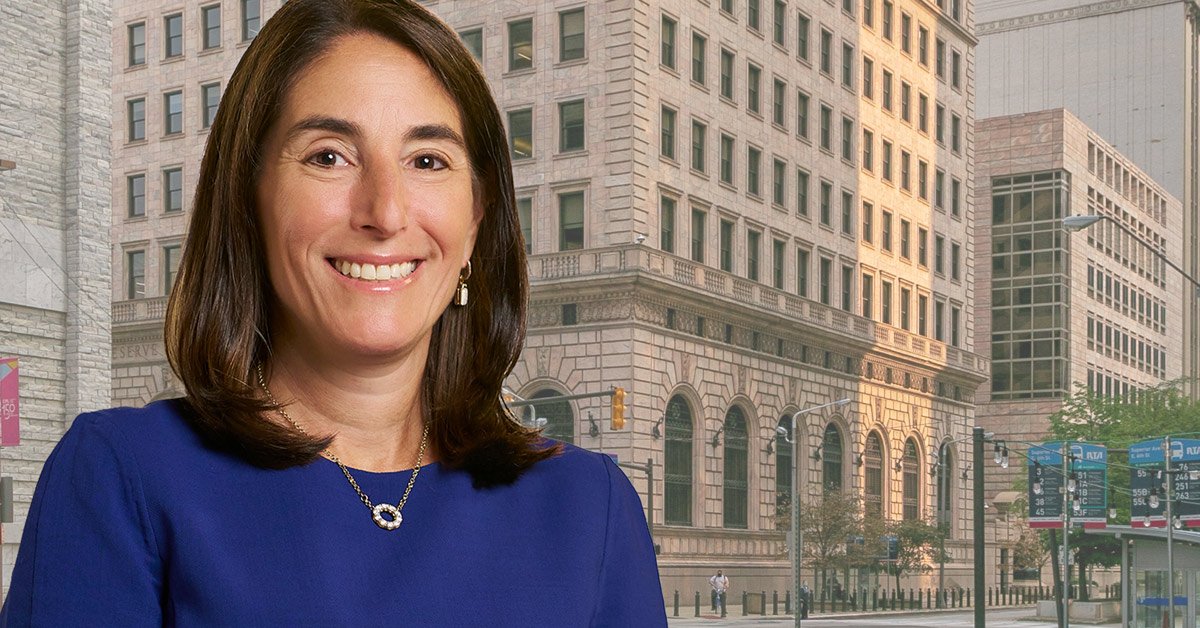
Cleveland Fed President Beth Hammack advocated for the return to a “restrictive” stance for U.S. monetary policy while delivering public remarks on Monday.
Speaking at an annual gathering of the National Association of Business Economists (NABE), which took place in Cleveland this year, Hammack said inflationary pressures are increasingly being observed in a wide range of sectors and industries.
“I see inflation pressures as relatively broad-based, rather than concentrated in one component,” said Hammack, citing rounds of “cost shocks” raising prices for consumers and businesses from wars, tariffs, a shrinking labor force and massive spending on the artificial intelligence buildout.
Advertisement

To counter these price pressures, the Federal Reserve raised the federal funds rate in September by a quarter-point, increasing the benchmark interest rate for the U.S. economy to a target range of 3.75% to 4%. That was the first Fed rate hike since 2023.
A majority of the Federal Open Market Committee (FOMC) that votes on the policy rate believes additional tightening will be necessary to return inflation to the central bank’s stated 2% target. The Fed has a dual mandate to maintain price stability and full employment.
But to the room of economists present on Monday, Hammack — who as a regional Fed president cycled onto the FOMC in 2026 — conceded that a few Fed rate hikes will likely do little to tame underlying drivers of inflation.
Key inflation drivers may be rate insensitive
“I’m under no illusion that raising interest rates will reopen the Strait of Hormuz, will lower energy prices, or will materially stop the data center demand,” said Hammack, adding that that higher short-term interest rates are unlikely to dissuade an AI hyperscaler from building a new data center.
What higher borrowing costs might do, however, is convince an aviation company to delay expansion plans for a year or two, she said. Lower demand for skilled workers and building materials like steel and aluminum could therefore ease cost pressures that Hammack says are emerging in more sectors.
“I want to cool the economy at the margins,” said Hammack. “We’re seeing strong growth in the economy and I want strong growth. I like that we’re seeing that.”
As supply-side pressures mount from global energy and trade disruptions, however, sticky services inflation and various demand-side pressures have increased the urgency for more aggressive action, said Hammack.
Demand-side pressures fueled by AI spending and investment, for example, have raised demand for computing, labor and construction resources also needed by the aviation, electricity production and home building industries. Businesses in Hammack’s district cite broader cost pressures “in health insurance, plastics, metals, grains, electricity and other areas.”
But while a decline in energy prices could help ease cost pressures, she underscored that demand-side pressures are “not self-correcting” and typically prove more persistent.
“Because of the breadth of inflationary pressures, my baseline forecast is that it will take some time for inflation to return to 2%, even with appropriate monetary policy,” said Hammack.
Even with recent increases in U.S. Treasury yields, too, Hammack said she observes financial conditions as “neutral, rather than holding demand back.” As a result, she believes the Fed needs to set “restrictive” monetary policy.
‘A reaction function is not forward guidance’
During prepared remarks, Hammack also explained her opposition to reducing Fed communication with consumers and financial markets.
Kevin Warsh, who took over as Fed chair in May, has advocated for a quieter central bank and has stopped including forward guidance in policy announcements. Warsh has also been criticized for a reluctance to explain his so-called “reaction function,” or how incoming economic data impacts his outlook on policy conditions.
“Explaining the reaction function is accountability through transparency,” stated Hammack. “As a policymaker, I believe I have a responsibility to the public to explain why I make the decisions that I make.”
On the flip side, Hammack emphasized her belief that when consumers and businesses understand the reaction functions of individual policymakers it “helps to limit unproductive volatility in financial markets.”
That reaction function should not be confused as forward guidance by markets, however, she said.
Echoing remarks made by Fed Governor Christopher Waller last week, Hammack also defended the benefits of the Summar of Economic Projections, a forward-looking tool that effectively allows policymakers to take the temperature of the U.S. economy within the context of monetary policy.
Warsh has refused to participate in the forecasting exercise, saying that he believes it tethers the Fed to a predetermined policy course.
“A reaction function is not forward guidance,” added Hammack. “Treating the two as interchangeable can turn a well-meaning explanation of logic into the expectations of a promise.”