The VC Rebound Won’t Save All Lab Real Estate
As the UK life sciences real estate sector grew in the years just before and after the pandemic, venture capital money was its lifeblood, seeding startup companies with big ideas and helping them grow and take more space.
That source of funding plummeted as rates rose from 2022 onward, and the sector suffered accordingly — leasing levels dropped sharply.
Now, venture capital is on the up again, more than doubling between the first and second quarter this year — but it is flowing in different directions, which may not help developers and owners of lab-led schemes who have been waiting to fill empty space.
:quality(75))
Bisnow/Damilare Media
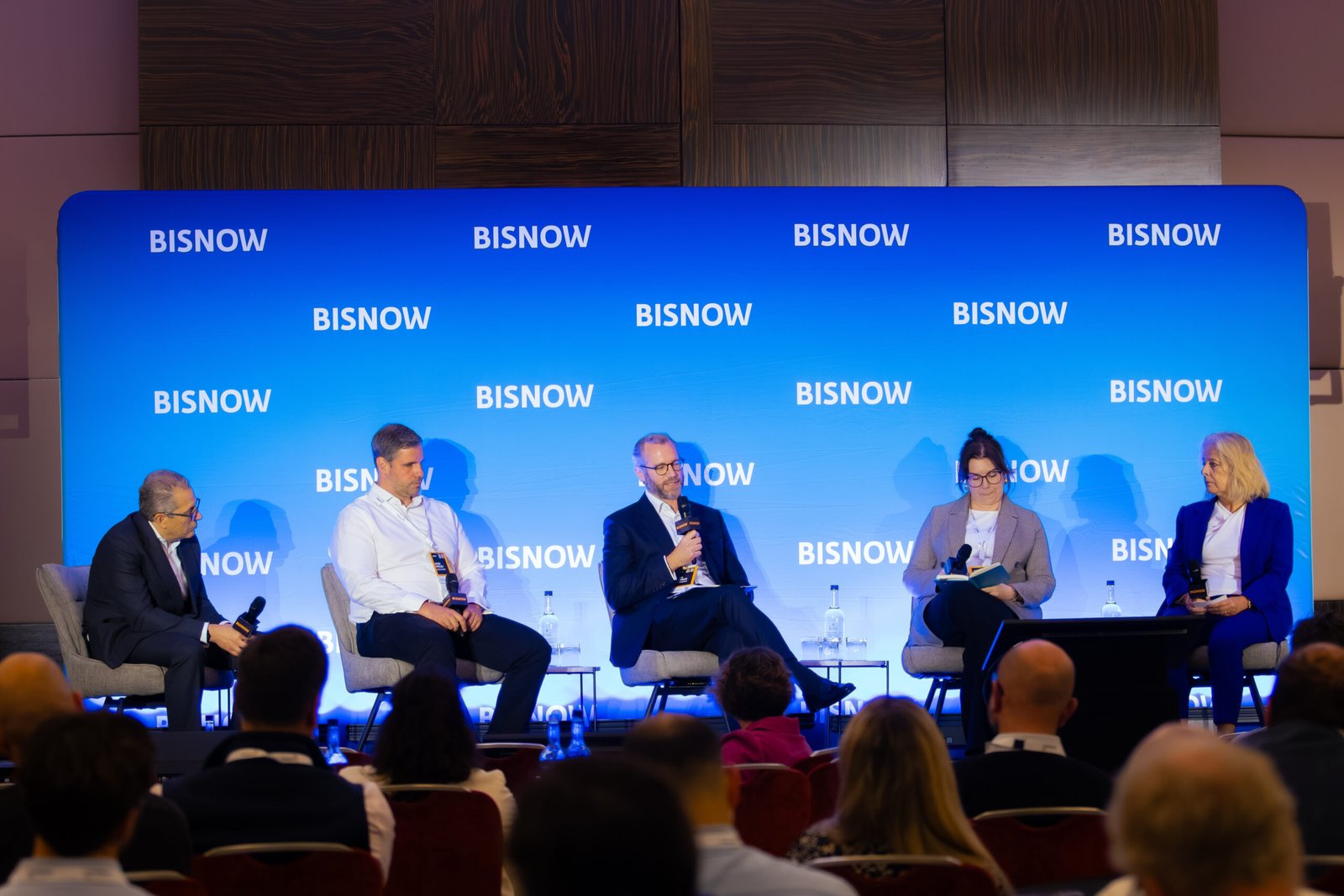
The Crown Estate’s Matthew Weiner, Mission Street’s Artem Korolev, Pioneer Group’s Harry Pickering, King’s College’s Felicity Ranger and CMS’ Candice Blackwood
“This latest VC increase over the last two quarters necessarily hasn’t helped that grassroots level as much as we would like,” Pioneer Group Head of UK Investment Harry Pickering told the audience at Bisnow’s UK Science and Technology Real Estate Annual Conference last week.
The decoupling of VC funding and the leasing of lab space speaks to the way artificial intelligence is the black hole at the centre of the economic universe, inexorably sucking in capital and talent.
But it also underscores the challenge of building real estate in any sector where occupiers are at the cutting edge of innovation. Technology and science change quickly, while building and adapting real estate is very, very slow.
VC funding hit £2B in the second quarter, according to Savills, a 135% increase on Q1 and double the rolling five-year quarterly average.
But £1.6B of that investment went to a single company, Isomorphic Labs, the DeepMind spinout focused on AI-driven drug discovery.
The bulk of VC money flowing toward large AI companies is a problem because much of the lab space designed and built in the development boom of 2021 and 2022 was aimed at smaller biotech and drug discovery companies and thus isn’t suitable for current demand.
And indeed, golden triangle life sciences leasing was 175K SF in Q2, 8% below the five-year rolling average.
“We are seeing some parts of the real estate market which are effectively dormant and are going to have to adapt,” Pickering said. “They can’t sit there in their current form.”
But adapting real estate to new demands is not a quick process, and occupiers have their pick of options given the elevated vacancy in the sector. Building flexibility into schemes is a watchword of the sector, but a biotech firm, an AI drug discovery company and a quantum computing company — another fast-emerging sector — might all have very different space needs.
The picture is even more complex for developers that have consented schemes but have not yet started development. Few firms have the appetite for speculative development at the moment, given build costs are high and values are down. And it is difficult to predict where demand will manifest in the coming months and years. Is a design conceived in 2023 still fit for purpose?
To a big extent, the changes in life sciences show that the real estate maxim of a good location trumping everything will always be true.
Several buildings in the King’s Cross and Euston “knowledge quarter” in London built to tap into lab demand have been leased by AI and tech firms keen to locate in what is fast becoming London’s artificial intelligence epicentre.
The clearest example is Belgrove House in King’s Cross, being developed by private family firm Precis.
The 250K SF building was originally developed to shell and core level for pharmaceutical giant Merck as its UK HQ, but the company pulled its investment last year in a row with the UK government over drug pricing.
But Microsoft is now in talks to lease 200K SF of the building as its UK HQ, drawn by the depth of AI talent in the area.
“Two years ago looked pretty scary as the VC capital started to drop off, but a lot of that space, which is lab-enabled space, has now been taken up in large part in King’s Cross by AI companies,” Pickering said.
“So where you do have strategically located good buildings with the right floor plates, with the right flexibility, with the know-how, you’re going to see a gravitation of talent and companies going to those locations.”