8th Pay Commission: DA rise over past few years fuels demands for higher fitment factor
The three-member 8th Pay Commission panel, headed by Justice Ranjana Prakash Desai, held its consultative meeting in Bengaluru on 8 October. The Commission will next hold key discussions in Mumbai on 22 and 23 October.
Over the last 11 months, since the constitution of the 8th Pay Commission on 3 November 2025, the panel has held several important meetings across India, including in Delhi, Ladakh, West Bengal and Puducherry.
In the meetings, several unions and associations have highlighted grievances related to rising inflation and urged the 8th Pay Commission panel to consider them to improve the livelihoods of serving central government employees and pensioners.
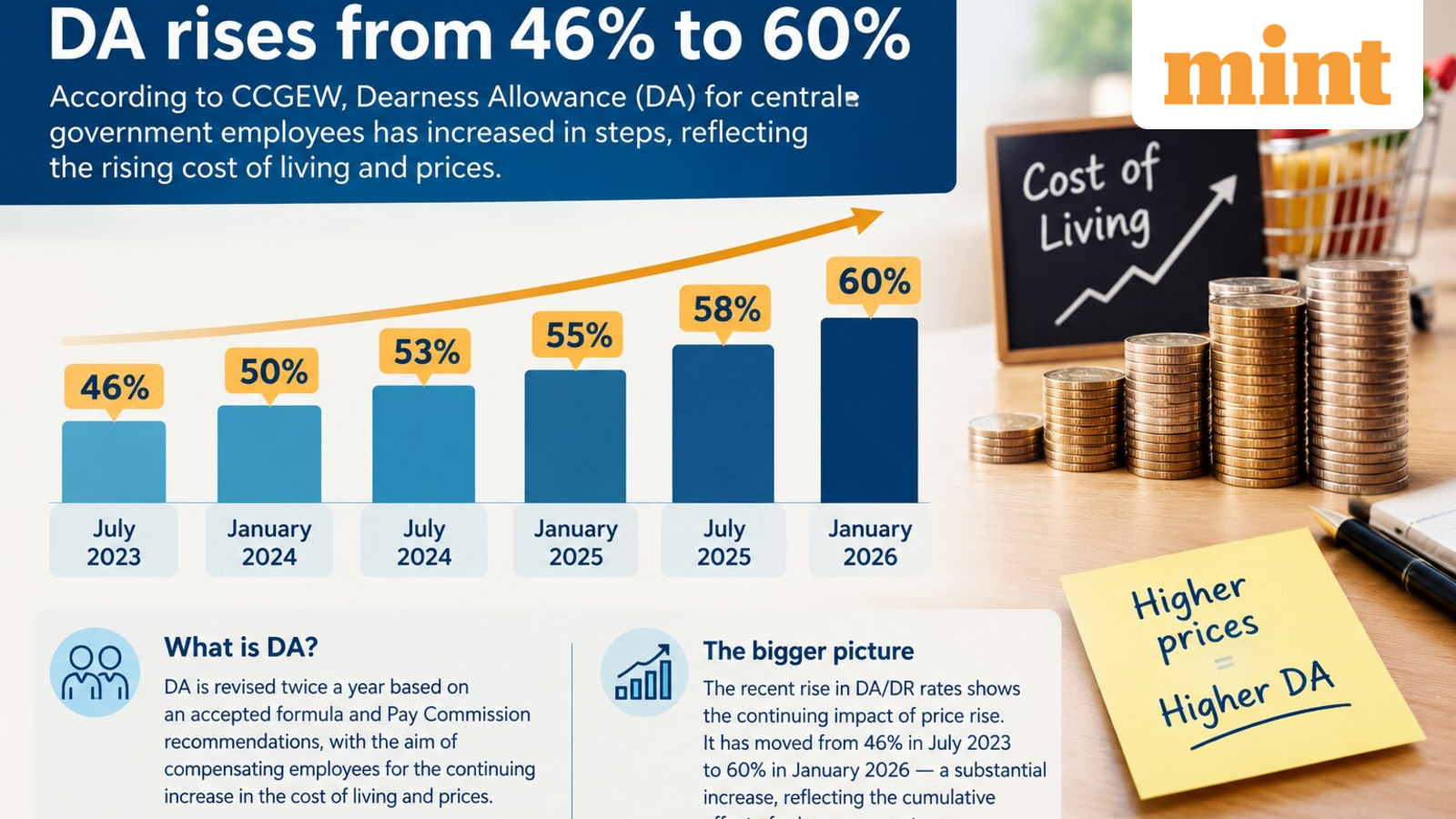
The Dearness Allowance (DA) rose from 46% in July 2023 to 60% in January 2026, highlighting the inflationary pressures that central government employees and pensioners underline should be reflected in the next pay revision.
As the 8th Central Pay Commission considers changes to salaries and pensions, employee organizations are pressing for a higher ‘fitment factor’ multiplier and changes to the existing DA mechanism.
Let us see how the rising DA is shaping the fitment-factor demands of prominent unions.
How rising DA is shaping fitment factor demands
As per the Confederation of Central Government Employees and Workers (CCGEW), DA increased from 46% in July 2023 to 50% in January 2024, 53% in July 2024, 55% in January 2025, 58% in July 2025 and 60% in January 2026. These numbers highlight the cumulative impact of price movements.
The fitment factor is a multiplier applied to existing basic pay to determine revised basic pay under a new pay structure. The 7th Pay Commission recommended a factor of 2.57, and the 6th Pay Commission adopted a fitment factor of 1.86. This time, several employee unions have proposed higher figures for the 8th Pay Commission.
The National Council-Joint Consultative Machinery (NC-JCM) staff side, for example, has sought a fitment factor of 3.833 and a minimum basic pay of ₹69,000. Bharat Pensioners Samaj, on the other hand, has also proposed a factor of 3.83, while the Ministerial Staff Association, Survey of India, has sought a factor of 3.61. These demands showcase unions’ shared aspiration to bring changes to address rising inflation.
Unions have also urged the 8th Pay Commission panel to focus on DA merger and periodic pay revisions, to address the same issue slightly differently.
DA merger and periodic pay revision proposals
The Federation of National Postal Organisations (FNPO) has proposed a Permanent Wage Review Body to recommend a revised fitment factor within 90 days whenever DA or Dearness Relief (DR) reaches 50%. It has also been suggested that DA/DR be merged with basic pay once it exceeds 25%.
Bharat Pensioners Samaj has, along similar lines, sought consideration of merging DR with the basic pension once it crosses 25%. Such proposals aim to address concerns that periodic pay revisions may not adequately protect the purchasing power of employees and pensioners against rising living costs.
Central government employees and pensioners await 8th Pay Commission recommendations
Central government employees and pensioners are waiting to see what changes the 8th Pay Commission panel recommends in its final report, tentatively expected to be tabled by May-June 2027.
The 8th Pay Commission’s final recommendations and the central government’s subsequent decision on the same will determine the revised pay structure.
Disclaimer: Readers should refer to the respective employee unions’ memorandums for complete details. These submissions are not approved recommendations. Final decisions will depend on the 8th Pay Commission’s recommendations and the Central Government’s eventual approval.