Will Manchester City’s scandal end ‘sportswashing’?
Manchester City football club has been found guilty of serious financial misconduct by an independent commission appointed by the Premier League, after years of investigations and legal wrangling.
It is a damning verdict. The panel found that the club artificially inflated its revenues by at least $1 billion, with sham contracts designed to get around the rules that are meant to ensure a roughly level playing field between the teams in the league.
The details are complex, but the bottom line is something that has been pretty obvious for years to anyone who follows the game: Manchester City was using the financial firepower of its oil-rich owners in the United Arab Emirates to outspend its rivals. It could offer the biggest transfer fees and the most lavish wages to secure any player it wanted. The club is appealing the decision, but faces significant punishment if it is upheld.
Sign up for MoneyWeek’s free twice-daily newsletter.
Join more than 165,000 subscribers and keep yourself informed with latest financial news, insights and expert analysis to help you understand what really matters when it comes to your finances.
Join more than 165,000 subscribers and keep yourself informed with latest financial news, insights and expert analysis to help you understand what really matters when it comes to your finances.
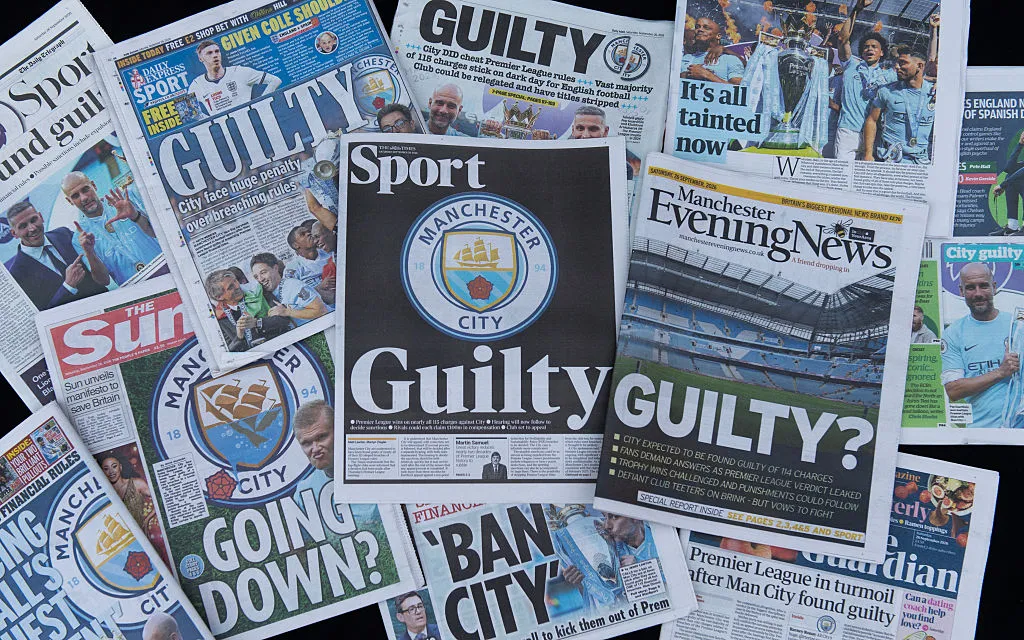
Newspaper headlines after Manchester City was found guilty
(Image credit: Visionhaus/Getty Images)
There is a bigger issue at stake here: “sportswashing” – engaging with high-level sport to spruce up a country’s reputation – is now under threat. It has become a huge business. The Premier League has become one of the most obvious examples, with a whole series of teams owned either directly by foreign states, their investment funds, or by oligarchs closely linked to them.
But it does not stop there. Saudi Arabia has invested heavily in the LIV golf tournament. Qatar spent billions hosting the 2022 World Cup. Russia hosted the 2018 tournament. Formula One includes races in such well-known bastions of human rights and democracy as Bahrain and Azerbaijan.
It’s not hard to see what is in it for the regimes. It raises their profile, boosts tourism and softens their image. For millions of viewers around the world, most of whom are not very interested in politics, the practice introduced them to a country they may not previously have been very aware of. It was all well worth the few billion you might have to spend on stadiums, sponsorship or prize money.

Formula One allows races in Bahrain, a country with a dire human rights violations record
(Image credit: Kym Illman/Getty Images)
Manchester City’s image tarnished beyond repair
The Manchester City scandal is going to change the equation dramatically. There are two major problems. To start with, entire investments can get wiped out in the space of a few days. No one really knows how much money was spent on turning Manchester City from a mid-table English club into one of the most successful teams in Europe. That, after all, is the whole point. We have no idea what was happening with the books. It was a lot, however, that much is for certain. If the team is relegated all the way down to League Two (what used to be the Fourth Division before they renamed it), it will be worth a whole lot less, and perhaps nothing at all. Billions will be lost, with very little chance of ever clawing it back.
Secondly, even if the allegations are proved inaccurate, the club’s image has surely been tarnished beyond repair. No one blames the players or the manager for the scandal, even if they might have asked harder questions about where all the money was coming from. They will blame the owners. But sportswashing only makes sense if it actually improves your reputation. In the wake of this scandal, everyone who follows football, even if only casually, will have a far lower opinion of the regime that backed Manchester City than they did before – the opposite of what was meant to happen.
We don’t yet know if all the money poured into sportswashing is about to dry up completely. The scandal may blow over, and many of the contracts that have been signed can’t be unwound quickly. But in its wake, countries are likely to be more cautious about backing major global events. They will be aware that the money they sink into them may well be lost. They will realise that it may well backfire and make them look very, very bad.
The result is that the money machine will be switched off. Most major sporting events will have to go back to being more modestly financed. The salaries will be lower, existing stadiums will have to be made to work instead of building new ones, and the agents and hustlers who surround the whole circus will have to find something else to do. Sport itself may be much better for that – but a lot of money will have been lost forever.
This article was first published in MoneyWeek’s magazine. Enjoy exclusive early access to news, opinion and analysis from our team of financial experts with a MoneyWeek subscription.