What the industry gets wrong about DIY investors
Processing Content
- Key insight: The line between DIY investors and clients of financial advisors is increasingly blurry, new research shows. Many affluent investors have both self-directed accounts and financial advisors, and planners say they don’t necessarily view held-away assets as a problem.
- Supporting data: In a study of 5,000 investors, benchmarking firm Crisil Coalition Greenwich found that nearly one-quarter of investors with $100,000 to $5 million were “hybrid” investors, using both DIY accounts and financial advisors.
- Expert quote: “I actually like working with self-directed investors. They’re engaged, knowledgeable and genuinely interested in their financial future. I don’t view a self-directed account as competition with the advisor relationship.” — Aaron Gaines of Gaines Capital Management
The wealth management industry’s traditional dividing line between do-it-yourself investors and clients who hire financial advisors may no longer apply to many affluent households.
Among consumers with between $100,000 and $5 million in investable assets, 67% worked with an advisor this year and 54% maintained self-directed accounts with Fidelity Investments, Vanguard, Charles Schwab, E-Trade from Morgan Stanley, Merrill Edge or Robinhood, according to a study released this week by financial industry benchmarking firm Crisil Coalition Greenwich.
Nearly one-quarter — 22% —
When researchers dug deeper into consumers with between $2 million and $5 million, they found that “some common stereotypes about self-directed investors are not necessarily true.” DIYers and hybrid consumers displayed similar risk preferences and willingness to work with investment professionals on a holistic basis. At the same time, hybrid and DIY-only consumers exhibited more cost-related concerns than advice-only investors, and hybrid customers were more likely to say that they could soon leave their advisor.
The findings highlight a familiar challenge for wealth management firms seeking to capture clients’ held-away assets. They also reflect the lead and referral strategies embraced by many of the largest financial services firms that work with both fully advised and DIY clients across multiple business lines.
“In the age of DIY investing, advisors must cultivate open relationships in which clients are comfortable discussing their complete financial picture, which will position the advisor to provide comprehensive advice that takes into account all assets — including those with the advisor and elsewhere,” Nathaniel Brown, the director of client development in wealth management with Coalition Greenwich, said in a statement.
Key findings from the study
Many planners, however, said the findings matched what they see in their practices. In responses to an email query to members of the Financial Planning Association sent by Financial Planning, advisors said that they already serve such “hybrid” consumers.
Still, the benchmarking firm’s “Coalition Greenwich Voice of Client – 2026 Wealth Study,” which surveyed more than 5,000 individual investors, provided a snapshot into how the DIY investors and hybrid consumers compare with traditional advisor-only clients.
On some measures, the groups present similarities:
- At least 26% of advisor-only clients, 28% hybrid consumers and 25% of solely self-directed investors said they “take bigger investment risks if it means the potential for higher returns.”
- Fifty-eight percent of advisor-only clients said they “prefer to work with [an] investment professional who can holistically address their needs across investments, life insurance, banking and taxes,” compared with 49% of both hybrid and self-directed investors.
- Hybrid and advisor-only clients had the same average age of 63, according to the lead author of the study.
The differences between investors became more pronounced when researchers asked them to weigh the value of human advice against digital services. Asked if they would prefer to pay more than 1% for a financial advisor or 0.1% for a digital service, pay 0.5%-1% to hire an advisor, or to pay that 0.1% for the digital service, only 7% of the advisor-only investors chose the cheaper robo option, while 22% of the hybrid investors and 29% of the DIY-only consumers picked it.
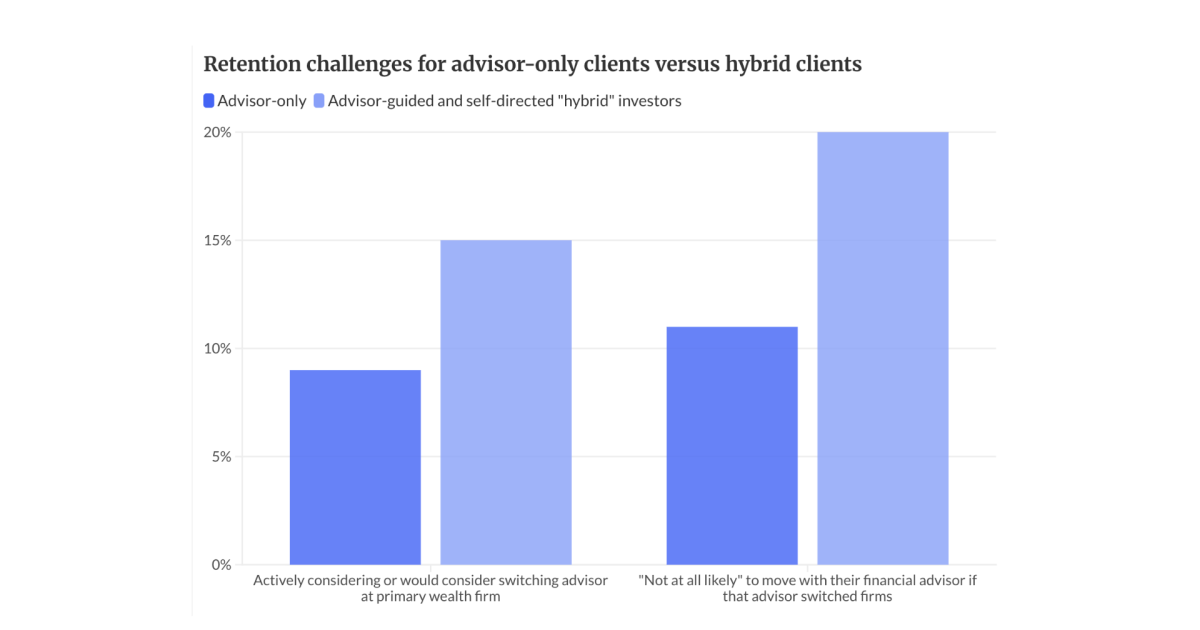
Hybrid investors also appeared less attached to their advisors and were more likely than the advisor-only group to say they would consider changing advisors. At least 15% of the hybrid investors said they were actively considering it or would consider it, compared with just 9% of the advisor-only clients. And 20% of the hybrid clients reported that they are “not at all likely” to follow their advisor to another firm if the advisor were to switch, versus 11% of advisor-only clients.
To better retain hybrid clients, the study suggested that advisors:
“In some cases, the presence of a self-directed account is not an indicator of trouble for the advisor,” the report said. “These clients might place a high value on the service and advice they receive from their advisor and be open to increasing the share of assets housed in the accounts with their advisor over time. The key is knowing when concern is merited. Advisors must understand their clients’ motivations for using a self-directed account and create a strategy that equally meets the needs of both pure advisor-led and hybrid clients.”
READ MORE: How RIA consolidation and slow organic growth is changing compensation
Clients with self-directed holdings are common for some financial planners
That strategy resembles the approach many planners describe toward clients with self-directed accounts, which they didn’t always view as lost wallet share that they needed to bring under direct management.
For instance, Aaron Gaines of Smyrna, Georgia-based Gaines Capital Management said he doesn’t “actively try to ‘convert’ every self-directed dollar,” even though he believes DIY investors can err “when investment management gets confused with financial planning.” So he helps them adapt those self-directed holdings into the overall plan.
“I actually like working with self-directed investors,” Gaines said. “They’re engaged, knowledgeable and genuinely interested in their financial future. I don’t view a self-directed account as competition with the advisor relationship. We have clients who enjoy managing a portion of their investments themselves, and I’m perfectly comfortable with that. My job isn’t necessarily to manage every dollar they have. My job is to help make sure all of those dollars are working toward the same retirement plan.”
Often, situations that demand more complex services, such as sophisticated tax planning methods, will likely nudge self-directed investors toward a full-bore relationship, according to Michael Walstedt of Hoboken, New Jersey-based Reliant Wealth Advisory.
“Some of my clients do have self-directed accounts still, but it doesn’t create any problems, so long as it is a smaller account relative to what is being managed,” Walstedt said. “If someone is inclined to be self-directed fully and they have developed a baseline knowledge of how to invest intelligently, they are going to be an extremely hard ‘sell’ for advisory services, especially if the advisor solely focuses on investment management.”
The rise of self-directed or hybrid investors represents another of the many changes to the industry and profession in recent decades, said Gregory Guenther of Matawan, New Jersey-based GRANTvest Financial Group.
“In my experience, many sophisticated investors want to stay involved, and that’s a good thing,” Guenther said. “I think the role of a true financial advisor today is very different than it was 10 or 20 years ago. It’s not just picking investments. It’s helping coordinate the entire financial picture around taxes, retirement income, estate planning, risk management and major life decisions. For us, the goal is to add value without taking away someone’s independence or control. If a client wants to manage a portion of their assets themselves, we’re comfortable with that.”
That level of engagement speaks to how DIY investors “can be great clients,” according to Joon Um of Beverly Hills, California-based Secure Tax & Accounting. They come to advisory practices for other reasons besides portfolio management.
“Many are comfortable managing investments themselves but still want help with taxes, retirement, and overall planning,” Um said. “We often act as a second opinion rather than managing investments, so I wouldn’t try to convert them. I’d focus on making sure their investment decisions fit their overall tax and financial plan.”
Many of those hybrid clients are seeking out advisors’ guidance for many other purposes besides their investments, noted John Bell of Highland, Maryland-based Free State Financial Planning.
“My practice is built around self-directed investors — DIY families who manage their own portfolios but hire me for planning on investments, taxes, retirement, and the like,” Bell said. “I don’t try to convert them into managed clients; for many of them, doing it themselves is part of the appeal, and an advice-only relationship actually fits better. What I’ve found is that they value a second set of eyes and a sounding board more than a portfolio manager, so we work together rather than me managing investments.
The reasons for guardrails
Nevertheless, several planners warned that held-away accounts can limit their ability to properly incorporate assets into a client’s plan. In some cases, that may require bringing the accounts under the firm’s management.
“The tricky thing with self-directed investors is that they might not be 100% bought into our process or methodology as the advisor,” said Michael Espinosa of Salt Lake City-based TrueNorth Retire. “It’s incredibly difficult to do your best work when the client is not fully committed to following your advice. It’s a big focus for us currently to try and convert any self-directed assets so we can do our best work. Our clients expect commitment from us as the advisor and we in turn expect commitment from them as well. It’s also a risk to the advisor to allocate the managed assets differently while trying to account or work around self-directed assets because you can’t control what the client does with those assets.”
Different planners have alternate approaches to self-directed holdings. At Houston-based WealthCreate, Juan G. Hernandez-Ariano asks clients whether they have self-directed accounts when he starts working with them.
“A lot of the self-directed investors I see do a decent job managing their own accounts, and they know it,” Hernandez-Ariano said. “Most of the ones I work with do it very responsibly, and there are still some outliers, but, in today’s day and age, I think building a portfolio is something people can learn to do responsibly, as long as they have strong principles and don’t let greed and fear get in the way. And yes, I have plenty of clients with self-directed accounts we don’t manage, and that’s OK.”
In general, many planners have been responding to the rise of DIY investing without resorting to the stereotypes of those self-directed investors as risk-seeking young day-traders. That simply doesn’t square with an industry deeply tied to technological advances and stock values. But planners did express some worries about how self-directed holdings affect the overall plan.
“Markets have done well for a long time, and a lot of people want to try managing some money themselves. I’m aware that several of my clients have self-directed accounts, and for newer investors I actually think it can be a good learning experience,” said Ciano Villaquiran of San Diego-based CURO Financial Planning. “If someone is making trades on the side that I don’t know about, it can create surprises at tax time or push the overall portfolio into more risk than they realize. I don’t necessarily try to convert every self-directed investor. What I care about is making sure all of their financial decisions are working toward the same goals.”