Alabama issuance expands due to energy prepay bonds

Alabama Department of Transportation
Municipal bond issuance in Alabama in the first nine months of the year surpassed that in Florida to lead the Southeast.
Processing Content
Alabama’s lead in the Southeast “is really a story about energy prepayment bonds,” said Lisa Washburn, managing director at Municipal Market Analytics.
Two Alabama-based issuers, Black Belt Energy Gas District and Energy Southeast, sold $14.9 billion in energy prepay bonds, according to Ipreo.
The final push to the top of the table came from the Alabama Toll Road, Bridge and Tunnel Authority, which issued the
Even before that, the prepaid natural gas surge had Alabama leading Southeast states for issuance over the first six months.
In 2026’s first nine months, according to LSEG data, issuers from Alabama sold $21.198 billion of municipal bonds in 72 issues, Florida issuers sold $19.757 billion of bonds in 256 issues, and Georgia issuers sold $9.917 billion of bonds in 90 issues.
During the period, the
A year ago, Black Belt Energy had issued $3.305 billion in the first nine months of 2025, which made it the 10th largest issuer nationally.
On a national level, energy prepay issuance grew steadily to $31.45 billion in 2025 from $1.76 billion in 2020, according to Bloomberg.
“I would expect more [energy prepay] issuance as long
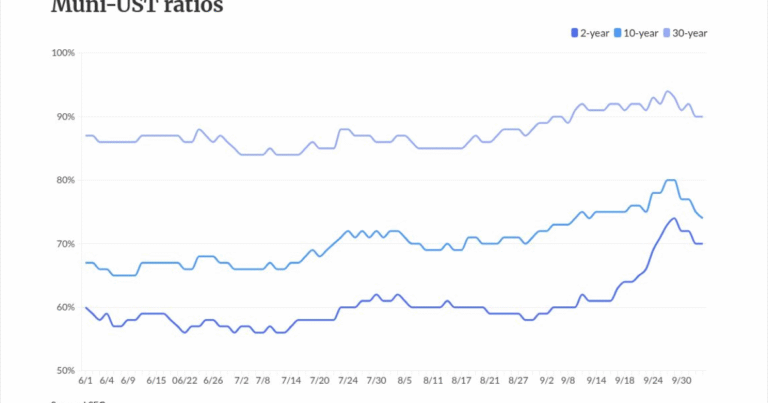
“Clearly the arbitrage opportunities are driving the dealer firms here as well. The spread between taxable and tax-exempt bonds will be important and that has recently cheapened up with the selloff in the muni market.”
“While today’s spread environment lessens the economics and incentives given the cheap relative value ratios, the AI data center craze and associated demand for electricity along with long-term corporate funding needs have kept issuance on track for a record year,” Lipton said.
“The energy prepay sector should remain an important source of municipal issuance over the next 12 months, supported by the attractive economics of tax-exempt financing and utilities’ continued interest in locking in long-term energy savings,” said Travis McGahey, vice president at investment manager Payden & Rygel.
“The pace of issuance will depend in part on the relative borrowing costs of taxable and tax-exempt financing, but we continue to see favorable fundamentals for the sector and expect Alabama-based issuers to remain among the most active,” McGahey said.
“Prepayment bond issuance depends heavily on the spread between tax-exempt and taxable rates,” Washburn said. “The upfront payment is converted through various agreements into a scheduled payment stream that is based on taxable rates. These transactions typically occur when the spread is large enough to create a payment stream that can cover debt service, transaction costs, and counterparty compensation, while still providing participating municipal utilities with a meaningful discount.”
Mousseau said the Alabama prepaid energy bond “amounts are deceiving because these issuers serve more than just Alabama customers. They can pool demand from across the nation. For example, Black Belt can issue on behalf of public utility buyers in Texas and Florida, California and other municipalities in the southeast. Similar for Southeast Energy.
“Because the buyers of prepay gas and electricity bonds tend to be national buyers, I don’t think it affects the overall Alabama market that much,” Mousseau said. “Yes, the bonds are Alabama exempt but no one is going to mistake the prepaid gas bonds for Birmingham Water Works or Mobile GO bonds.”
The two energy prepay authorities plus the Mobile bridge and Bayway project are the whole story of the state’s expanding municipal issuance in the last nine months, said a municipal advisor who didn’t want to be identified. Take them out of the data, and Alabama issuers sold $2.934 billion in the first three quarters of 2025 and $2.485 billion in the first three quarters of 2026.
Excluding the two authorities and the Mobile bridge and bayway deal there were 61 deals in the first nine months of 2025 and 52 deals in the first nine months of 2026.
Black Belt Energy is a public natural gas utility jointly founded by the cities of Jackson, Thomasville, and Grove Hill, Alabama.
“Alabama’s strong municipal bond activity reflects the state’s ability to strategically leverage the capital markets to make significant investments that strengthen communities and support economic growth,” said the Alabama Finance Department in a statement to The Bond Buyer. “These investments not only address needs today but also help position Alabama for continued growth and opportunity for decades to come.”

Bloomberg News
“The Mobile River Bridge and Bayway Project is a prime example of the transformational impact that can be achieved through this type of financing,” the Finance Department said. “The new six-lane Mobile River Bridge and improvements to the Bayway will address a major bottleneck along Interstate 10, improve travel through Mobile and Baldwin counties, strengthen freight movement and access to the Port of Mobile and enhance one of the nation’s most important transportation corridors.”
Hopes and plans for a Mobile River Bridge for Interstate 10 next to Mobile have been developing for decades.
“Separately managed accounts are finding value in the municipal energy prepay sector as customization and active portfolio management identify additional yield opportunities for this expanding investor base,” Lipton said.
“While credit diversification within the sector may present challenges, the market is seeing new entrants with insurance companies… absorbing the credit risk through a guarantee to deliver the commodity and/or guarantee of payments pursuant to a purchase and sale agreement,” he said.
“Since the mid-2010s, transaction structures have been strengthened and there is now uniformity with 4-6 year hard puts – with 10-year puts being the max – on long-term 20-30 year energy contracts,” Lipton said. “The put optionality effectively reduces duration and liquidity risk and provides investors with a par exit strategy while avoiding reinvestment risk, thus contributing to tighter option-adjusted spreads.”