Growth Demands More Than AI: Transformation, Protection and Response Readiness Is Key, Protiviti and NC State Survey Finds
Amid more challenging business conditions, global executives are prioritizing resilience, strategic partnerships and workforce readiness as they pursue growth
MENLO PARK, Calif., Oct. 8, 2026 /PRNewswire/ — Global business leaders are entering 2027 under pressure to transform faster, protect enterprise value and respond more effectively to disruption, yet most organizations lack a high level of confidence that they can do all three at once.
This is among the many notable findings in Unleashing Enterprise Value, the report on the results of the 15th annual Top Risks and Opportunities Survey from Protiviti and NC State University’s Enterprise Risk Management Initiative.
Cyber threats, risks from implementing AI and economic uncertainty top the near-term concerns of the 1,330 global board members and C-suite executives surveyed. In addition, ecosystem partnerships are now seen as the best opportunities by organizations to drive growth.
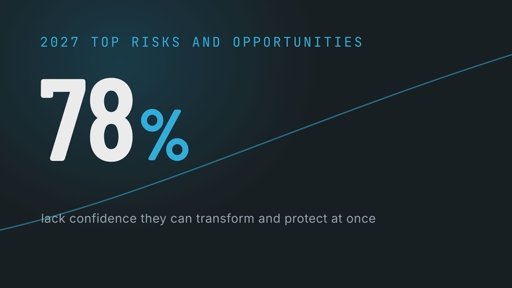
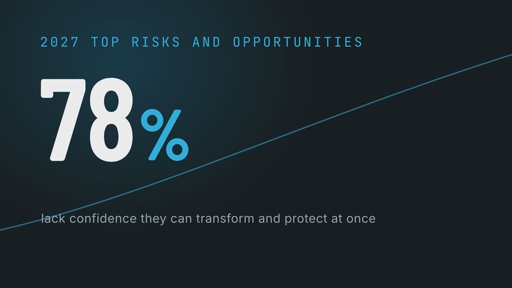
The bottom line: Organizations want to transform and grow. but most executives lack strong confidence that their companies can transform, protect enterprise value and respond quickly to emerging opportunities and risks at the same time. However, while executives expressed greater confidence in their organizations’ ability to protect enterprise value (48%) and transform the business (45%), fewer were highly confident in their ability to respond with agility to emerging opportunities and risks (38%). The survey found that 78% of organizations lack strong confidence across all three of these vital capabilities.
The findings also reveal a sense that risk levels are escalating across the board, with nearly every near-term risk measured year over year increasing in significance.
“Transformation alone will not be enough in 2027,” said Matt Moore, global leader of Legal, Risk & Compliance at Protiviti. “The advantage will go to organizations that can turn uncertainty into opportunity, using risk insights to adapt faster, act decisively, and accelerate growth. Connecting those priorities will be critical to competing and growing with confidence.”
Key findings: What leaders need to know
- Protecting enterprise value dominates the risk agenda. Five of the top 10 near-term risks relate to cyber threats, regulation, privacy, third parties and resilience-related capabilities.
- Growth expectations are moderating. 64% see significant revenue growth opportunities over the next two to three years, down from 69% last year.
- Ecosystem partnerships are gaining importance. 65% see significant opportunities to expand strategic alliances and partnerships, up from 62% last year.
- AI value depends more on operating discipline than technology deployment. Workforce enablement, integration and governance lead executives’ near-term AI priorities to maximize value.
Top 10 near-term global risks
- Cyber threats
- New risks from implementing AI
- Economic conditions, including inflationary pressures
- Heightened regulatory change, uncertainty and fragmentation
- Rapid disruption from emerging technologies and other market forces
- Skills and talent acquisition and retention, leadership development and succession
- Privacy and compliance with growing identity-protection regulations and expectations
- Third-party risks
- Limited workforce skills to adopt new and emerging technologies
- Inability to use rigorous data analytics for strategic and operational advantage
Why it matters: The findings do not point to a more risk-averse strategy. In fact, protecting the enterprise is essential to enabling growth and a prerequisite for transformation. The results show that security, governance and resilience will determine how quickly organizations can scale AI, modernize infrastructure and pursue growth initiatives.
“Resilience should be treated as an integrated business capability, not as separate risk, transformation and strategy initiatives,” said Dr. Mark Beasley, professor of enterprise risk management, director of NC State’s ERM Initiative and co-author of the report. “Breaking down silos can help leaders recognize change earlier, accelerate strategic decisions and turn uncertainty into competitive opportunity.”
Strategic alliances emerge as a growth path
The findings also suggest that leaders are looking beyond organic growth and internal capabilities as uncertainty increases, with ecosystem development representing the leading growth opportunity for organizations over the next two to three years. As traditional growth avenues become more challenging, strategic alliances and broader business ecosystems can offer access to specialized capabilities, emerging technologies and new customer segments.
“No organization can solve the AI or cyber risk challenges alone,” said Kim Bozzella, global CIO & CISO solutions leader at Protiviti. “Strategic alliances can give companies access to specialized capabilities, established platforms and innovation opportunities they may not be able to build as quickly or effectively on their own.”
AI priorities shift from adoption to value creation
Executives are moving beyond AI experimentation and focusing on what it takes to realize measurable value from their investments. Their top priorities to maximize the value of AI deployments are:
- Equipping the workforce to realize AI’s value
- Integrating AI with existing technologies, business processes and workflows
- Improving governance and accountability for AI deployments
The takeaway: Deploying AI is not the same as operationalizing it. Organizations need workforce readiness, governance and integration discipline to translate AI investment into productivity, better decision-making and enterprise value.
Report and resources
The report, “Unleashing Enterprise Value: Executive Perspectives on Top Near-Term Risks and Long-Term Risks,” provides results and analysis by executive position and industry group.
A webinar featuring Protiviti leaders will be held Oct. 15, 2026, at 1:00 p.m. ET.
About Protiviti
Protiviti (www.protiviti.com) is a global consulting firm that helps clients transform and protect their businesses, and respond to planned and unexpected events. Through a network of more than 90 offices in over 25 countries, Protiviti and its independent and locally owned member firms deliver deep expertise and tailored capabilities across technology, artificial intelligence, data, operations, finance, legal, compliance, HR, marketing, digital, risk, and internal audit — enabling organizations to accelerate innovation, navigate risks and safeguard what matters most.
Named to the Fortune 100 Best Companies to Work For® list since 2015, Protiviti Inc. has served more than 80% of Fortune 100 and nearly 80% of Fortune 500 companies. The firm also works with government agencies and smaller, growing companies, including those looking to go public. Protiviti Inc. is a wholly owned subsidiary of Robert Half (NYSE: RHI).
About North Carolina State University’s Enterprise Risk Management (ERM) Initiative
The Enterprise Risk Management (ERM) Initiative (www.erm.ncsu.edu) in the Poole College of Management at North Carolina State University provides thought leadership about ERM practices and their integration with strategy and corporate governance. Faculty in the ERM Initiative frequently work with boards of directors and senior management teams helping them link ERM to strategy and governance, host executive workshops and educational training sessions, and issue research and thought papers on practical approaches to implementing more effective risk oversight techniques.
SOURCE Protiviti