AI could take advisors back 3 decades. That’s a good thing
- Key Insight: Speed and automation help advisors work faster, but they can lose the personalization that clients crave.
- What’s at stake: Authenticity, which is paramount to the success of the relationship, calls for a delicate balance between automation and personalization.
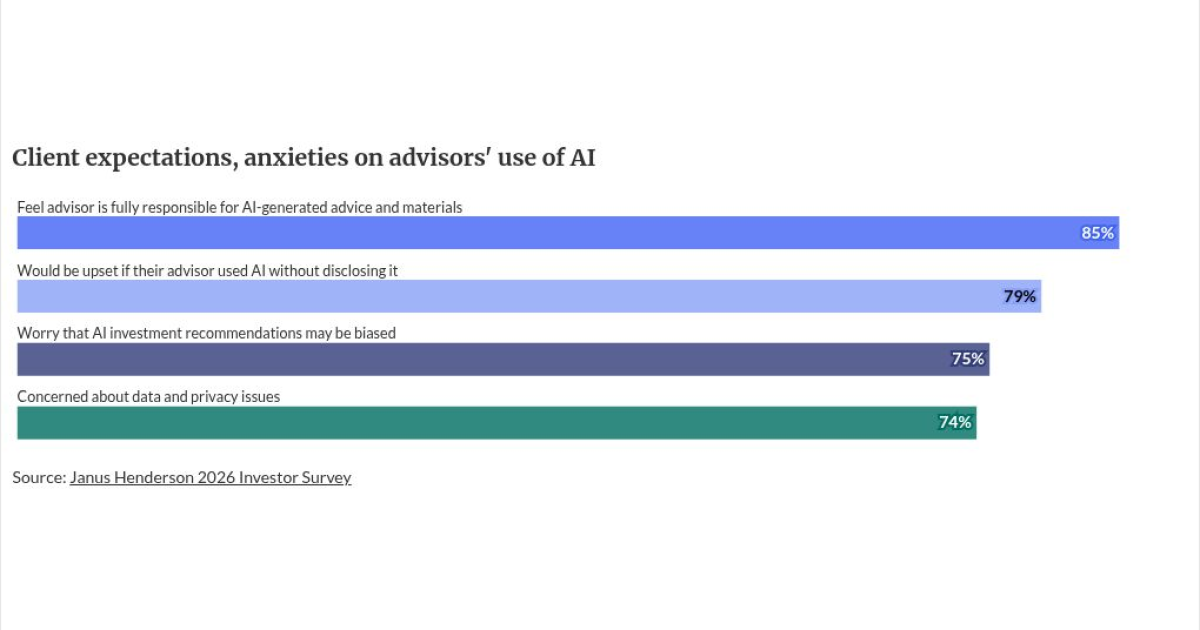
- Supporting data: Undisclosed AI use is a huge red flag: 79% of investors said it would upset them.
Thirty years ago, Ewen Harris of Assets by Introduction Methodology entered the financial services industry as an advisor in the U.K. At that time, printers were a technological marvel that took forever but came with a side benefit of forced conversation.
Processing Content
“You would have to make small talk with the client for 20 minutes while waiting for a four-page report to come off,” he said. “If you weren’t any good at that, the client would go, ‘no thanks, I’m not signing,’ because it was uncomfortable.”
Harris recently sold his business and is now stateside as an advisor coach. Technology for technology’s sake is less impressive than human interaction, according to Harris, who believes AI provides advisors with an opportunity to develop a major craft it can’t compete with: their interpersonal skills.
In an age of digital documents and texts, AI has made sending information faster and easier. Yet, advisors who rely too much on technology tools and less on their personal, soft skills run the risk of losing personal connection that clients value. As one firm found during the pandemic, clients increasingly want more than information: They want to hear from their advisor directly.
Automation isn’t personal enough
By now, many advisors and firms use AI assistance for at least a portion of their tasks. Note-taking and emails are two examples that save time.
Yet, “there are two groups of people out there when it comes to AI: those who use it well and those who use it,” said Tim Riddle, founder and CEO of the financial marketing firm Discover Blind Spots.
Good automation won’t “show up and you can see it three days before it gets there … screaming ‘this is automated,'” Riddle said.
An advisor who writes up something about Social Security strictly using AI to create the piece is “going to get more of a bland type thing,” Riddle said.
Advisors should avoid having AI “and bots begin to go in and do the work,” he said, because “that could quickly make it impersonalized instead of feeling like it was personalized.”
Earlier this year, Janus Henderson Investors reported that investors varied in their comfort level with advisors using AI. Eighty-seven percent weren’t bothered by their advisor using it to create educational content or with administrative tasks. Automation to respond to email or text, however, would upset 40% of respondents while 33% said an advisor using AI to provide investment recommendations would be upsetting. Undisclosed AI use was the biggest red flag: 79% said it would be a problem for them.
The generational communication breakdown
For younger advisors and the younger generation as a whole, text and images often narrate daily life. Gone are the days when a cord-attached phone affixed to a kitchen served as a primary means of communication. Even email has in some cases been replaced by texts and emoji. Although they can be quicker in getting the message across, they don’t always resonate with clients.
Overreliance on digital communication presents a key generational dilemma. The bulk of wealth sits with clients aged 60 and older, Harris noted.
This generation wasn’t “raised with these direct messages, and [they] do relate personally,” he said.
For younger advisors who prefer AI or DMs for communication, Harris has a word of caution. Older clients “understand it’s got to be there, but they prefer a good old human touch,” he said. “That’s where the industry for me needs to just take a step back.”
Partnering with technology to provide clients with what they actually value
In an era of clicks and algorithms, clients crave personalization. AI’s best role, according to Riddle and Harris, is behind the scenes while what clients actually see needs to come from the advisor.
Standing out is paramount at Riddle’s firm, where AI-assisted content starts with the advisor’s own voice to avoid generic output. The firm uses AI more like “a research assistant,” he said.
To ensure personalization, the firm conducts a 30-minute brand-voice session, “because we don’t want it to look the same for John and Sally,” he said.
During COVID, Riddle’s camp discovered that client attitudes had changed. Prior to lockdown, the message given to advisors was “use your voice,” he said. And advisors would respond that clients weren’t concerned with the voice as much as they were about getting the information.
“COVID happened, and … [advisors] received some interesting feedback when, say, a video that we shot would go out to that client,” he said. Interest had migrated from the information itself to the advisor.
They were saying, “‘Wow, it was just so great to see and hear you,'” he said.
Personalization can also come from smaller signals, according to Riddle. Sending emails that use the advisor’s own name rather than a generic one such as “marketing@” and using first names instead of “Hi, All” as a salutation can go a long way.
Riddle said advisors can also personalize their communication by segmenting clients and prospects, providing shorter content more often and varying formats.
For Harris, AI is going to make advisors “better humans because we are going to have to relate better to each other.” Clients “need me because they need a human to relate to,” he said, noting that people still want empathy, to be related to and to trust.
As such, “I actually think AI beautifully will take us back three decades,” said Harris.