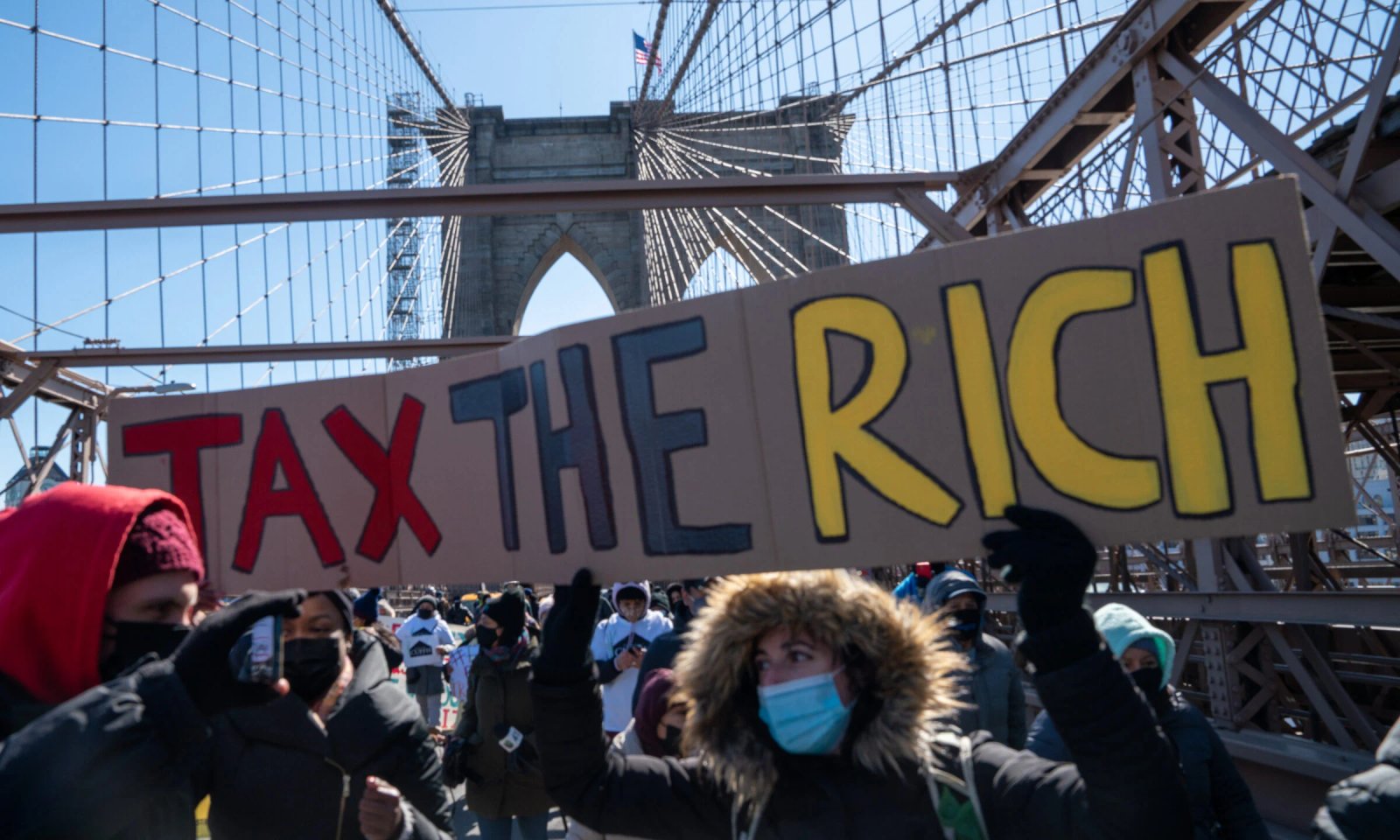
What Does ‘Tax the Rich’ Actually Mean?
NerdWallet will be defining some of the slogans and catchphrases that are appearing in campaign ads and coverage in the weeks leading up to the midterm elections. This is the first in the series.
“Tax the rich” is one of the easiest slogans to get behind as a voter. It’s simple and repeatable. There’s no jargon. Its message is populist, and ‘the villain’ is clear. It’ll fit on a bumper sticker.
It’s a phrase that frequently comes out of candidates’ mouths — typically Democrats’ — and this campaign season is no exception. But when it comes down to brass tacks, what does it really mean?
The simplicity of “tax the rich” also lends itself to its biggest weakness. Who are “the rich?” Are we talking billionaires? Millionaires? People with incomes over $250,000? Were they born with a silver spoon, or did they bootstrap their way to the top?
Meet MoneyNerd, your shortcut to smart money moves
NerdWallet’s twice-weekly newsletter offers practical, no-fluff guidance to help you spend smarter, save more, and make confident money decisions. Delivered free to your inbox.

When you break the proposals down even further, he’s advocating for:
-
Tax the rich: Brisport’s proposal would make New York state’s income-tax system more progressive by adding new and higher tax brackets for the wealthiest residents. He has supported legislation that calls to make these changes a permanent fixture in New York’s tax structure.
-
Tax on wealth: Brisport supports amending the New York State Constitution to allow a direct tax on accumulated wealth, particularly intangible financial assets held by the most wealthy residents. But he does not name a single dollar threshold for what constitutes “wealthy” in this context.
-
Heirs’ tax: Brisport supports taxing inherited wealth, which his campaign says would affect only the top 1% of inheritances and would apply only to the portion of an inheritance that’s above $250,000. The legislation he sponsored would start at 5% on the amount between $250,000 and $500,000, rising to 15% between $500,000 and $1 million, 30% between $1 million and $2 million, 40% between $2 million and $10 million, and 50% above $10 million.
Brisport’s multiple proposals under the “tax the rich” umbrella highlight the complexity behind the slogan.
Washington offers a different version: The state has no broad individual income tax, but in March 2026 lawmakers enacted a 9.9% tax on individual income above $1 million. The tax is set to begin in 2028, but a measure to repeal it is on the ballot in November.
Here are some of the other approaches candidates are taking in the midterms.
A higher tax on investment income
In Texas, Democratic U.S. Senate candidate James Talarico supports raising taxes on income and capital gains for wealthy Americans. He would also close the “buy, borrow, die” loophole — a strategy that allows people to hold appreciated assets and borrow against them in order to potentially pass them on to heirs without anyone having to pay capital-gains income tax.
Payroll taxes on top earners
A tax on a luxury asset
Earlier this year, New York state Sen. Andrew Gounardes (D-Brooklyn) supported a tax on high-worth second homes, known as a pied-à-terre tax. The state law, which passed on May 28, targets New York City homes valued at $5 million and higher that are not a primary residence.
Gounardes also sponsored a bill to raise the income tax rate from the current 10.3% to 10.8% for incomes between $5 million and $25 million, and from 10.9% to 11.4% for those with incomes above $25 million. (As mentioned above, Brisport supports the legislation, which is part of his broader “tax the rich” platform.)
How to learn more about what you’re voting for
(Photo by David Dee Delgado/Getty Images News via Getty Images)