Donald Trump is launching a new AI task force. Here’s who he’ll have to keep happy
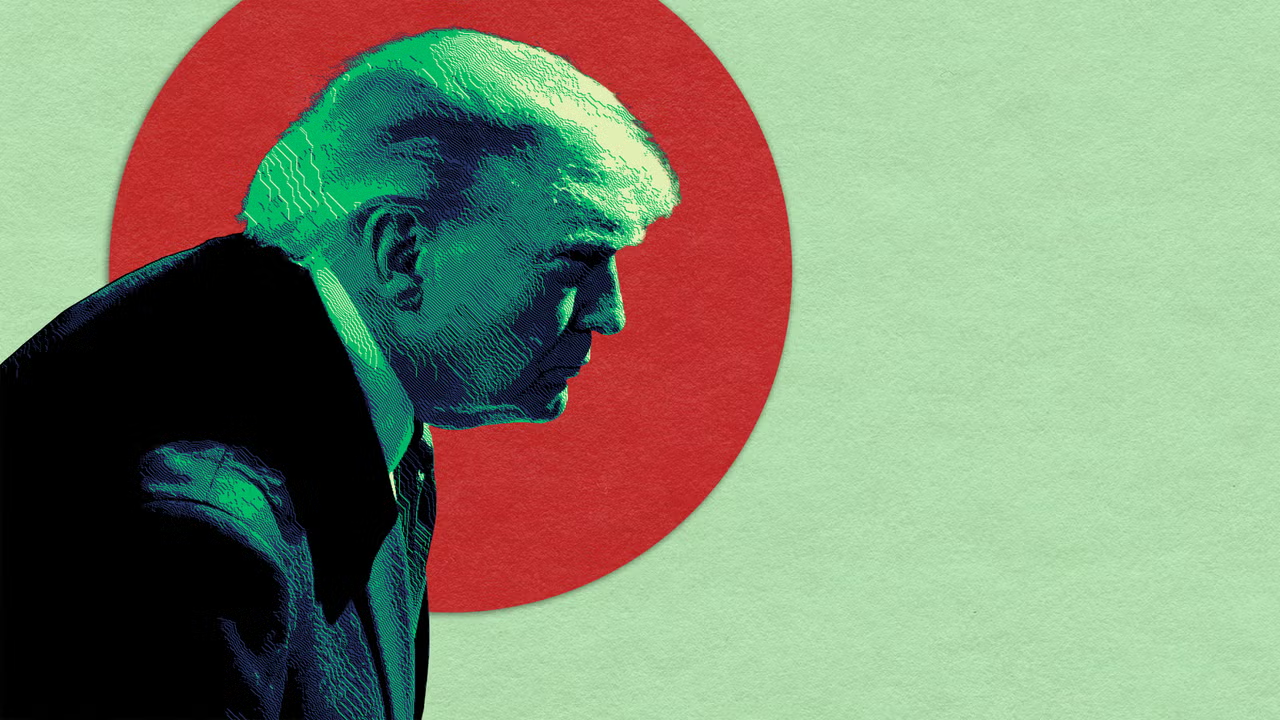
Donald Trump didn’t become one of the world’s most recognizable businessmen by worrying too much about keeping everyone happy. What Trump wants, Trump tends to pursue, consequences be damned.
But his administration’s new AI task force may require a different touch. Co-chaired by director of national intelligence Jay Clayton, Office of Personnel Management director Scott Kupor, chief technology officer Emil Michael, and FTC vice chair Andrew Ferguson, the group brings together officials representing some of the competing forces shaping the administration’s approach to AI.
The choice of four co-chairs reflects a broader split over how the U.S. should approach the technology—and the challenge Trump faces in keeping those interests aligned. So who does the task force have to keep happy?
Silicon Valley accelerationists
Ask around Silicon Valley and plenty of people have a clear idea of where the U.S. should be on AI: America’s overriding priority should be building more capable systems, faster. David Sacks, who played a major role in shaping the Trump White House’s AI agenda, is a leading proponent of that worldview, while task force co-chair Scott Kupor has warned against writing detailed rules for a technology that is changing so quickly.
The administration has already addressed many of this group’s concerns, including by trying to head off tougher state-level AI laws and pushing for a “minimally burdensome” federal framework.
MAGA’s Big Tech-hating branch
A sizable part of the MAGA coalition wants much tougher controls on frontier AI. In May, more than 60 Trump allies—including Steve Bannon, Amy Kremer, and Brendan Steinhauser—signed a letter coordinated by Humans First calling for mandatory testing, evaluation, vetting, and government approval before potentially dangerous frontier models can be deployed.
Bannon has even reached across the political divide, appearing alongside Bernie Sanders at an event earlier this year focused on stronger AI regulation. Bannon’s chief concern is AI-driven job losses; others in the MAGA world are more focused on the concentration of power in a handful of enormous technology companies.
Republican lawmakers
AI companies also have a steep hill to climb with lawmakers chastened by the relatively blasé approach to safety that Big Tech companies displayed as social media came under political scrutiny. So it is little surprise that Senators Josh Hawley and Chris Murphy are drafting bipartisan legislation that would create civil and criminal liability when AI agents hack computer systems.
They’re hardly alone in raising concerns. Senate Majority Leader John Thune has also acknowledged the threats posed by AI and argued for guardrails around the technology.
China hawks
Pulling in the opposite direction are China hawks within the Republican Party, who worry that putting too many brakes on U.S. AI labs will hand an advantage to Beijing.
Treasury Secretary Scott Bessent has taken an aggressive stance toward Chinese labs using distillation to piggyback on the capabilities of U.S. models. National Cyber Director Sean Cairncross, along with officials at the Commerce and Defense departments, has also pushed for the U.S. to talk—and act—more aggressively when it comes to Chinese AI companies.
Big Tech companies themselves
Then there are the companies and AI labs that will actually have to live under whatever rules emerge. And even they are far from united.
Companies like OpenAI have argued, in effect, that accepting some harms may be part of continuing to develop increasingly capable AI. Anthropic, meanwhile, has talked about “pacing the frontier” and taking a more cautious approach to the speed of development.
If the companies building the technology can’t agree on how quickly to push forward or how much risk to accept, Trump’s task becomes even harder: finding an AI policy that can satisfy an industry racing ahead, a political movement suspicious of Big Tech, lawmakers demanding safeguards, and national security officials worried that slowing down could mean losing ground to China.