Had You Parked $5,000 in This Vanguard ETF When Warren Buffett Recommended It in 2014, Here’s How Much You’d Have Today
Key Points
-
Warren Buffett steered Berkshire Hathaway to market-beating returns during his 60-year tenure as CEO.
-
Buffett consistently recommended index funds for everyday investors because of their ability to generate steady, long-term returns.
-
Buffett was a fan of the Vanguard S&P 500 ETF because of its very low cost.
- 10 stocks we like better than Vanguard S&P 500 ETF ›
Warren Buffett served as chief executive officer of the Berkshire Hathaway (NYSE: BRKA)(NYSE: BRKB) holding company for 60 years between 1965 and 2025. His investment decisions turned it into a conglomerate with numerous wholly owned subsidiaries, a $357 billion stock portfolio, and a $1 trillion valuation.
Berkshire stock delivered a compound annual return of 19.7% during Buffett’s tenure, so an investment of $500 in 1965 would have grown to a whopping $24 million by the time he stepped down. But he was a full-time professional, and he always knew the average investor would struggle to replicate his results.
Missed Nvidia in 2009? This Rare Signal Is Flashing Again. In 2009, a “Double Down” signal flashed for a little-known chipmaker called Nvidia. For the first time in years, that same “Total Conviction” signal is flashing for a company 1/100th the size of Nvidia. Continue »
For that reason, Buffett often recommended buying a low-cost, exchange-traded fund (ETF) that mimics a diversified index like the S&P 500 (SNPINDEX: ^GSPC) rather than trying to pick individual stocks. In Berkshire’s 2013 annual report (published in February 2014), he specifically suggested the Vanguard S&P 500 ETF (NYSEMKT: VOO) for its extremely low fees.
Had an investor parked $5,000 in the Vanguard ETF when Buffett recommended it, here’s how much they would have today.
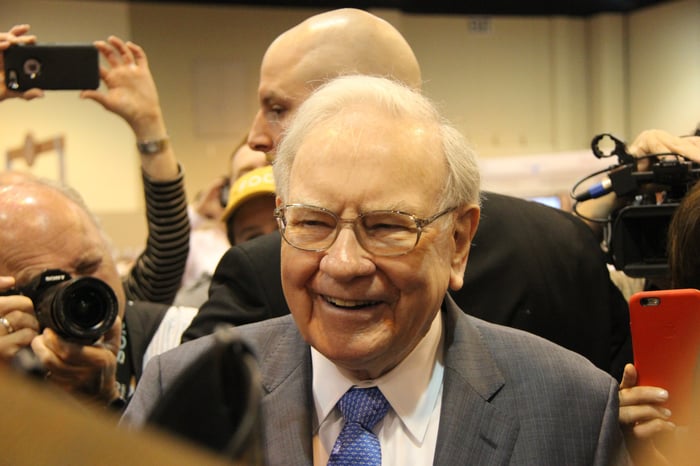
Warren Buffett at Berkshire Hathaway’s annual shareholder meeting. Image source: The Motley Fool.
The ideal diversified index fund for investors of all experience levels
The S&P 500 is the most diversified of the major U.S. indexes. It’s made up of 500 companies from 11 different sectors of the economy, and it has very strict entry criteria that require each of its members to be profitable and to maintain a market capitalization of at least $22.7 billion. But even after a company meets those standards, a special committee still has the final say over which companies make the cut to ensure the index maintains a high-quality composition.
But despite its diversification, the S&P is weighted by market capitalization, so the largest companies in the index have a much larger representation than the smallest and, therefore, a bigger influence over its performance. Since the three largest sectors in the S&P are home to the bulk of America’s trillion-dollar companies, they represent a combined 60% of the index’s entire value.
They are listed below along with their weightings and their three largest constituents.
|
Sector |
Vanguard S&P 500 ETF Sector Weighting |
Largest Companies |
|---|---|---|
|
Information Technology |
38.6% |
Nvidia, Apple, Microsoft |
|
Financials |
11.3% |
Berkshire Hathaway, JPMorgan Chase, Visa |
|
Communication Services |
10.4% |
Alphabet, Meta Platforms, Netflix |
Data source: Vanguard. Sector weightings are accurate as of May 31, 2026 and are subject to change.
The other eight sectors are consumer discretionary, industrials, healthcare, consumer staples, energy, utilities, materials, and real estate.
Warren Buffett’s advice would have yielded a 386% return since 2014
The S&P 500 has delivered a compound annual return of 10.7% since it was established in 1957. But it has climbed at an even faster pace of 14.1% per year since Buffett recommended the Vanguard S&P 500 ETF in 2014, fueled by rapid growth in industries like cloud computing, enterprise software, and artificial intelligence (AI).
That means an investor who put $5,000 into the Vanguard ETF 12 years ago would have about $24,344 today. That doesn’t include costs, but with an expense ratio of 0.03%, investors would incur an annual fee of just $1.50 for every $5,000 they have invested in the fund. In other words, fees are almost a non-factor, which is why Buffett liked this ETF.
It’s reasonable to expect similar returns from here, as long as investors maintain a long-term horizon of a decade or more. Futuristic technologies like AI, robotics, autonomous driving, and quantum computing could produce unfathomable amounts of economic value over time, so I expect them to be major sources of gains for the S&P 500.
By investing in the Vanguard S&P 500 ETF, investors get exposure to those technological revolutions, with a healthy dose of diversification from more defensive sectors like financials and consumer staples. Simply put, Buffett’s advice is still relevant today, so it’s not too late to buy this ETF.
Should you buy stock in Vanguard S&P 500 ETF right now?
Before you buy stock in Vanguard S&P 500 ETF, consider this:
The Motley Fool Stock Advisor analyst team just identified what they believe are the 10 best stocks for investors to buy now… and Vanguard S&P 500 ETF wasn’t one of them. The 10 stocks that made the cut could produce monster returns in the coming years.
Consider when Netflix made this list on December 17, 2004… if you invested $1,000 at the time of our recommendation, you’d have $397,351!* Or when Nvidia made this list on April 15, 2005… if you invested $1,000 at the time of our recommendation, you’d have $1,304,257!*
Now, it’s worth noting Stock Advisor’s total average return is 934% — a market-crushing outperformance compared to 210% for the S&P 500. Don’t miss the latest top 10 list, available with Stock Advisor, and join an investing community built by individual investors for individual investors.
*Stock Advisor returns as of July 17, 2026.
JPMorgan Chase is an advertising partner of Motley Fool Money. Anthony Di Pizio has no position in any of the stocks mentioned. The Motley Fool has positions in and recommends Alphabet, Apple, Berkshire Hathaway, JPMorgan Chase, Meta Platforms, Microsoft, Netflix, Nvidia, Vanguard S&P 500 ETF, and Visa. The Motley Fool has a disclosure policy.
The views and opinions expressed herein are the views and opinions of the author and do not necessarily reflect those of Nasdaq, Inc.